


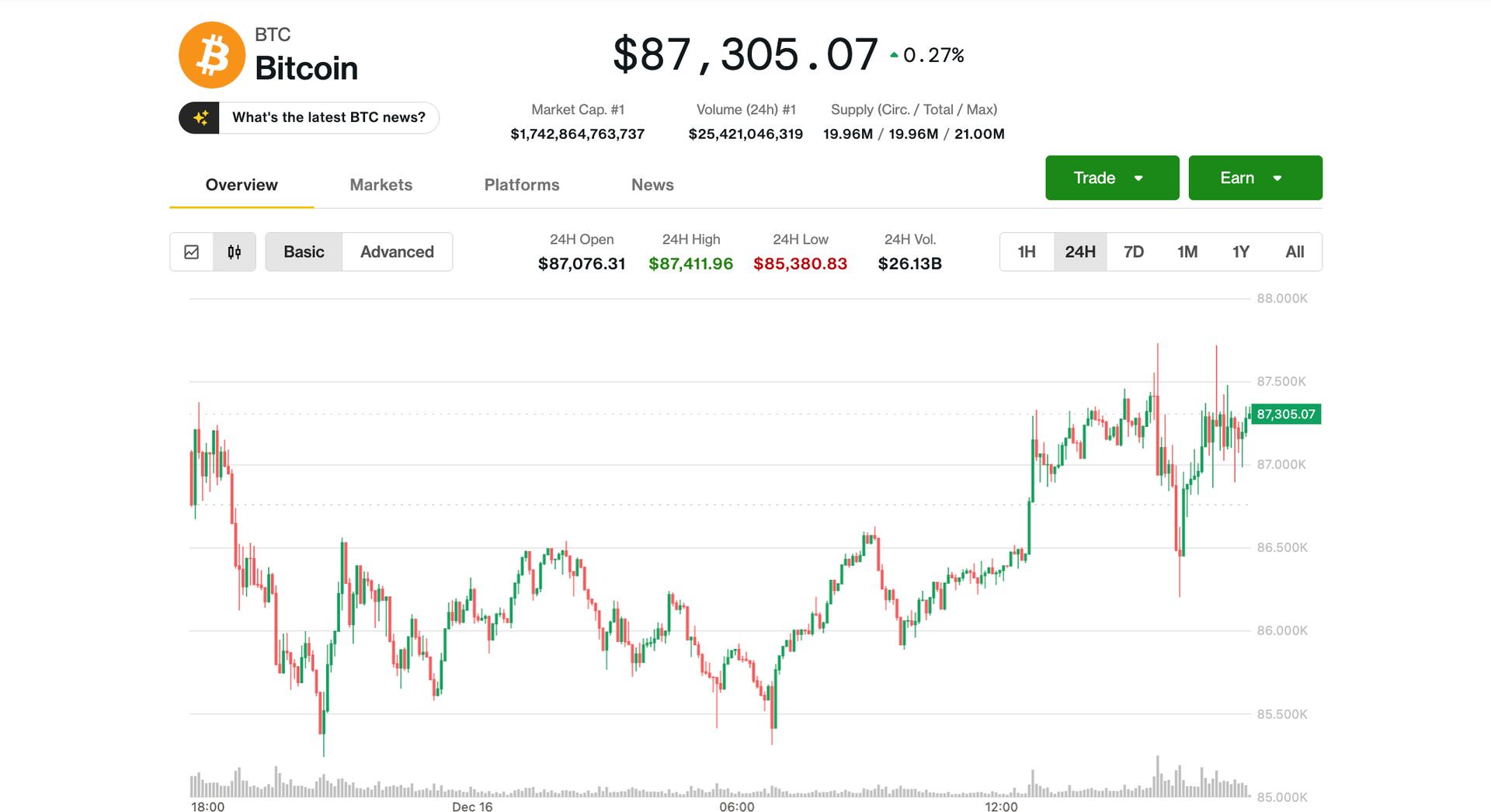
Cryptocurrencies have found stability following Monday’s significant selloff, with bitcoin holding steady above $87,000 during the early hours of the U.S. trading session on Tuesday.
The predominant cryptocurrency rose approximately 3% from its overnight lows, while ether lagged behind, increasing only 1.4%. Major altcoins such as BNB , , and demonstrated notable strength, with gains between 3% and 6% overnight.
Stocks linked to cryptocurrency also saw a resurgence following Monday’s chaotic trading. Companies such as Bitcoin treasury firm Strategy (MSTR) and brokerage Robinhood (HOOD) experienced increases of 3%-4%, while Circle (CRCL), the issuer of the $78 billion USDC stablecoin, surged by 9%.
In an unusual turn of events, cryptocurrencies are currently outperforming U.S. equities, which are experiencing slight declines on Tuesday, with the S&P 500 down 0.5% and Nasdaq dropping 0.3%.
Recent news includes delayed U.S. employment data, revealing a troubling rise in the unemployment rate to a four-year high of 4.6% for November. Despite this, trader expectations for a rate cut by the Fed in January remain subdued, with only a 24% probability.
Dead cat bounce or something more?
Tuesday’s early movements might provide some optimism that bitcoin’s decline from last week’s peak of over $94,000 has been halted temporarily, yet at least one analyst warns that BTC may soon hit new lows.
Samer Hasn, senior market analyst at broker XS.com, posited that BTC’s recovery from the November low of $80,000 to early December was merely a “corrective high,” forecasting another downward leg that could take it below $80,000.
In a market note issued on Tuesday, he described the existing environment as “fragile,” emphasizing that the derivatives markets reflect this caution. Over the past two days, $750 million in long liquidations were recorded, including $250 million related to bitcoin futures.
“Traders are either stepping aside ahead of the data or being forced out, reinforcing downside momentum,” Hasn emphasized. “Without a favorable macro catalyst to shift sentiment, bitcoin remains vulnerable to a deeper downturn, with sub-$80,000 levels increasingly becoming a near-term topic rather than just a risk on the horizon.”
“The market now grapples with a short-term conflict between the postponement of monetary easing and the long-term appeal of BTC as a value storage mechanism,” commented David Hernandez, crypto investment specialist at 21shares. “Immediate selling pressure could arise as traders reassess the risk landscape, compelling BTC to defend crucial support levels,” he noted. “However, the prevailing economic tensions bolster the bullish case for accumulating BTC: as the Fed struggles to control inflation without derailing the economy, bitcoin’s limited supply emerges as an essential asset.”
