

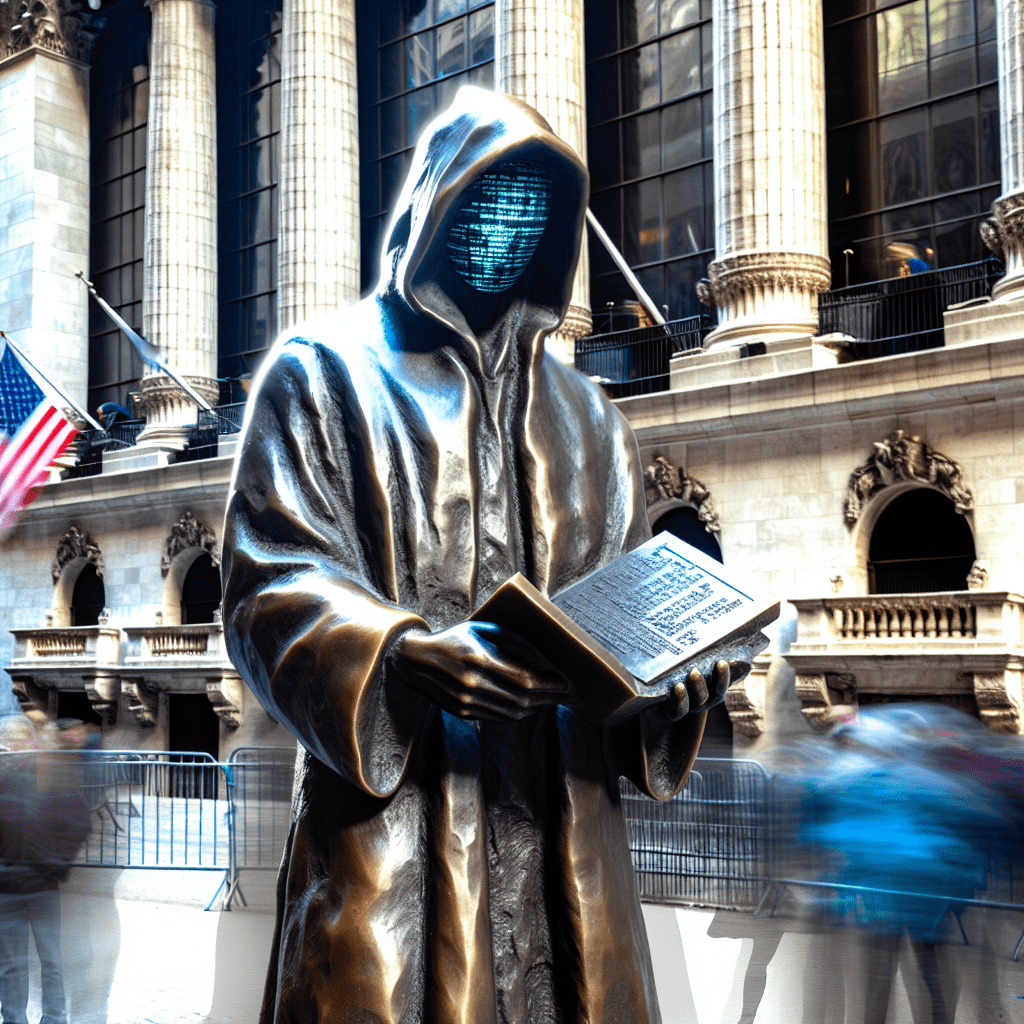

- The Satoshi Nakamoto statue has made its debut at NYSE, highlighting the increasing acceptance of crypto on Wall Street.
- This artwork contributes to a global initiative as Bitcoin’s history and conventional acceptance gain recognition.
- Institutional adoption of Bitcoin is ramping up, with public holdings exceeding 3.7 million BTC.
The New York Stock Exchange now hosts Valentina Picozzi’s “disappearing” Satoshi Nakamoto statue, showcasing the evolution of digital assets from being unwelcome to embraced on Wall Street.
The statue’s arrival was announced via an X post on Wednesday, illustrating a merging of traditional finance with developing decentralized systems.
This installation coincides with the Bitcoin mailing list anniversary, launched on 10 December 2008, emphasizing Bitcoin’s evolution from a niche concept to a mainstream entity.
Installation at NYSE
Brought to the NYSE by Bitcoin company Twenty One Capital, which commenced trading this week, the statue constitutes a significant addition.
Created by Picozzi, who is known for her “disappearing” Satoshi series on her Satoshigallery platform.
This New York installation is the sixth in a worldwide venture she aims to extend to 21 locations.
Her post on X referred to the installation in such a key financial hub as a notable milestone for her series.
The NYSE display starkly contrasts the earlier narrative where crypto was considered off-limits on Wall Street.
The Journey of Bitcoin
The statue’s reveal aligns with a pivotal moment in Bitcoin’s timeline, occurring just before the anniversary of its mailing list initiated by Satoshi Nakamoto on 10 December 2008.
Nakamoto mined the genesis block on 3 January 2009, generating the first 50 Bitcoins and laying the groundwork for the entire industry.
More than a year later, on 22 May 2010, Laszlo Hanyecz conducted the first documented Bitcoin transaction, spending 10,000 Bitcoin on two pizzas from Papa John’s.
In the following years, this asset encountered considerable resistance.
Institutions and banks remained apprehensive, while governments sought to limit crypto activities via measures that many referred to as Operation Chokepoint 2.0.
Even notable skeptics in finance revised their views after initially dismissing the technology.
Shift in Institutional Mindset
Change began as major industry figures like BlackRock’s Larry Fink transitioned from skepticism to active engagement.
Wall Street institutions then ramped up involvement through the establishment of exchange-traded funds and direct Bitcoin acquisitions for corporate reserves.
Collectively, public entities, private firms, nations, and ETFs now exceed 3.7 million Bitcoin holdings, as reported by Bitbo.
This accumulation translates to over 336 billion dollars, underscoring Bitcoin’s integration into mainstream investment portfolios.
In this context, the NYSE installation stands as a tangible reminder of how crypto has woven itself into the fabric of financial culture.
Global Statue Initiative
Picozzi’s statue has found homes in five other locations: Switzerland, El Salvador, Japan, Vietnam, and Miami, Florida.
The project aims for a total of 21 statues worldwide, symbolizing Bitcoin’s capped supply of 21 million tokens.
The design embodies the theme of disappearance, featuring a figure that seems to blend into its environment.
The artwork represents Nakamoto as a hacker in a signature seated posture, laptop aglow, symbolizing both the anonymity of Bitcoin’s creator and the programmers who shaped its ecosystem.
The installation at NYSE marks another chapter in Picozzi’s quest to illustrate Bitcoin’s cultural impact via public art, connecting significant global sites with its origins and development.
