


The price of Bitcoin is poised for a breakout from its current consolidation phase as buyers regain dominance. Meanwhile, spot BTC exchange-traded funds have experienced more than $780 million in net outflows.
Summary
- On Monday, Bitcoin price successfully regained the $90,000 level.
- Renewed tensions between Russia and Ukraine, along with speculation regarding BTC prices, have driven this rebound.
- A bullish symmetrical triangle pattern is emerging on the 4-hour chart.
According to data from crypto.news, Bitcoin (BTC) price dropped from the $90,000 threshold on December 22, falling to as low as $86,740 by Christmas Eve. Although bulls attempted to reclaim the $90k mark, they were stalled at just over $89,000 on Friday, trading within the $87,000-$88,000 range throughout the weekend.
Last week, Bitcoin’s price declined due to persistent outflows from spot ETF funds, a reversal from the significant inflows observed during much of the second and third quarters of the year that had supported Bitcoin’s rise towards its all-time high of $126,080 in October.
According to data from SoSoValue, the twelve spot BTC ETFs experienced $782 million in net outflows between December 22 and December 26. This continues a trend that has seen a total of $1.08 billion exit these investment products in December and $3.48 billion in the previous month.
These outflows indicate a lack of long-term conviction among institutional traders, which is likely to keep investor sentiment muted.
Furthermore, Bitcoin’s price is restrained by waning expectations of Fed rate cuts for January and the following months, as the latest statements from the Fed Chair and key officials reflect a more cautious approach regarding potential rate changes.
According to data from Polymarket, the likelihood of a 25 basis point cut stands at 13%, while the probability of no changes is at 87%.
On Monday, December 25, BTC briefly surpassed $90,000, reaching just over $90,200, before settling at $89,830 by press time.
Today’s uptick in Bitcoin’s price seems to be influenced by renewed geopolitical tensions between Russia and Ukraine on Sunday, which led to higher oil prices and, consequently, prompted traders to seek safe-haven assets, including Bitcoin, often considered a digital hedge against instability.
The rise in BTC prices was also helped by an increase in demand from derivative traders, predominantly driven by short-term retail investors.
Data from CoinGlass indicates that the Bitcoin weighted funding rate has surged to one of its highest levels since October, signaling that more investors are betting on Bitcoin’s upward potential in the short term.
Bitcoin futures open interest has increased by 7% in the past 24 hours, suggesting more participants are entering the market, which could further reinforce price movements.
On the 4-hour chart, Bitcoin has been forming a symmetrical triangle since mid-November this year. Typically a neutral formation, a breakthrough of the upper trendline may serve as a bullish indicator for sustained upward momentum.
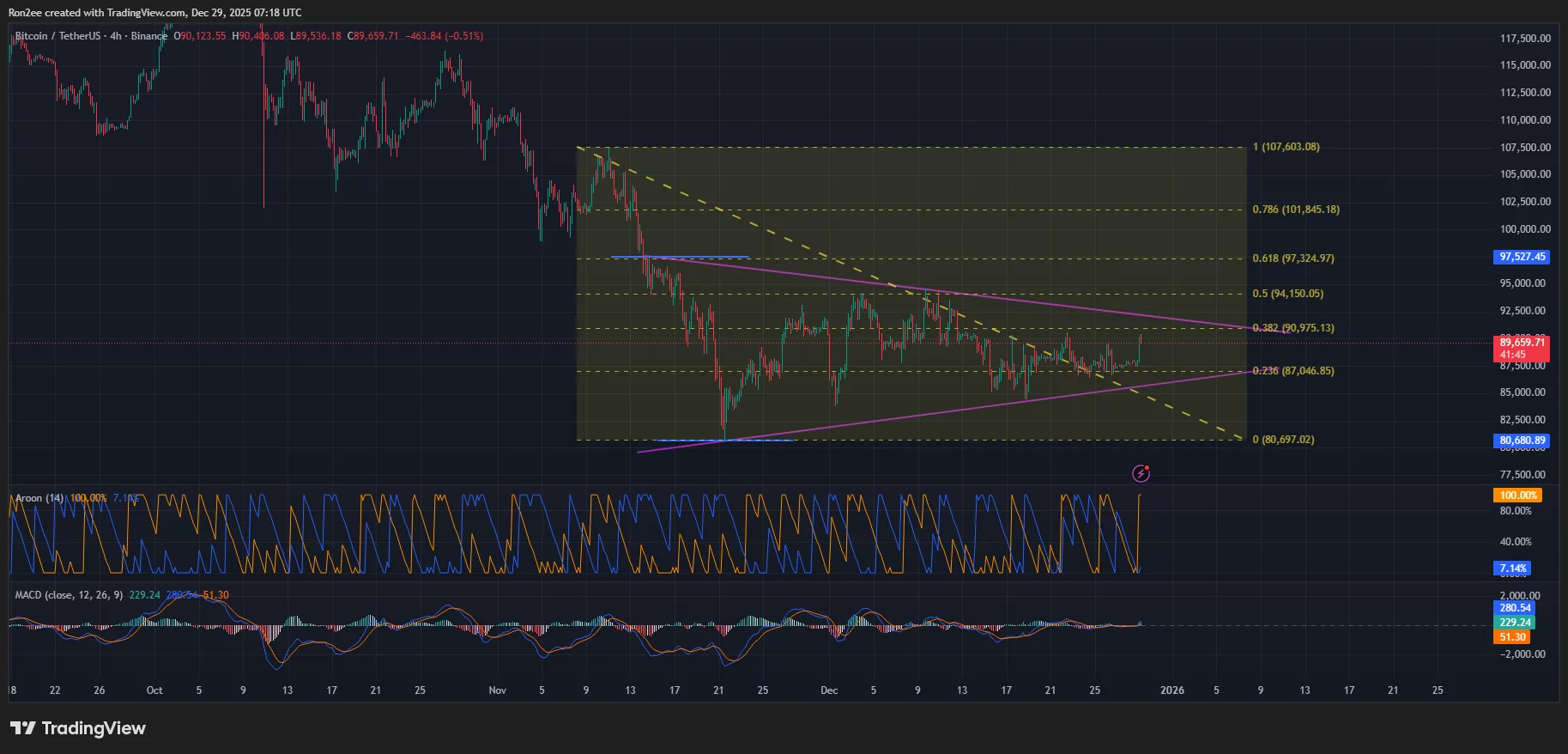
As of now, bulls seem to have the upper hand in the market. The Aroon Up indicator has reached 100%, while the Aroon Down stands at 7.14%, underscoring much stronger buying interest than selling pressure.
Additionally, the MACD lines have crossed above the zero line and are trending upward, further confirming the trend reversal toward bullish sentiment.
Traders are closely monitoring the $90,975 mark, which aligns with the 38.2% Fibonacci retracement level. A decisive breakout above this level with substantial volume could validate the pattern breakout and drive prices as high as $94,200, a level reached earlier this month before a retreat.
While the momentum favors upward movement, a decline below the $87,000 support level would invalidate the current bullish outlook, potentially exposing Bitcoin to a drop toward the psychological $85,000 level.
Disclosure: This article does not constitute investment advice. The content and materials provided on this page are for educational purposes only.
