


The price of Bitcoin remained around the $89,000 level on Monday, as interest in its spot exchange-traded funds continued to wane.
Summary
- Bitcoin ETFs experienced nearly $4.5 billion in outflows in the last week.
- The BTC price chart indicates a potential extended bearish phase.
Data from SoSoValue reveals that the 12 spot Bitcoin ETFs saw $497.05 million in net outflows from December 15 to December 19. BlackRock’s IBIT faced the most significant outflows, with $240.3 million leaving the fund. Additionally, Bitwise’s BITB and ARK 21Shares’ ARKB saw net outflows of $115.1 million and $100.7 million, respectively.
VanEck’s HODL, Grayscale’s GBTC, and BTC funds collectively contributed to $74.1 million in outflows. In contrast, Fidelity FBTC managed to attract $33.1 million in inflows for the week.
These outflows point to a dwindling institutional interest in these financial products, continuing a trend that has lasted throughout the past month, during which these funds recorded around $3.5 billion in net outflows. This is a stark contrast to October’s trend, where these ETFs amassed nearly $7 billion in inflows as Bitcoin reached a new all-time high.
Bitcoin (BTC) saw a decline of 6%, dropping from approximately $90,000 to a weekly low of $84,580 on Friday. It recovered to about $89,800 earlier today, December 22, but was pulled back down to around $89,100, showing just a 1% increase over the last 24 hours.
In addition to the poor performance of its spot ETFs, Bitcoin’s price action remains muted due to reduced liquidity during the holiday season and ongoing macroeconomic concerns. Traders are also taking a cautious approach ahead of significant U.S. macroeconomic data releases, including GDP figures and jobless claims, scheduled for Thursday, December 25.
On the daily chart, Bitcoin has triggered a combination of bearish indicators that usually precede significant market corrections.
Importantly, Bitcoin has been establishing a bearish flag formation since late October. As of now, Bitcoin’s price is nearing a potential break below the lower trendline of this formation, which generally suggests further downside in the near term.
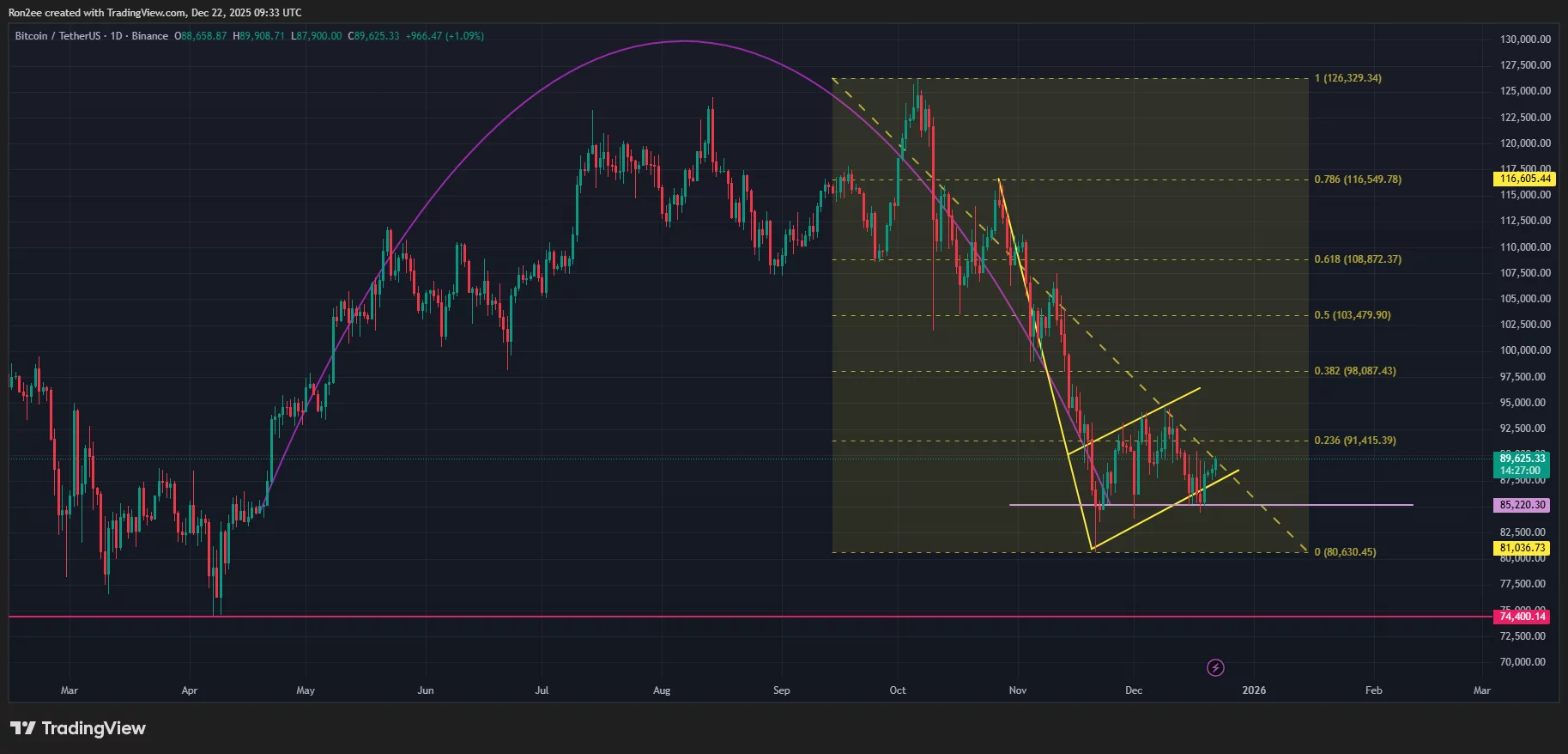
A breakdown from this bearish flag could further confirm a decline from a more extensive inverse cup and handle pattern, as noted by crypto.news.
With both of these bearish formations apparent on the chart, Bitcoin is expected to face sustained pressure unless a clear reversal signal appears or fundamental factors change the momentum.
Currently, traders are monitoring the $85,220 level, which acts as immediate support and has previously served as a strong price floor where buyers have intervened to prevent deeper losses. A drop below this support could lead to prices testing the psychological $80k support level.
Conversely, $91,415—aligned with the 23.6% Fibonacci retracement from its all-time high in October to its sharp decline in November—serves as a crucial resistance level that bulls must surpass for any significant upside movement.
Disclosure: This article does not constitute investment advice. The information and materials presented on this page are for educational purposes only.
