


As Bitcoin ETFs experienced their initial outflows in several days, investors turned to alternative safe havens — propelling the Swiss franc upward and bringing gold close to setting a new record.
Summary
- Bitcoin, gold, and the Swiss franc are increasingly recognized as vital safe-haven assets in light of rising U.S.–China trade tensions and a notable drop in equity markets. The Swiss franc rose to 1.2500 against the dollar, gold approached a record high at $4,017, and Bitcoin recovered to $112,800 after a brief decline to $107,000.
- Despite a modest outflow of $4.5 million from spot Bitcoin ETFs on Friday, these funds still achieved a weekly increase of $2.7 billion, pushing cumulative inflows to over $62.7 billion—significantly surpassing the $1.7 billion outflow from the SPDR S&P 500 ETF. Major U.S. indices saw declines exceeding 2% as the Fear and Greed Index fell from 53 to 29, indicating growing investor unease.
- Experts note that the strength of BTC, gold, and the franc illustrates a migration toward assets characterized by limited supply, central bank interest, and economic neutrality—qualities that persistently establish them as modern safe havens during market disruptions.
Safe haven assets
Bitcoin, gold, and the Swiss franc have surfaced as reliable safe-haven assets as the stock market and the Fear and Greed Index decline following recent trade escalations.
The Swiss franc surged to 1.2500 against the US dollar, up from 1.2390 earlier this week, and climbed to a multi-month peak of 1.0763 compared to the September low of 1.0587.
The price of gold soared to $4,017, just shy of the all-time high of $4,053. Meanwhile, Bitcoin (BTC) initially fell to $107,000 before recovering to $112,800.
Crucially, the net outflow from spot Bitcoin ETFs was a mere $4.5 million on Friday. Yet, these funds reported a weekly gain of $2.7 billion, boosting the cumulative total over $62.7 billion.
The outflow from Bitcoin’s ETFs was also significantly lower than the $1.7 billion recorded for the SPDR S&P 500 ETF. Additionally, the S&P 500, Nasdaq 100, and Dow Jones indices all suffered declines of more than 2%.
BTC, gold, and the Swiss franc remained resilient as the Fear and Greed Index fell into the fear zone at 29, down from a neutral 53 just a week ago.
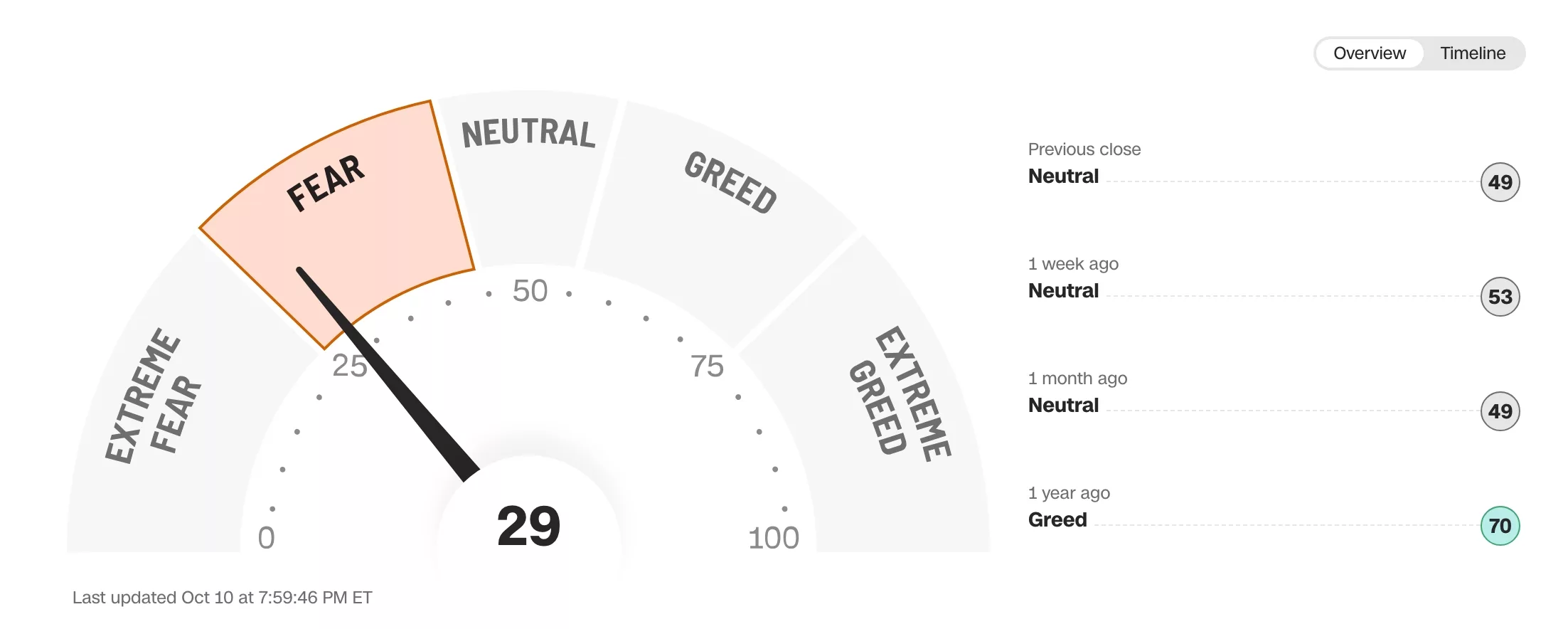
The index decreased as the market volatility indicator shifted to extreme fear, with the VIX reaching 23. Additionally, there was a spike in demand for both safe-haven and junk bonds.
This occurred amid deteriorating trade relations between the U.S. and China, as President Donald Trump imposed significant tariffs on Chinese imports, which China countered with its own series of measures, including export controls and tariffs.
Why BTC, gold, and CHFF are safe haven assets
Bitcoin is widely seen as a safe-haven asset due to its economic model. With a capped supply of 21 million and persistent demand, the ongoing supply constraints continue. Bitcoin availability on exchanges has hit multi-year lows as companies and ETFs ramp up purchases.
Gold remains a significant haven, with many central banks actively accumulating it. This year, global central banks have acquired 900 tons of gold, and for the first time since 1996, they now hold more gold than U.S. Treasury securities.
