


The price of Bitcoin has been experiencing significant volatility for more than a month, leading to the emergence of a bearish inverse cup and handle pattern. This development coincides with liquidation spikes that are keeping buyers on the sidelines.
Summary
- Since late November, Bitcoin has been trading within a range.
- In the last 24 hours, $160 million has been liquidated from Bitcoin.
- A multi-month inverse head and shoulders pattern has developed on the daily chart.
As reported by crypto.news, Bitcoin (BTC) experienced a rise from $86,000 to an intraday high of $90,165 on Wednesday, ultimately settling at $86,612 at the time of writing. The largest cryptocurrency by market cap has been oscillating between the $82,000 and $95,000 range for over a month, showing no definitive trend. Currently, BTC is 31.3% below its all-time high reached in October of this year.
The price of Bitcoin has come under pressure due to major liquidation events within the crypto market, which have dampened investor interest. Derivative traders have remained cautious since the crypto market experienced $19 billion in liquidations on October 10, prompted by a sudden rise in U.S.–China tariffs.
This announcement led to the liquidation of highly leveraged traders, resulting in a chain reaction of cascading liquidations as forced sell orders drove prices down, triggering successive waves of stop-losses and margin calls.
Coinglass data indicates that the crypto market experienced over $540 million in liquidations in just the past 24 hours, with Bitcoin contributing approximately $160 million to this total.
Investor confidence in Bitcoin has also diminished as institutional demand for the asset has declined over the past weeks. Data from SoSoValue reveals that U.S. Bitcoin ETFs have only achieved $21.36 million in net inflows in December, following nearly $3.5 billion in outflows in November, a stark contrast to the previous two months, which saw inflows close to $3.5 billion each.
A recent bearish catalyst emerged from the Fed’s rate cut on December 10, where the Fed Chair expressed a cautious outlook, hinting at fewer rate cuts as we approach 2026. Cryptocurrencies, including Bitcoin, often lose momentum when the Fed delays rate cuts.
Moreover, losses in AI-related stocks like Nvidia and Broadcom in recent days have further pulled the Nasdaq down, adding another layer of risk-averse sentiment across risk assets.
Currently, the Crypto Fear and Greed Index shows a persistent “Extreme Fear” sentiment prevailing in the wider crypto market.
On the daily chart, Bitcoin has been forming an inverse cup and handle pattern since mid-April this year.
This structure arose as the price increased and then gradually declined in a rounded shape, followed by a short bounce that failed to reclaim previous highs. Typically, this pattern signals a bearish continuation, indicating a potential downturn ahead if the price breaks below the neckline of the formation.
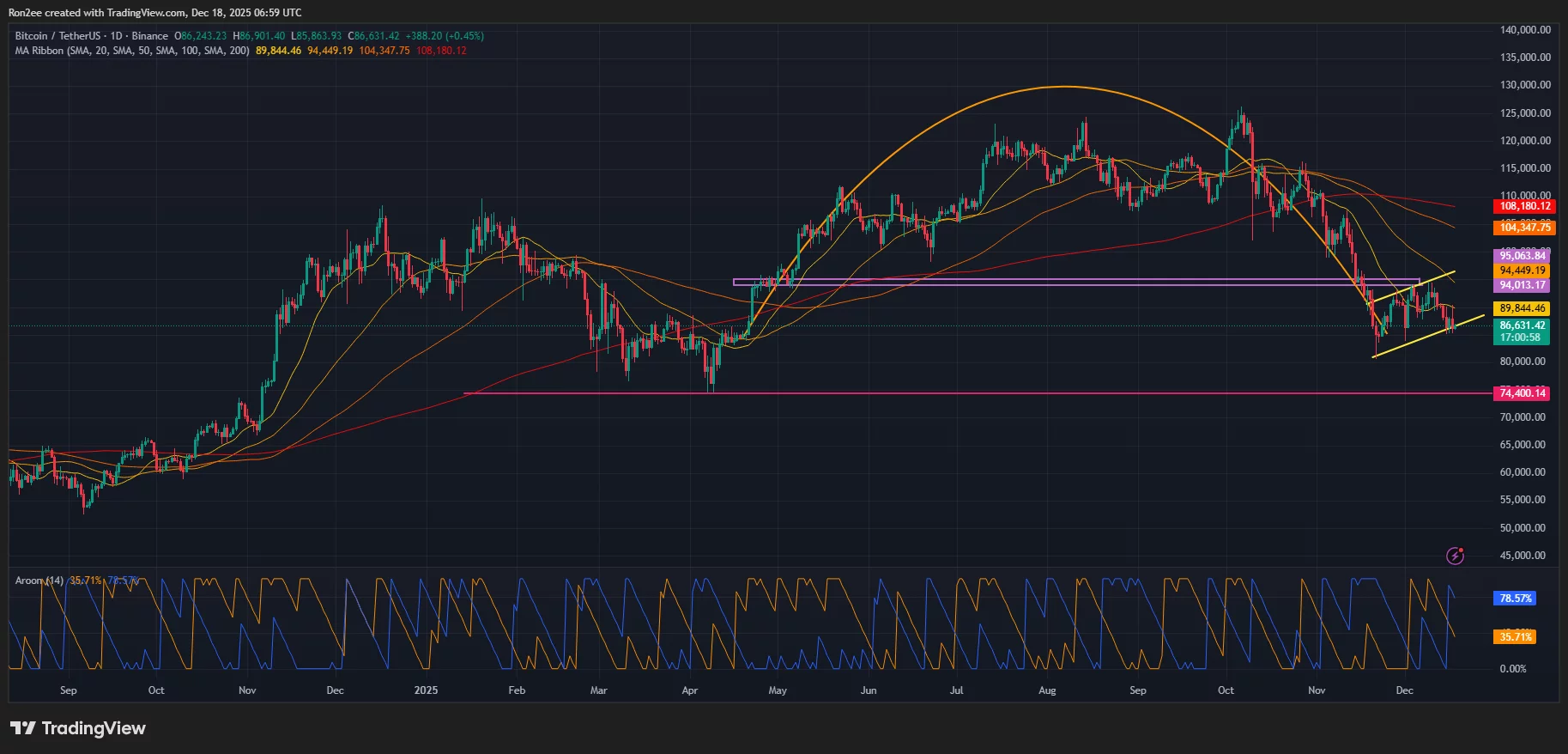
At the same time, Bitcoin has fallen below all major moving averages, with the shorter-term averages now trading beneath the longer-term ones, indicating increasing bearish momentum in the market.
Additionally, the Aroon indicator shows Aroon Down at 78.5%, while Aroon Up stands at 35.7%, further signifying that bears currently dominate the trend.
Thus, Bitcoin’s price is at risk of falling to its April low of $76,400, representing a decline of 11.7% from the current price.
Nevertheless, a decisive break above the $94,000-$95,000 resistance zone in the coming weeks could negate this bearish outlook and potentially indicate a resurgence of bullish momentum.
Disclosure: This article does not constitute investment advice. The content and materials presented on this page are intended for educational purposes only.
