


Macro trader plur daddy (@plur_daddy) contends that bitcoin’s outlook for 2026 hinges less on specific crypto factors and more on the normalization of US liquidity post a notably tight period for risk assets.
His main argument is that repo “plumbing” has come under pressure due to a deficit of bank reserves as economic leverage surged quicker than the Fed’s balance sheet, causing widespread market stress — marked by “volatile and rotational dynamics in equities” — and creating “a rather challenging environment for crypto.” As the new year approaches, he anticipates incremental changes that could shift conditions from tight to neutral, although not necessarily ushering in a new “loose” phase.
4 Macro Themes That Will Be Essential for Bitcoin
The first factor is the Fed’s reserve management purchases (RMPs). “Since the December FOMC, where they announced $40bn/month in RMPs for three months (and an undefined smaller amount thereafter), this liquidity has been entering the market. The Fed has already acquired $38bn of the initial month’s allocation,” he notes. “Thus far, we haven’t observed a significant impact, as this was countered by year-end liquidity factors, as broker-dealers close their books and minimize risk for year-end, but this is expected to change.”
Related Reading
He emphasizes that the initiative aims to alleviate funding constraints, not to instigate a risk-on surge. “As a disclaimer, this is not QE; it’s a targeted measure to resolve a blockage in the financial plumbing matrix, so don’t get overly excited about its potential impact,” he explains. “It can help revert a tight environment to normalcy, but it won’t transition a normal environment to loose.”
Regarding size, he acknowledges its lack of precision but still finds it significant: “Estimating the deficit is more an art than a science, but my gut suggests it’s probably around $100-200bn (in line with the announced RMP size), hence one month of RMPs won’t cover the entire gap, but it should exert a substantial influence.”
The second aspect is fiscal incrementality. He foresees a slight re-expansion of the deficit: “My analysis indicates a growth of $12-15bn/month beginning January 1 from the OBBBA effects,” he comments, adding, “We are operating in a fiscal dominance regime.”
The analyst links the recent softness to a contrasting trend, arguing that deficit contraction — attributed to tariffs — has negatively impacted markets, and even a partial reversal is significant: “$12-15bn/month isn’t sufficient to counteract the tariff impacts, but it is incremental compared to Nov/Dec, and I believe incrementality is crucial.” He also notes the eSLR change effective Jan. 1 for early adopters as a minor supportive factor, with broader banking deregulation anticipated for 2026.
The third theme is disinflation and the subsequent policy trajectory. He highlights declining market-based inflation expectations, referencing the one-year inflation swap, framing the situation as a “goldilocks setup.” “The disinflationary scenario creates a goldilocks environment,” he states. “The economy is sufficiently weak but not overly so, and softer inflation provides the Fed the leeway to continue cutting.” He observes that markets are currently cautious — “a January cut at only 13%” and “a total of 2 cuts priced into the curve for the year” — before laying out his own forecast: “I expect closer to 4 cuts under normal policy assumptions, and even more with a Trump administration.”
Related Reading
Lastly, he suggests that political factors could influence the Fed chair’s dynamics. “Trump ultimately values loyalty above all,” he asserts, believing that Trump felt “betrayed by Powell.” He emphasizes: “The Fed Chair’s position is especially pertinent here, as Trump doesn’t have the power to fire them unlike other roles.” He considers Kevin Hassett “very likely” based on that relationship. He also discusses market sensitivities: “Gold would notably benefit from a Hassett nomination. Equities may face initial tension but are likely to rise ultimately.”
For bitcoin, his conclusion remains cautious yet directionally optimistic if these macro elements align. “In terms of crypto, theoretically, all of this should be beneficial,” he notes. “I probably won’t engage actively, as I prefer gold at this point, and crypto presents an increasingly arduous bet when you consider the drains on mental capital.” Nevertheless, he provides a timing insight: “However, there’s an argument to be made that if one were to adopt a bullish stance, this would be the moment. Avoid being overly bold; watch for changes in character and positive reactions as liquidity conditions begin to improve.”
At press time, BTC was priced at $87,053.
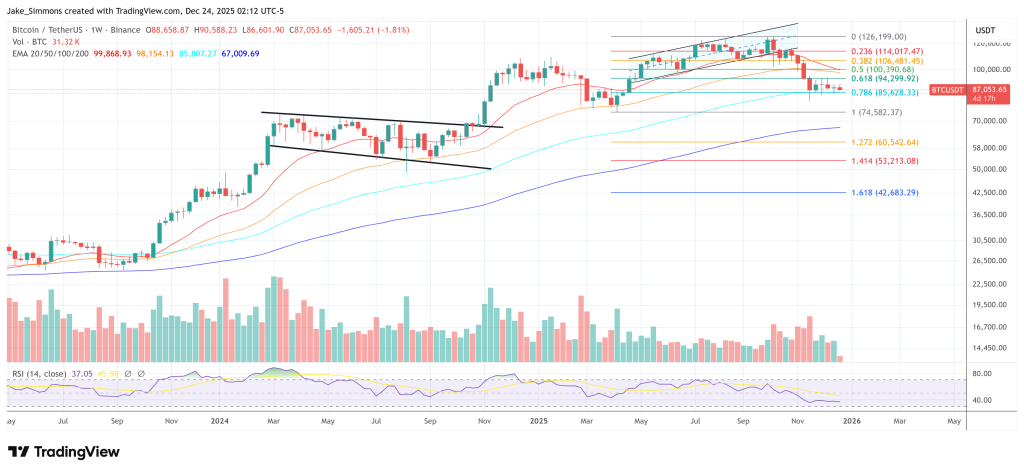
Featured image created with DALL.E, chart from TradingView.com
