


Russia has reaffirmed its strong position on cryptocurrencies, clearly differentiating between digital assets and conventional currency. As international discussions persist about the potential coexistence of crypto with national currencies, Russian lawmakers are upholding a long-standing perspective.
Related Reading
Within the nation, transactions are exclusively conducted in rubles. This stance comes as global crypto usage rises and Russia experiments with alternative tools for cross-border transactions in response to sanctions.
Anatoly Aksakov, chair of the State Duma Committee on Financial Markets and a prominent figure in Russia’s crypto legislation, is central to these recent comments. He told state media that there is clarity in the law.
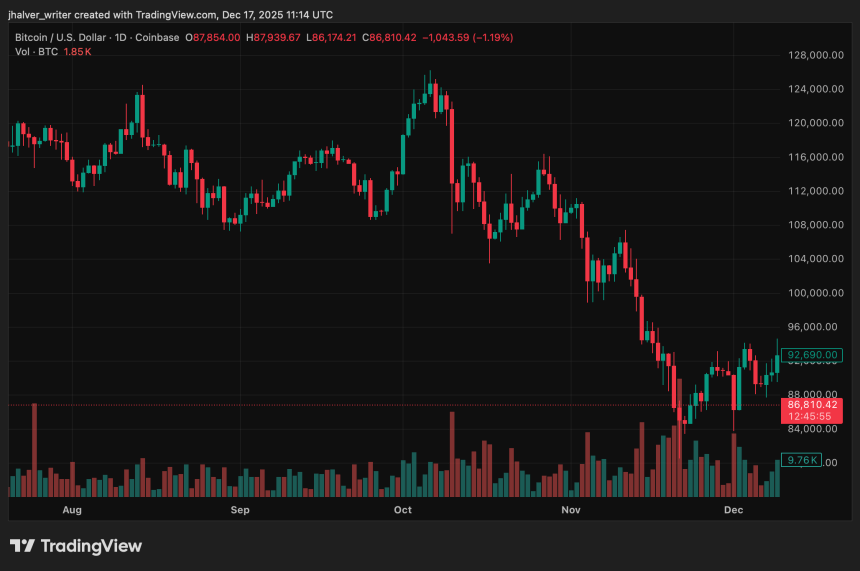
BTC's price shows some daily gains. Source: BTCUSD on Tradingview
Lawmakers Emphasize Ruble-only Payment Policy
In Russia, cryptocurrencies like Bitcoin and Ethereum can be held or traded as assets, but they are not allowed to be used for payments in domestic transactions, as stated by lawmaker Anatoly Aksakov. All transactions for goods and services must still be conducted in rubles.
Aksakov’s comments reaffirm the stipulations of Russia’s 2020 digital assets legislation, which excluded cryptocurrencies from being considered legal tender. Legislators maintain that currency must be issued and regulated by the government, asserting that private digital currencies do not satisfy this criterion.
Officials indicate that there are no intentions to relax this policy. The regulation is applicable across retail, online services, and business contracts, definitively eliminating the possibility of crypto payments regardless of market trends or adoption rates.
Skepticism from the Central Bank Shapes Regulations
The Bank of Russia plays a crucial role in this regulatory framework. Governor Elvira Nabiullina has consistently highlighted the risks cryptocurrencies pose to financial stability and consumer protection.
The central bank has persistently resisted using crypto as a method of payment and has previously advocated for extensive restrictions on exchanges and transactions.
This stance has resulted in ongoing tensions with the Ministry of Finance, which preferred regulation and taxation instead of outright prohibitions. Although several legislative proposals emerged from this dialogue, none altered the essential ban on crypto payments. Presently, policymakers seem united in maintaining the ruble’s dominant status.
International Use Increases Despite Domestic Restrictions
Even though crypto is prohibited for internal transactions, Russian authorities recognize its escalating significance in international trade. Businesses are allowed to utilize digital assets for cross-border settlements through an experimental legal framework, an approach that has gained momentum due to global financial constraints.
Officials estimate that substantial volumes of trade, worth billions of dollars, have already been conducted through these channels. Similarly, cryptocurrency mining has been legalized, with increased oversight of the sector, highlighting a dual strategy: limited international use paired with strict domestic control.
Related Reading
This dichotomy is at the core of Russia’s crypto policy. Digital assets may be utilized as investment vehicles or for external trading purposes, but within the country, the ruble is the only approved payment method.
Cover image from ChatGPT, BTCUSD chart from Tradingview
