


Donald Trump declared his intention to impose a 100% tariff on Chinese imports effective Nov. 1, in a strong response to China’s decision to limit exports of rare earth materials vital for high-tech manufacturing.
Markets reacted sharply to this news, with the S&P 500 index dropping 2.7% compared to the previous day. This announcement led to widespread volatility in global equities, resulting in substantial declines in crypto-related stocks as investor risk appetite diminished.
Sponsored
Sponsored
Crypto Stocks Lead Double-Digit Market Sell-Off
The renewed trade tensions between the US and China prompted a broad market sell-off that significantly affected crypto-related stocks. As of Friday’s market close in New York, leading digital-asset companies experienced sharp declines across the board.
Global cryptocurrency exchange Coinbase (COIN) closed at $357.01, a decrease of 7.75% from the previous close of $387. The stock opened at $387.66 and plummeted to a low of $351.63 during the trading session, reflecting increased risk aversion among investors.
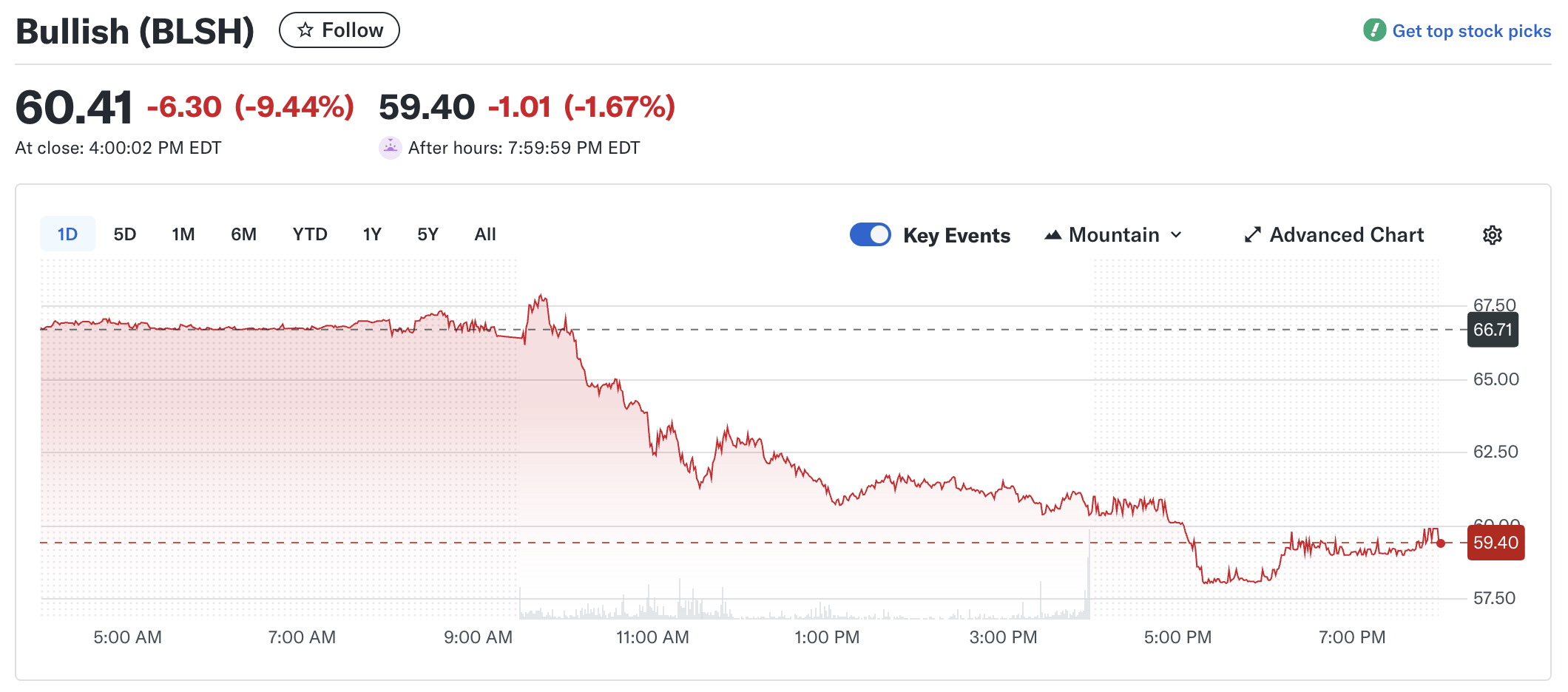
Crypto financial-services firm Bullish (BLSH) also faced significant losses, dropping 9.42% to $60.37 from the previous close of $66.65. The stock briefly reached $68 earlier in the day but fell to $60.25 due to overall market weakness.
Japan-based Bitcoin treasury company Metaplanet (MTPLF) ended 2.25% lower at $3.48, compared to the previous close of $3.56. Although it hit $3.65 intraday, those gains proved short-lived as the stock reversed course later in the session.
Bitcoin mining firm MARA Holdings, Inc. (MARA) experienced one of the sharpest declines, closing down 7.67% at $18.65. The stock dropped sharply around 11 am after an early attempt to rebound, continuing to weaken in after-hours trading with a further 1.72% decline to $18.33, signaling ongoing investor anxiety.
Sponsored
Sponsored
Strategy’s mNAV Highlights Bitcoin Treasury Risks
Leading Bitcoin treasury company Strategy (MSTR) was also adversely affected by the sell-off. The stock closed at $304.79 on the same day, down 4.84% from the previous day’s close of $320.29. During trading, it fluctuated between a high of $323.43 and a low of $303.57, indicating high volatility.
Importantly, the focus has shifted beyond the temporary stock decline to growing concerns surrounding the company’s fundamental valuation metrics. Analysts reported that the company’s multiple-to-net asset value (mNAV) has fallen below 1.180, marking its lowest point in nearly two years (19 months).
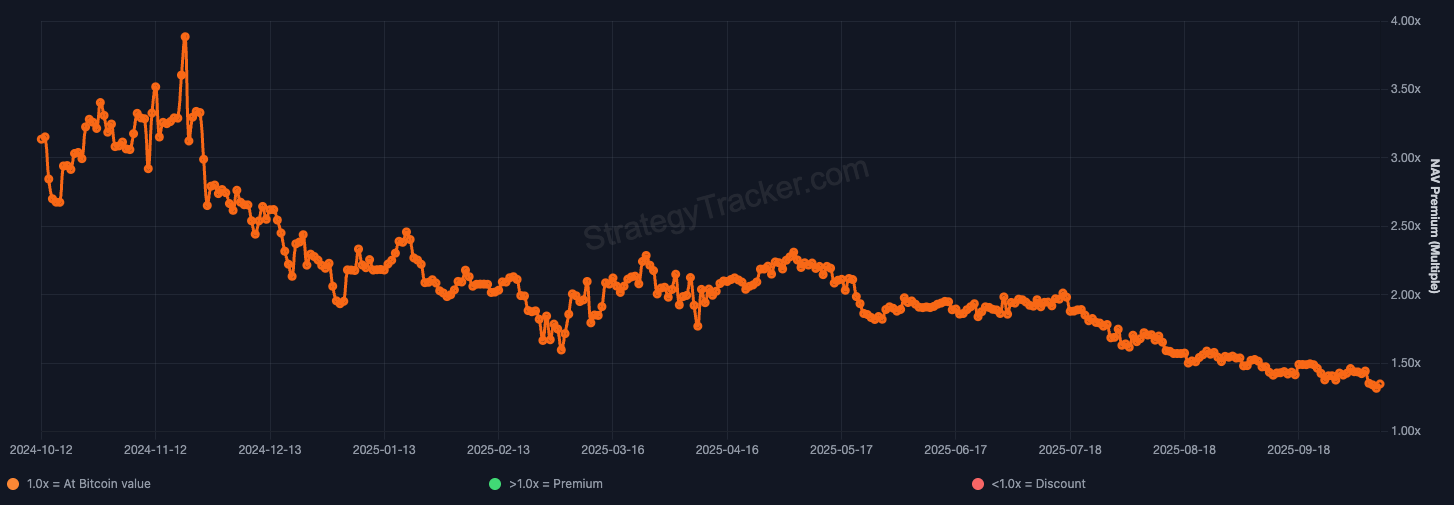
Geoffrey Kendrick, Head of Digital Assets Research at Standard Chartered, emphasized that maintaining an mNAV above 1.0 is crucial for digital-asset treasury (DAT) companies to grow their holdings. Values below this threshold indicate weakened balance sheets and increasing consolidation pressure across the sector.
Strategy and similar companies are also under mounting pressure from PIPE (Private Investment in Public Equity) financing structures used to support their Bitcoin acquisitions. According to a CryptoQuant report last month, Bitcoin treasury stocks often converge toward their discounted PIPE issuance prices, resulting in some early investors facing losses of up to 55%.
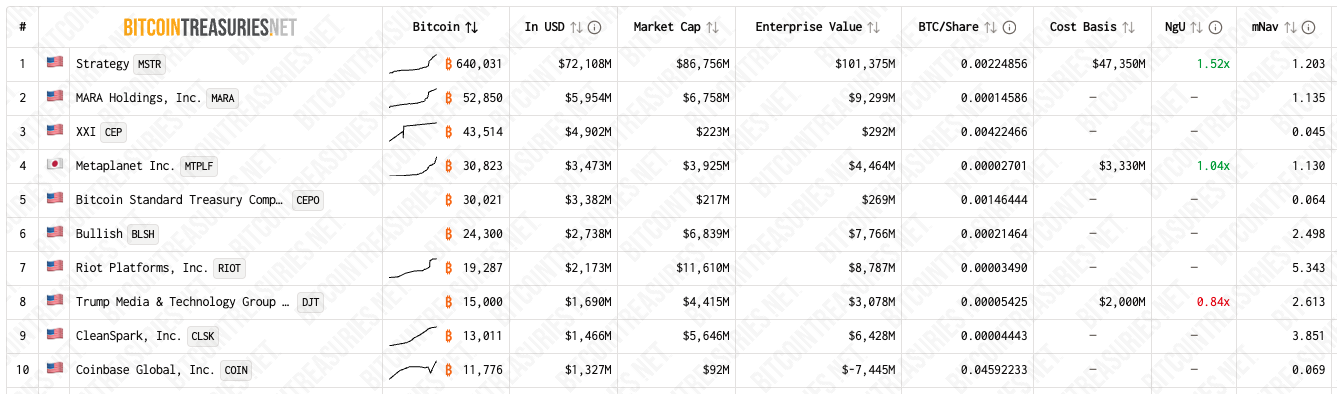
Strategy currently holds approximately $78 billion worth of BTC, while its market capitalization stands at $94 billion, indicating a $16 billion premium. However, considering the company’s total profit over the past year was under $350 million, most analysts see this premium as reflecting investor optimism linked to founder Michael Saylor’s efforts to promote Bitcoin-backed debt and investment products.
