


The aftermath of the paper bitcoin summer illusion has hit hard and quickly. We’re witnessing it not in the bitcoin price, which is once again steadily climbing—approaching $117,000 Tuesday evening—but in the stock values of bitcoin treasury firms. They’re all getting decimated: Check the charts of $MSTR, Metaplanet, $NAKA, H100, and Smarter Web Company; they all display a similar pattern—an exhilarating rise followed by a prolonged downturn back to where they began (or significantly lower).
At one point, we—and much of Wall Street—believed market arbitrage was the name of the game. Issue shares above their intrinsic value; purchase bitcoin; repeat. During this dizzying summer affair, Wall Street was willing to pay more than a dollar for a dollar’s worth of bitcoin, filling everyone with dollar signs; this is a trade that, if you’re able, you’d happily engage in all day.
But with that phase behind us, there will be consequences—and they’re already unfolding.
Moreover, it’s not fair to kick someone when they’re already down (especially when that someone is, in a way, your superior…) but considering that $NAKA plummeted by an astonishing 50% recently after the S3 PIPE shares restriction period concluded—after having already plummeted about 87% from its May peak—it would be negligent of us price analysts not to take a closer look.
With the outstanding, tradeable share float increased overnight by around 50x—and, presumably, numerous second-layer PIPE “insiders” eager to unload—the formula was quite straightforward: abundant extra supply without demand leads to plummeting prices. As bitcoin treasury analyst Adam Livingston puts it in his words: “You get a perfect physics lesson here: add mass, you lose altitude.”
As expected, bitcoin remained indifferent: it surged nearly 2% today without any significant news, after a brief dip from its consistent $116,000 level. According to Bitcoin Magazine Pro’s Matt Crosby in a recent video, bitcoin price is “poised for breakout.”
This, however, isn’t the case for the distressed treasury firms.
Even the top performer, Saylor’s Strategy ($MSTR), is facing challenges—continuing since operational offloading began last year; Strategy is accumulating coins by the hundreds, yet the mNAV keeps compressing, hitting an (unadjusted) yearly low of 1.27. We’re rapidly reaching a point where the stock premium (i.e., the magic behind all treasury companies) is fading, leading these entities to resemble overpriced, glorified ETFs.
“Always have been,” the meme creators might counter.
Returning to our dear frog, Nakamoto. Bad developments have plagued it recently. The chart is grim:
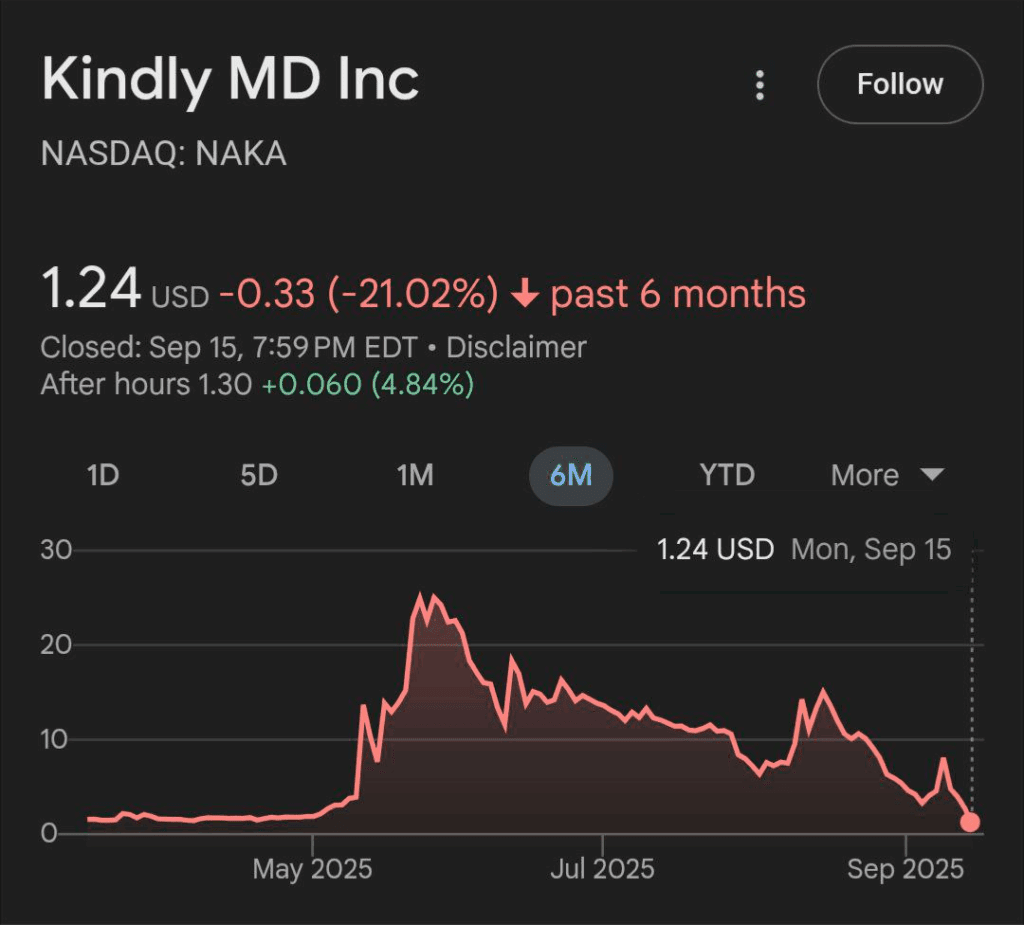
Creating an endless number of copyable papers against a non-credible bitcoin strategy could never have concluded differently. Congratulations, NAKA leadership; you squandered six months (or more) of prime bull market opportunities engaging in high finance, and now you’re reaping the consequences.
The illusion surrounding the bitcoin treasury strategy has dissipated, and the NAKA approach—implementing the mNAV-squared treasury strategy—has suffered significantly as a result. (Though, at the time of writing, $NAKA is up 20% on the day from its extreme low… sure, nobody cares.)
Livingston once again clarifies the chaotic landscape:
“The September 15 crash was not some mysterious market mood fluctuation. It was the predictable outcome of half a billion shares discounting overwhelming the order book that was built for a few million: the supply surged, the price dropped, and the physics lesson completed.”
The relentless upward enchantment of (money-printing) bitcoin treasury firms is over. Good riddance. Now these companies must demonstrate real value with the corporate-wrapped coins they cling to so fervently… or perhaps we can revert to de-financializing the economy—that annoying, original mission of Bitcoin.
