


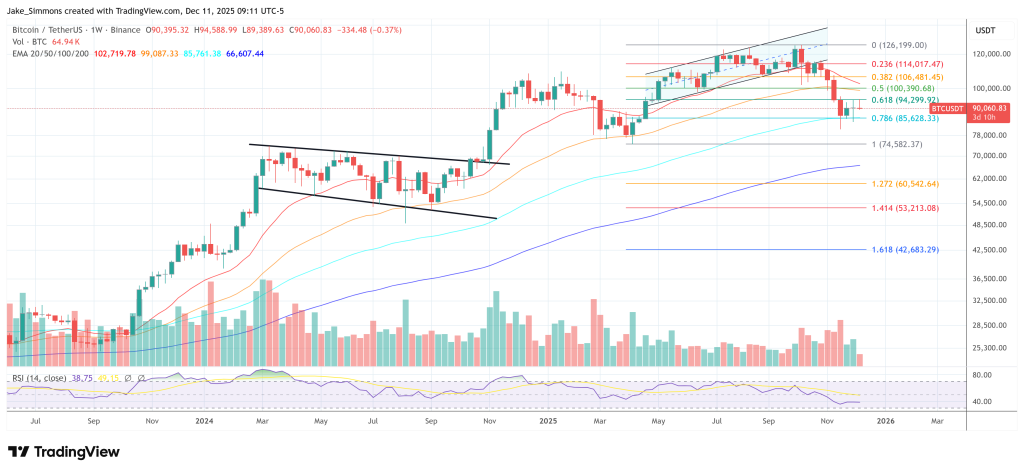
Bitcoin is navigating a landscape where headlines loudly proclaim “bull” or “bear,” yet the market’s underlying dynamics seemingly remain indifferent. After surging to a peak around $124,000–$126,000 in early October and subsequently dropping about a third of its value by November, BTC is currently hovering in the low-$90,000s—still a leader in the space but visibly fatigued.
Amidst this uncertainty emerges the pseudonymous, esteemed crypto veteran plur daddy (@plur_daddy) who proposes that the market might be in a state that doesn’t align with either category. “Due to the four-year cycle, all participants in the crypto market are conditioned to see it as being either in a bull or bear phase,” he articulated on X. “What if, as part of market maturation, we are merely in an extended consolidation phase where the overhead supply is gradually being absorbed?”
This reframing is simple yet carries significant implications. He draws parallels with gold, which he notes “fluctuated between $1,650–2,050 from April 2020 to March 2024,” contending that it’s “reasonable to expect that as BTC matures, it will display more gold-like traits.” In essence: not dead, not ecstatic, just… mired in a robust, liquidity-rich range where supply transitions from weaker hands to stronger ones for a duration that longer-term traders, used to clearer halving cycles, may struggle to handle emotionally.
Related Reading
The range dynamics are already observable at the upper bounds. According to plur, “sellers appeared aggressively whenever the price approached the $120k range.” He points out that there are “strong arguments” suggesting these sellers were motivated by the four-year cycle narrative, but equally valid reasons related to age, pricing, liquidity, thesis changes, and “emerging tail risks.” Should BTC return to that range, he believes it is “rational for traders to front-run that, which reinforces the range.” Classic reflexivity: memories of past peaks help forge the next one.
On the downside, he doesn’t subscribe to a doom-and-gloom outlook. “This coincides with my intuition that the lows are likely in, or at least not significantly below what we have observed, while upside potential might also be capped,” he remarked, adding that liquidity conditions are “set to moderately improve,” allowing for a potential rebound—just not necessarily a new market regime. Put simply, he’d “proceed with caution regarding bets on regime change.”
Bitcoin Market Conundrum: QE or Not QE?
That “moderate improvement” isn’t merely theoretical. The latest FOMC meeting revealed a 25-basis-point rate reduction, nudging the Fed funds target to 3.50–3.75%, along with an unexpected announcement of approximately $40 billion monthly in “reserve management purchases” (RMPs) of short-term Treasuries, commencing December 12 and expected to persist at elevated levels for several months.
The official narrative is that this is a technical adjustment to maintain “ample” reserves and ensure smooth functioning of the repo markets, rather than a fresh wave of QE.
Unsurprisingly, macro perspectives on X are divided regarding this distinction. Plur Daddy remarked on X: “This is distinct from QE because the primary mechanism of QE involves withdrawing duration from the market, compelling participants to ascend the risk curve. However, they sneaked in the possibility of purchasing up to three-year treasury notes, indicating some duration will indeed be removed. This is more bullish than anticipated, facilitating market liquidity into the upcoming year.”
Miad Kasravi (@ZFXtrading) asserts, “The FED is NOT engaging in QE. It’s simply expanding the balance sheet via money-market displacement,” claiming that when the Fed acquires bills, the previous holders receive cash that “must go somewhere,” and “some of it trickles into credit, equities, and crypto.”
Related Reading
LondonCryptoClub takes a bold stance. He believes the Fed is “essentially going to print money to keep financing this deficit for as long and as extensively as necessary,” emphasizing that “the debasement trade is on autopilot.” He supports Lyn Alden’s earlier comment that “it’s money printing. Whether it’s QE or not is simply semantics. The Fed will avoid calling it QE since it lacks duration and isn’t aimed at economic stimulus.”
Lyn Alden hits the nail on the head
Markets will complicate and overanalyze the semantics
Yet they are indeed printing money and monetizing the deficit
It’s all fundamentally the same thing. Admittedly, this is more of QE-lite…for the time being at least
Believe it or not, market participants… https://t.co/cf7QLogWom
— LondonCryptoClub (@LDNCryptoClub) December 10, 2025
Peter Schiff, as expected but with a touch of rationality, commented via X: “QE, regardless of its nomenclature, still equates to inflation. The Fed just announced its intention to continuously buy T-bills.” He warns that as long-term rates are likely to increase because of this inflationary policy shift, it won’t be long before the Fed extends QE5 to longer-term maturities. Got gold?”
So What’s the Conclusion?
As Plur mentions, these operations augment bank reserves and alleviate repo tension; the Fed will predominantly purchase T-bills, but “they may acquire up to three-year treasury notes, indicating some duration will indeed be removed.” This moves the program closer to “QE-lite” rather than pure technical adjustments. It is supportive for risk assets and arrives precisely when year-end liquidity is low, with additional balance-sheet expansion strategies on the horizon.
For Bitcoin, the bittersweet reality is that both scenarios can coexist: the “debasement trade” remains fundamentally active, while price movements mimic those of a large, semi-institutional asset grappling with a turbulent rally and a new macro shock. A range-bound churn lasting another six to eighteen months, as plur proposes, “wouldn’t be unusual at all.” Whether labeled as bull, bear, or merely purgatory is largely a matter of narrative. Markets, quite frankly, will respond similarly regardless.
As of the latest update, BTC was trading at $90,060.
Featured image created with DALL.E, chart from TradingView.com
