

Over the last two weeks, Bitcoin has experienced price movements that have introduced a new level of tension among traders, with on-chain metrics indicating that realized losses have surged to levels not seen since 2022.
According to the latest Week-On-Chain report from Glassnode, Bitcoin is trading above a key cost-basis level but is concurrently facing mounting loss realization, dwindling demand, and decreased liquidity, leaving short-term investors in a tough spot.
Realized Losses Plunge Deep
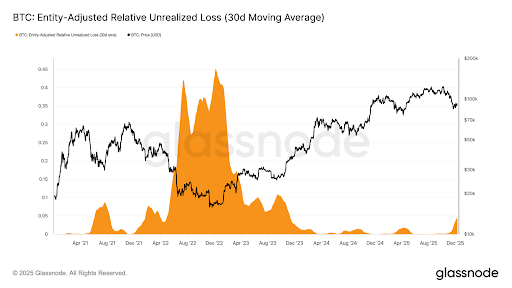
Glassnode reports that realized losses among Bitcoin holders have surged significantly, nearing levels seen during the severe downturns of the 2022 bear market. Notably, the Relative Unrealized Loss (30D-SMA) has increased to 4.4%, marking a steep rise after remaining below 2% for nearly two years.
Related Reading
The uptick in realized losses underscores how the recent decline below $90,000 has compelled numerous market participants to sell coins at a loss. This disruption has hindered the gradual profitability improvement observed earlier in the year.
Despite Bitcoin’s recent rebound from the November 22 low, rising above $92,000, the pressure on holders remains. Glassnode notes that entities continue to realize losses at an accelerating rate, with the 30-day average of realized losses now approximately $555 million per day.
These circumstances indicate a diminishing confidence among investors regarding the short-term prospects for Bitcoin, leading to a reduction in exposure, even at less favorable prices. Consequently, the report emphasized that resolving this situation will necessitate a renewed influx of liquidity and demand to restore confidence.
Additionally, Glassnode points out a significant increase in profit-taking among long-term holders, whose realized gains have surged to approximately $1 billion daily and briefly spiked above $1.3 billion.
Despite this high level of distribution, Bitcoin is currently hovering just above the True Market Mean, an enduring cost-basis benchmark that acts as a structural support point. The recent price decline below $90,000 has brought this zone to its limits, yet signs of demand around it suggest the price could revisit the 0.75 quantile near $95,000 and potentially approach the short-term holder cost basis as well.
ETF, Futures, and Options Markets Reflect Weakness
The report from Glassnode highlights ongoing weakness in ETF flows, which have significantly cooled off following a period of strong inflows earlier this year. This slowdown indicates a decline in one of the primary sources of buy-side liquidity for Bitcoin.
Related Reading
Liquidity in the spot market has also diminished, with order books on major exchanges nearing the lower end of their 30-day range. This creates a situation where trading activity has weakened through November and into December, leading to fewer liquidity flows capable of absorbing volatility or supporting directional movements.
Positioning in derivatives markets shows similar caution, with funding rates remaining around neutral. The open interest in futures has also been low and has not substantially rebuilt since the breakdown below $90,000.
Across all major venues, the sentiment is consistent: liquidity is lighter, sentiment is softening, and participants are adopting a defensive approach rather than chasing short-term rallies. Attention is now focused on how Bitcoin will react following the recent rate cut by the Federal Reserve.

Featured image from Pixabay, chart from Tradingview.com
