


Although Bitcoin’s price has declined, the amount of BTC held on exchanges has fallen to its lowest point in over a decade, indicating that investors are still accumulating rather than liquidating their holdings.
Summary
- Bitcoin’s exchange reserves have reached a 10-year low, demonstrating robust accumulation.
- Liquidations have removed excess leverage, resulting in a healthier environment for recovery.
- Technical indicators remain mixed, but long-term support around $108K remains intact.
Bitcoin has dropped below $113,000 as traders pulled back following a weekend sell-off spurred by tariff news. Over the last week, Bitcoin has fallen by approximately 10%, fluctuating between $109,883 and $125,023. The cryptocurrency is now 9% below its record high of $126,080 reached on October 6.
Trading activity has also diminished, with daily volumes decreasing by 25% to about $69 billion. Data from CoinGlass indicates a slight rise in derivatives volume of 0.14% to $109.97 billion, while open interest has decreased by 1.8% to $73.36 billion.
This combination of rising volume alongside falling open interest often suggests that traders are liquidating leveraged positions, a positive reset following a week of volatility.
Bitcoin exchange reserves drop to a 10-year low
An analysis by CryptoQuant contributor Chairman Lee, conducted on October 14, reveals that the amount of Bitcoin (BTC) held on centralized exchanges has fallen to approximately 2.4 million BTC, the lowest level since 2015. In 2020, this figure exceeded 3.5 million BTC. The continuous decline is one of the most pronounced withdrawal trends in Bitcoin’s history.
Lee points out that a lower availability of coins for trading tends to reduce selling pressure. Historically, such periods of dwindling supply have often preceded significant price rallies, as observed in 2020 and 2021.
This trend implies that while prices may seem weak in the near term, the underlying market dynamics remain strong. As long-term holders, institutional investors, and exchange-traded funds persist in transitioning Bitcoin into regulated custody and cold wallets, Bitcoin’s supply will continue to tighten.
Post-liquidation reset could trigger the next rally
Another analysis by XWIN Research Japan compares recent liquidation events with prior recovery phases. Following the announcement of new U.S.-China tariffs, leveraged positions valued at around $19 billion were liquidated on October 10. Bitcoin briefly dipped to $104,000 before stabilizing.
History indicates that major liquidation events, like those in 2021, often recalibrate the market rather than disrupt it. When leverage dissipates, spot demand generally resurfaces, leading prices to recover.
This time around, the inflow of ETFs, institutional interest, and decreased exchange balances signal that a similar pattern is unfolding. On-chain data provided by XWIN Research Japan supports this, with normalized funding rates and the aSOPR—a vital profitability metric—rising above 1.0, indicating a transition from panic selling to accumulation.
The current apparent weakness may well mark the onset of a rebuilding phase, mirroring patterns following every major sell-off in Bitcoin’s past.
Bitcoin price technical analysis
Bitcoin is currently in a cautious position. With a relative strength index of 44, momentum is neutral. Most short-term moving averages (10 to 50 days) suggest mild selling pressure, while momentum and MACD indicators exhibit a slightly bearish tendency.
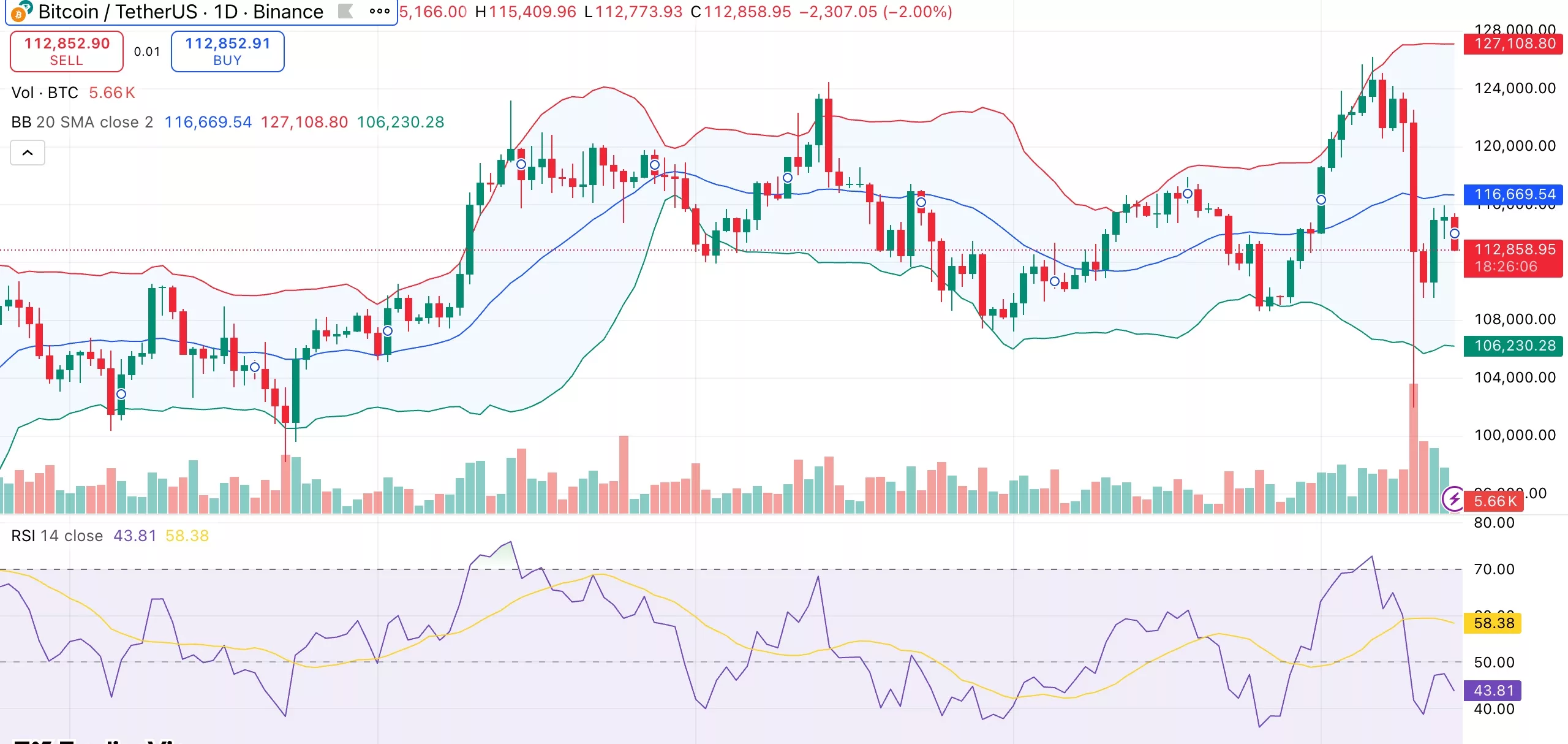
The 200-day moving averages near $108,000 serve as robust support. As long as Bitcoin remains above this threshold, the long-term market structure stays healthy.
A rise above the $116,000 to $118,000 range would suggest renewed strength, potentially paving the way back toward $125,000. Conversely, if prices fall below $110,000, the next support test could be around $105,000.
