


Bitcoin has surged back above the $92,000 mark after lingering below $90,000 for several days, providing a momentary reprieve to a market under strain since late 2025. This rebound has helped to stabilize short-term sentiment, although confidence remains tenuous. Analysts continue to caution that 2026 could signal a larger bear market due to weak spot demand, diminishing momentum, and ongoing sell-side activity from larger players.
Related Reading
Amidst this backdrop, macroeconomic headlines have started to re-emerge. An analysis by XWIN Research Japan highlights potential US military involvement in Venezuela, reviving geopolitical concerns across global markets. Historically, such events often lead to increased volatility, prompting investors to adopt defensive strategies.
However, analyzing Bitcoin’s reactions solely through price metrics may be misleading, especially in a landscape dominated by derivatives and algorithmic trading.
On-chain activity provides a clearer perspective. Exchange Netflow data becomes crucial during periods of geopolitical tension, reflecting whether holders are choosing to sell or remain on the sidelines. When fear prevails, exchange inflows typically rise as participants move their coins to trading platforms.
In contrast, low inflows or continued outflows indicate that investors are not rushing to diminish their exposure, even in the face of unsettling news.
Exchange Netflows Indicate Caution, Not Panic
This analysis contextualizes the current geopolitical developments within a broader historical framework. During past military conflicts—most notably Russia’s invasion of Ukraine and more recent tensions in the Middle East—Bitcoin often witnessed sharp yet fleeting price swings.
Nevertheless, on-chain data presents a calmer narrative. Exchange Netflow, which measures whether coins are being sent to exchanges for sale or withdrawn for holding, rarely showed significant decline during those episodes. Since 2023, the market has demonstrated a growing capacity to absorb localized geopolitical shocks without triggering widespread liquidation activity.

The situation regarding Venezuela aligns with this pattern. While headlines have added layers of uncertainty and contributed to short-term price sensitivity, there hasn’t been a significant influx of Bitcoin onto exchanges. The lack of heightened inflows indicates that investors are not reacting in panic; rather, the market appears to be observing developments while preserving current positions.
Historically, Bitcoin’s more significant on-chain responses have been linked to structural economic threats instead of isolated military events. Instances such as US–China trade conflicts, regulatory shifts, or capital control measures typically influence global liquidity and investor freedom more directly, leaving clearer marks in exchange flows.
At this point, the narrative surrounding Venezuela has not reached that level of concern. Exchange Netflow activity suggests a market that is vigilant but not retreating.
Related Reading
Bitcoin Tests Key Resistance After Relief Rally
Bitcoin has mounted a notable recovery, regaining the $92,000 level after days of struggling beneath $90,000. This move is notable on the chart as a relief rally following a sharp decline from the $105,000–$110,000 range earlier in Q4. Nonetheless, the overall structure continues to reflect a market in consolidation rather than a definitive trend reversal.
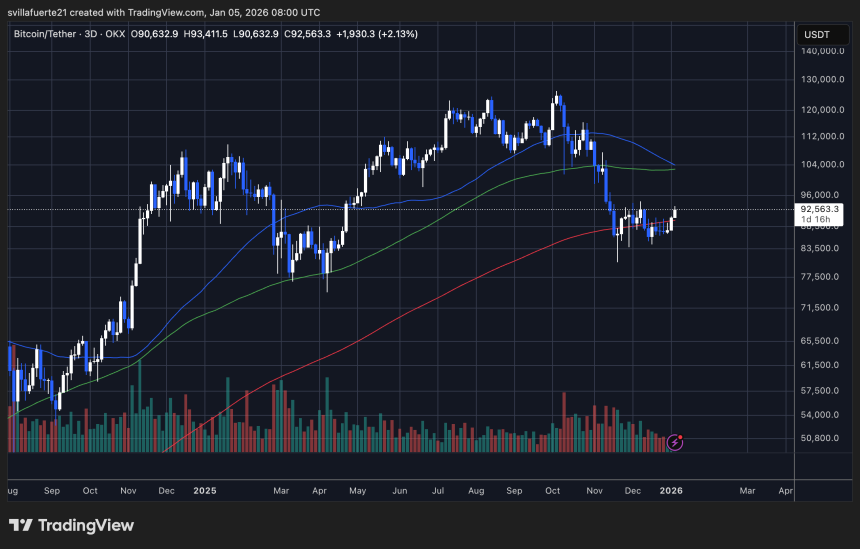
The price is currently trading beneath the declining short-term moving average (blue), which has acted as dynamic resistance since the November sell-off. While BTC has managed to claw back above the 200-day moving average (red), this level remains relatively flat, indicating stabilization rather than a resurgence of bullish momentum. The medium-term moving average (green) around the $100,000 region presents a significant barrier that bulls have yet to effectively challenge.
Related Reading
The recent bounce has occurred with moderate involvement, lacking the robust participation typically seen with strong trend continuations. This suggests that it was more about short covering and tactical buying instead of widespread market demand returning.
Structurally, Bitcoin appears to be establishing a range between approximately $88,000 and $96,000. Maintaining above the lower boundary would keep the consolidation intact, while a fall back below $88,000 would reopen downside risks toward the mid-$80,000s.
For now, the price action signifies relief and stabilization, but a confirmation of a sustainable uptrend would require a decisive reclaim of higher resistance levels.
Featured image from ChatGPT, chart from TradingView.com
