


Bitcoin ended the year slightly negative, breaking its typically observed four-year cycle of one down year followed by three up years. The annual decrease was mild—approximately 6%—and minimal compared to historical downturns seen in previous bearish periods. However, this subtle red close carries significant implications, indicating a potential shift in market dynamics rather than outright vulnerability.
Related Reading
Recent on-chain analysis by Axel Adler provides vital insights into this shift. Data tracking cumulative Net Taker Flow indicates that aggressive buying peaked around New Year’s before tapering off. Since then, market aggressiveness has leaned toward selling, though not in an extreme manner.
The indicator currently exists in a moderate negative range, suggesting that sell-side pressure has grown but remains distant from capitulation levels.
Historically, such situations have often coincided with increased downside sensitivity rather than immediate trend reversals. This implies that Bitcoin could be susceptible to additional weakness if demand does not recover, yet it isn’t exhibiting the stress typical of deeper bearish phases.
The main point is nuance. Bitcoin isn’t collapsing, but it’s also not acting like an asset in a straightforward, momentum-driven growth phase. The mild selling pressure combined with a rare negative yearly close suggests a market in transition, evolving into a more intricate and discerning phase rather than adhering to its familiar cyclical pattern.
Derivatives Momentum Turns Cautious as Sell-Side Pressure Aligns
Adler’s analysis underscores a developing shift in short-term market behavior via the Bitcoin Net Taker Flow momentum metric, which gauges how aggressively traders are positioning on either the long or short side. Unlike cumulative flow, this indicator is designed to respond swiftly to sentiment shifts, offering an early glimpse into changes in trader behavior rather than long-term positioning.

Recently, this momentum indicator has decisively rolled over. After maintaining positive levels in late December, the smoothed reading has dipped into negative territory, currently around -0.3. While this doesn’t yet indicate extreme stress, it firmly places the market within a moderate bearish pressure regime. The timing is crucial: the momentum downturn coincided with a decline in cumulative Net Taker Flow, reinforcing the signal instead of contradicting it.
This alignment is significant. When both cumulative pressure and short-term momentum weaken simultaneously, it decreases the chances that the move is driven by noise or isolated positioning. Instead, it suggests a broader shift in trader aggression toward selling. Adler notes that deeper downside risk would arise if momentum continues to slip, particularly if readings drop below the -0.4 threshold.
The conditions imply controlled yet persistent selling pressure. Bitcoin is not yet in capitulation territory, but the synchronized signals indicate that bearish pressures currently lead, increasing sensitivity to any loss of price support.
Related Reading
Bitcoin Holds Key Support As Momentum Remains Fragile
Bitcoin is stabilizing around the $88,000–$90,000 range following a steep pullback from recent highs, reflecting a market caught between consolidation and ongoing downside risk. The price remains below both short-term and medium-term moving averages, indicating that bullish momentum has not yet reestablished itself.
The 50-period moving average has emerged as dynamic resistance, while the 100-period average is flattening, reinforcing the notion of a broader compression phase rather than an immediate trend reversal.
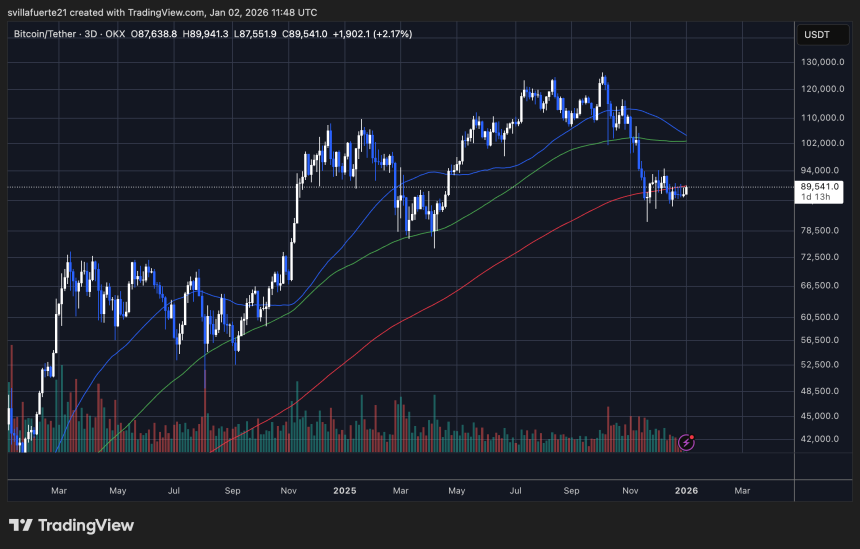
Crucially, Bitcoin remains well above the 200-period moving average, which is still trending upwards. This indicates that, from a higher-timeframe perspective, the overall structure has not completely deteriorated. However, the loss of the $100,000–$105,000 region previously indicated a clear shift from expansion to distribution, amplifying sensitivity to sell-side pressure.
Volume has significantly decreased during the recent sideways actions, suggesting a lack of conviction from buyers and sellers alike. This reinforces the view that the market is digesting past excesses rather than aggressively repricing downwards. Nevertheless, ongoing failures to reclaim the $92,000–$95,000 range underscore weak demand at those higher levels.
As Bitcoin maintains support around the $85,000–$88,000 band, consolidation remains the prevailing scenario. A drop below this range would likely pave the way for deeper retracements.
Featured image from ChatGPT, chart from TradingView.com
