


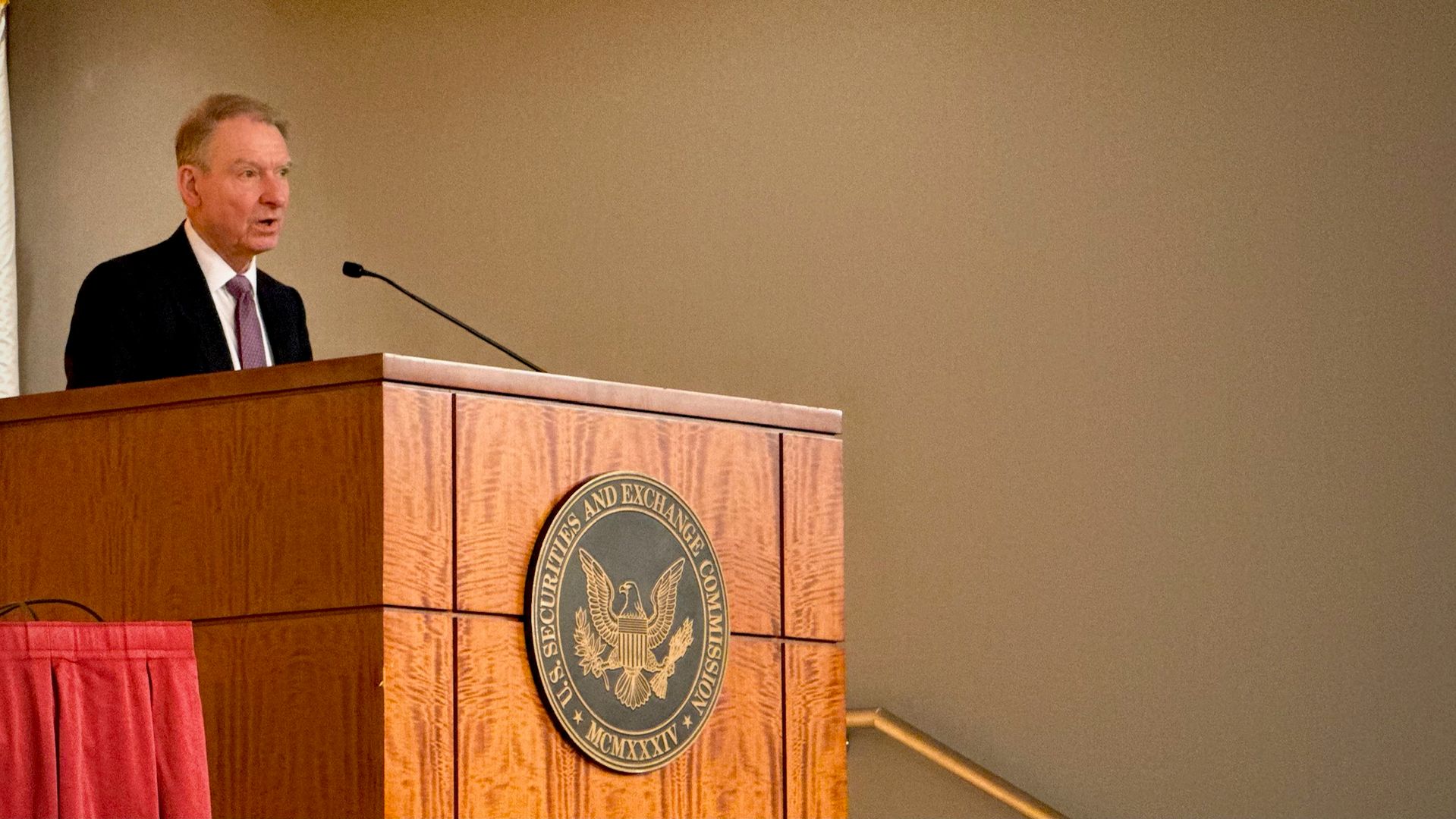
WASHINGTON, D.C. — SEC Chairman Paul Atkins expressed concerns that, without stringent regulations, the federal government could exploit the cryptocurrency sector for extensive surveillance capabilities. He noted that the industry also holds the potential to develop systems that can monitor users for illicit finance protections while preserving their privacy.
Atkins commented, “It’s easy to envision a future where government entities, together with various intermediaries, can scrutinize nearly all aspects of an individual’s financial life.” He spoke at a financial surveillance and privacy roundtable held at the SEC’s Washington headquarters, marking the sixth such meeting on cryptocurrency this year.
“Regulators may have an insatiable thirst for data, but this tendency fundamentally clashes with the principles of a free society that has contributed to America’s greatness,” he said.
The chairman referenced the SEC’s ongoing grappling with the consolidated audit trail (CAT) technology intended to provide better oversight of U.S. markets, alongside rules established following the 2008 financial crisis that required greater reporting by investment firms.
“Regrettably, the federal government’s relentless quest for data has expanded these tools in ways that increasingly threaten the freedom of American investors,” said Atkins. He warned that emerging blockchain technologies could be corrupted to create the “most powerful financial surveillance mechanism” in history.
It is crucial for government policies to protect lawful financial activities from “bulk surveillance.”
In discussions about surveillance and privacy related to digital assets, the narrative has often focused on U.S. Department of Justice prosecutions and the Department of the Treasury, particularly the Financial Crimes Enforcement Network (FinCEN), which works to combat illicit finance. However, the SEC is poised to announce new rules governing its portion of the industry.
Under Atkins’s leadership, the SEC has been eager to advance the crypto agenda set by President Donald Trump. His “Project Crypto” involves several initiatives, such as clearly defining crypto securities, establishing standards for tokenizing securities, and creating an “innovation exemption” that enables crypto companies to test new products more easily.
Atkins has consistently emphasized his intention to collaborate closely with the Commodity Futures Trading Commission on joint oversight of crypto markets. He advocates for a regulated framework where crypto investors can efficiently manage their transactions within accessible, seamless platforms that obscure regulatory boundaries. In contrast to his predecessor, Gary Gensler, Atkins contends that many digital assets do not meet the criteria for securities and therefore fall outside the agency’s jurisdiction.
The federal government has long been engaged in legal conflicts with the crypto sector, particularly against developers of privacy-enhancing tools like Tornado Cash. Although Trump-appointed regulators have retreated from this battle, asserting the need for protections for software developers, several cases have already concluded with convictions against crypto insiders.
SEC Commissioner Hester Peirce, who heads the agency’s crypto task force, stated that “the government should refrain from imposing regulatory requirements, including Bank Secrecy Act obligations, on software developers who do not hold custody of user assets or have the ability to override user choices.”
Atkins warned about the implications of the government’s forthcoming actions as legislative and regulatory measures regarding crypto move forward.
He cautioned, “If the government’s instinct is to categorize every wallet as a broker, every software as an exchange, every transaction as a reportable event, and every protocol as a surveillance tool,” then it risks transforming this ecosystem into a financial panopticon — akin to a theoretical constant-observation prison conceptualized by an English philosopher.