


The cryptocurrency community faced a significant downturn after key assets like Ethereum and Bitcoin began to plummet, with long liquidations exceeding $1 billion within the last hour of trading.
Summary
- Long liquidations within the crypto space have contributed to one of the largest mass liquidations in this market cycle, surpassing $1 billion in merely one hour.
- Concerns about inflation and assertive central bank actions have prompted traders to turn to safer assets, resulting in a wave of liquidations.
The crypto market has recently undergone one of the most significant wipeouts observed yet, with margin traders suffering devastating losses. Panic has swept through traders as total crypto liquidations surged past $1 billion in just the preceding hour, with Bybit alone accounting for $712 million in liquidations.
This wipeout largely occurred during a market-wide sell-off, triggered by sharp declines in prices, leading major cryptocurrencies like Bitcoin (BTC) and Ethereum (ETH) to drop significantly within a few hours. The extreme volatility in the crypto sector has resulted in forced liquidations.
According to data from CoinGlass, approximately 406,814 traders were liquidated within the past 24 hours. The cumulative liquidations amount to $1.74 billion, with long liquidations alone accounting for $1.04 billion, representing over 95% of the total. ETH contributed $309 million of the liquidations within the last hour, while BTC added $214 million.
Historically, long positions have borne the brunt of losses, with previous significant events surpassing even the most severe equity margin calls, serving as crucial lessons in leverage management.
The last major crypto liquidation surge occurred in February 2025, when about $2.2 billion was liquidated in a single day, primarily from long positions. Ethereum investors were hit the hardest, followed closely by Bitcoin holders. Around 700,000 traders lost their positions as a result of this fallout.
In the same month, traders also experienced the ripple effects of unexpected trade tariffs from the Trump administration, which incited panic and forced liquidations across all major platforms. Bybit’s CEO estimated that actual global liquidations exceeded approximately $8 billion to $10 billion.
Forced liquidations: Why is the crypto market crashing right now?
Currently, the wave of crypto liquidations is largely driven by rising interest rates. Expectations for tighter monetary policy typically have a negative impact on alternative assets such as cryptocurrency. When yields on safer investments like bonds and savings rise, cryptocurrencies become less appealing for investors looking to allocate capital.
After the Federal Reserve cut interest rates earlier last week, the rally was short-lived as worries about global inflation and recent economic indicators made traders more cautious about investing in alternative, riskier assets. Just a few days ago, Gulf central banks reduced key interest rates, following the Federal Reserve’s decision to lower U.S. rates by 25 basis points.
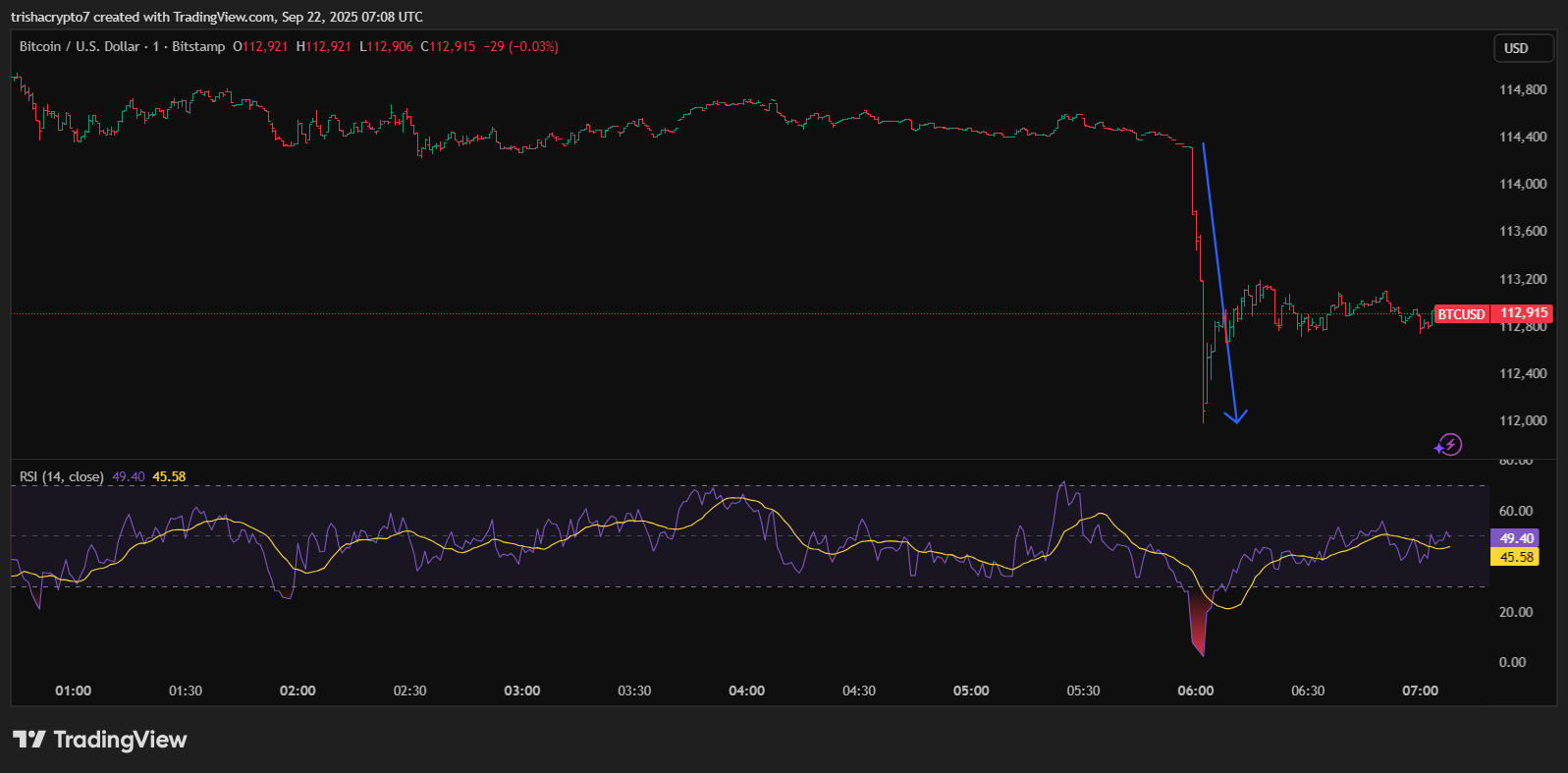
On September 22, Bitcoin plummeted below the $115,000 level. The largest cryptocurrency by market capitalization experienced a drop from approximately $114,400 to nearly $112,000 within minutes before stabilizing around $112,900.
This steep decline coincided with one of the cycle’s most substantial long liquidation events, where more than $1 billion in leveraged long positions were eradicated in just one hour. Such forced selling created a domino effect, further accelerating Bitcoin’s decline as margin calls and liquidations triggered a cascade of automatic sell orders.
During this massive sell-off, the Relative Strength Index dipped into oversold territory, briefly falling below 20, underscoring the rapid and severe trading maneuvers. Such deep oversold conditions frequently follow liquidation-driven crashes, indicating that price movements are less about organic selling and more about forced exits.
