


Bitcoin is currently facing challenges in regaining traction below the $90,000 mark but continues to stay above $86,000, indicating a market characterized by uncertainty. The price movement has tightened into a narrow range, with neither buyers nor sellers establishing a decisive lead.
As volatility decreases, a sense of indifference has become prominent in the current climate, prompting more analysts to consider the trend may be shifting towards a more extensive bear market phase.
Related Reading
While price levels capture attention, on-chain data reveals that a more significant struggle is occurring beneath the surface. As noted by CryptoQuant analyst Burak Kesmeci, understanding Bitcoin’s current position requires more than just looking at price.
Focus is shifting to the cost bases of significant market participants, particularly whales and Binance spot users. Even though Bitcoin trades around $87,000, the critical level lies much higher.
Data indicates that the average cost basis for new whales, categorized as holders with coins aged less than 155 days, is concentrated around $100,500. This area signifies an essential break-even point for large players who have recently joined the market.
Consequently, every approach towards $100,000 assumes considerable importance. This level could either prompt distribution as whales look to safeguard their capital or initiate renewed accumulation if confidence is restored.
Cost Basis Data Maps Bitcoin Real Support and Resistance
The report emphasizes that underlying Bitcoin’s current price action, cost basis data provides a clearer framework for assessing market risk. For Binance spot users, the average cost basis hovers around $56,000. This represents the greatest concentration of spot volume in the market and effectively marks the “deep water” zone should conditions worsen.
In a prolonged bearish trend, $56K is where the majority of spot holders would face significant testing, establishing it as a crucial long-term support level rather than a short-term trading point.

Additionally, long-term whale positioning adds another critical perspective. The cost basis for whales holding Bitcoin for more than 155 days clusters around $40,000. This indicates these participants are still enjoying profits of over 2x, even after the recent downturn.
This profit margin helps clarify the increase in realized gains noted in recent weeks. For many long-term holders, current prices already represent an adequate exit point, raising the incentive to distribute into strength rather than aggressively accumulate.
Together, the data reshapes Bitcoin’s market structure. The key short-term ceiling remains close to $100,000, where newer whales approach their breakeven, and supply tends to emerge. Conversely, $56,000 stands out as the point where spot market conviction would be under the most pressure.
Related Reading
Bitcoin Consolidates Above Key Weekly Support as Momentum Cools
Currently, Bitcoin trades around the $88,700 level on the weekly chart, stabilizing after a sharp decline from the cycle highs of $120,000–$125,000. While the broader uptrend from 2024 remains intact, recent price patterns indicate a marked slowdown in momentum. The market has transitioned from an impulsive expansion phase into a corrective and consolidative structure, with volatility compressing around a significant support zone.
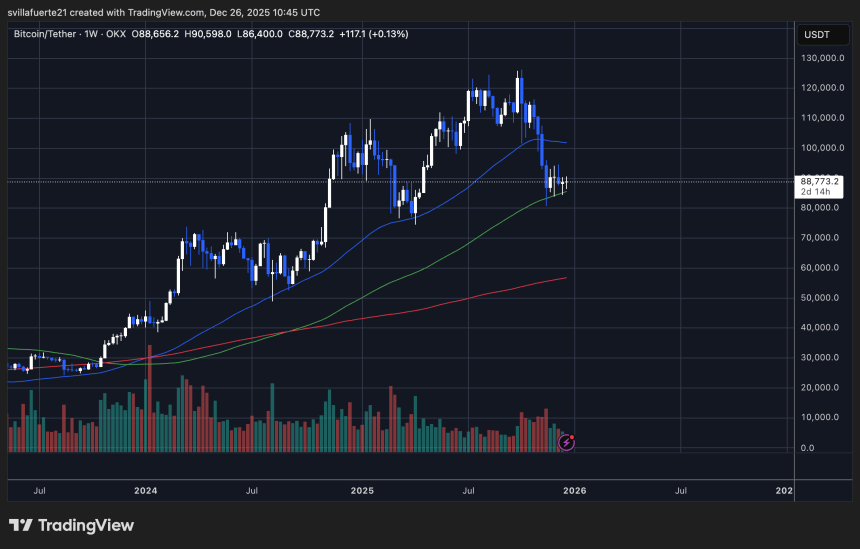
From a technical viewpoint, Bitcoin remains just above its rising medium-term moving average, which has served as dynamic support throughout this bull cycle. The rejection above $110,000 signifies a notable loss of bullish control, and the inability to quickly reclaim that range suggests a trend toward distribution rather than a mere pause. At the same time, the price remains well above the long-term moving average, indicating that this move continues to be corrective within the larger trend and has not yet confirmed a reversal.
Related Reading
Volume dynamics back this narrative. Selling pressure increased during the initial decline, but the past weeks show decreasing volume as prices stabilize between approximately $86,000 and $90,000. This suggests seller fatigue; however, buyers have yet to enter with conviction.
Structurally, the $86,000–$88,000 range is critical. Maintaining this zone preserves the higher-timeframe bullish structure. A decisive breakdown would unveil deeper declines. A recovery above $95,000 would be necessary to reinstate bullish momentum and reopen the pathway to previous peaks.
Featured image from ChatGPT, chart from TradingView.com
