

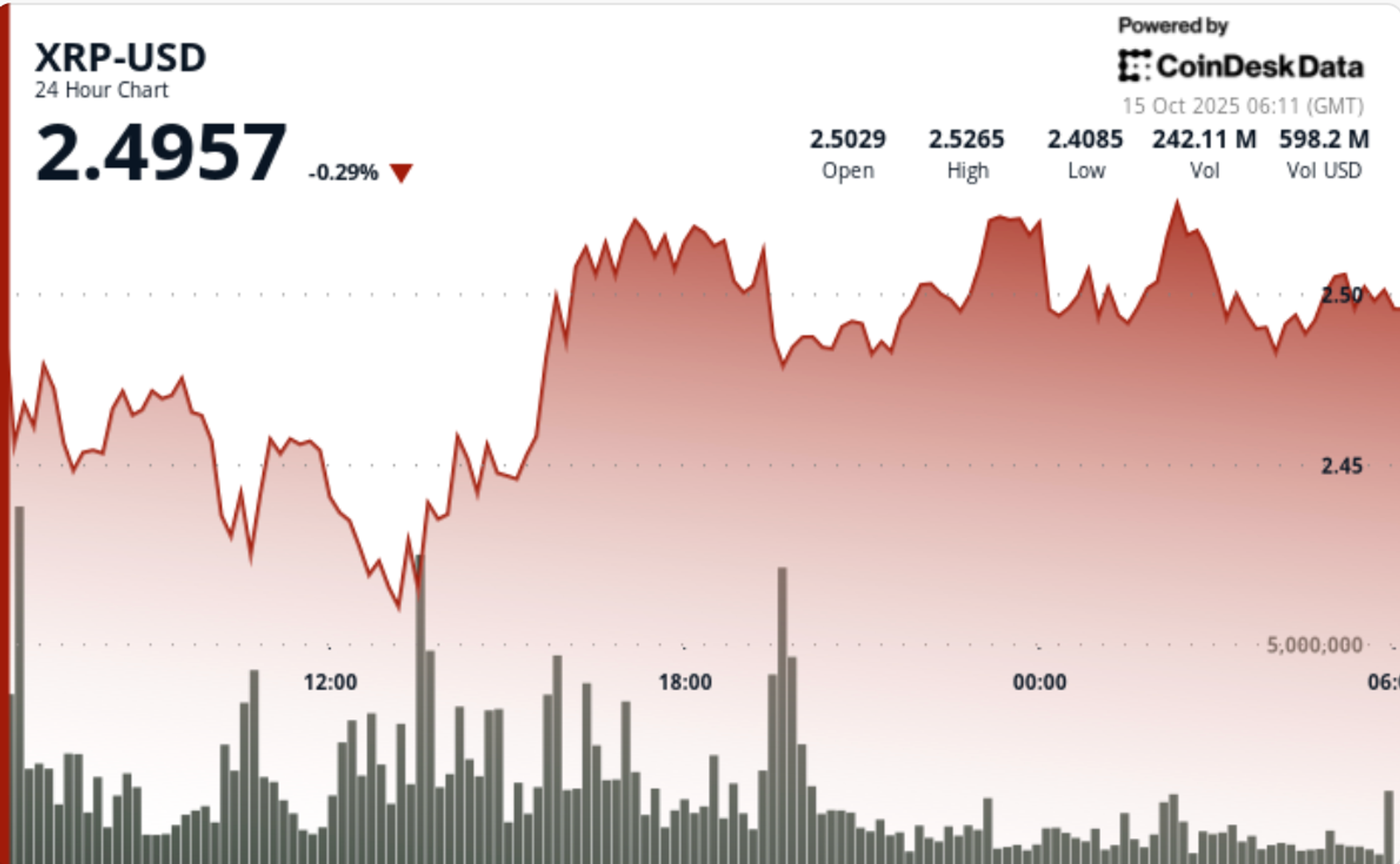
The extensive deleveraging in derivatives markets has caused XRP to dip, but buyers are stepping in to protect the $2.40 level, establishing a crucial support retest as trading heads into the Asian session.
News Context
- XRP experienced a significant decline during the October 14–15 trading period, as macroeconomic pressures combined with a widespread crypto deleveraging reduced open interest by 50% to $4.22 billion.
- In the midst of the downturn, spot trading volumes surged by 40%, indicating renewed interest from institutional investors.
- Ripple’s recent collaboration with Immunefi—a $200,000 security audit on the XRP Ledger set for October 27 to November 24—provided a stabilizing effect on market sentiment following the early session decline.
Price Action Overview
- XRP decreased by 1.97%, falling from $2.54 to $2.49, traversing a volatility range of $0.16 ($2.55–$2.39).
- Buyers consistently supported XRP within the $2.40–$2.42 range, reinforcing essential support levels after a midday sell-off.
- Trading volume surged to 179.4 million at 13:00, nearly double the average over the past 24 hours, confirming accumulation at lower levels.
- Sellers limited recoveries near $2.53, establishing a short-term resistance ceiling.
- In late trading, XRP made a slight recovery to $2.50, as buying on dips helped to stabilize order books.
Technical Review
- The $2.40–$2.42 range is pivotal for bullish traders. Repeated rebounds indicate institutional support; however, momentum remains tenuous below the $2.53–$2.55 resistance area.
- A sustained drop below $2.40 would open up downside targets at $2.33 and $2.25, while regaining $2.53 might reinvigorate a push towards the broader breakout point at $2.65.
- Volume-weighted analysis suggests accumulation amidst forced liquidations, marking a traditional base-building phase if funding conditions normalize.
Key Considerations for Traders
- Monitoring whether the $2.40 support will hold through the start of Monday’s Asian session.
- Identifying signs of re-leveraging following the significant decrease in open interest on derivatives platforms.
- Volume continuity above $2.50 to confirm accumulation trends.
- Considering macroeconomic news related to trade tensions and Federal Reserve policies as influencers of volatility.