


Prediction markets are swiftly evolving from mere crypto novelties into significant financial structures — yet regulators remain divided on whether they represent innovation or gambling.
Massachusetts’ 2025 lawsuit against Kalshi concerning NFL contracts, despite earlier CFTC approval, highlighted the growing disconnect between state and federal regulation. Simultaneously, Intercontinental Exchange’s (ICE) billion-dollar investment in Polymarket has pushed event-driven trading into the realm of mainstream finance.
Once labeled as “legalized gambling,” prediction markets are now drawing institutional investment as regulators hasten to clarify where speculation ceases and financial innovation commences.
Sponsored
Sponsored
Federal vs. State Law: Who Sets the Line?
To evaluate whether these markets signify the next stage of financial innovation or merely high-stakes speculation, BeInCrypto consulted Rachel Lin (SynFutures), Juan Pellicer (Sentora), and Leo Chan (Sportstensor). Each provided unique insights into the legal and economic dynamics influencing prediction markets as we approach 2026.
Massachusetts’ lawsuit against Kalshi’s NFL contracts unveiled a clash between federal and state oversight. The CFTC had greenlit the contracts, yet the state categorized them as unregulated gambling — a conflict that is now shaping the placement of event markets within US law.
“Investors should fundamentally trust the federal CFTC framework, which overrides state laws on derivatives and has explicitly sanctioned Kalshi’s NFL contracts. This provides nationwide clarity amidst ongoing state disputes,” stated Juan Pellicer, Head of Research at Sentora.
Leo Chan, CEO of Sportstensor, remarked that inconsistent state regulations have already caused confusion in sports-betting supervision and asserted that uniform federal guidance is necessary for both platforms and participants. Both executives concurred that a cohesive regulatory framework is vital for institutional acceptance.
Volume vs. Value: The Real Indicator of Market Health
Industry data from Dune indicates that weekly trading across major platforms has recently exceeded $2 billion, with Kalshi capturing approximately 60% of the market and Polymarket around 35%, reflecting $1.3 billion and $773 million, respectively, as token-free models dominate the overall value locked.
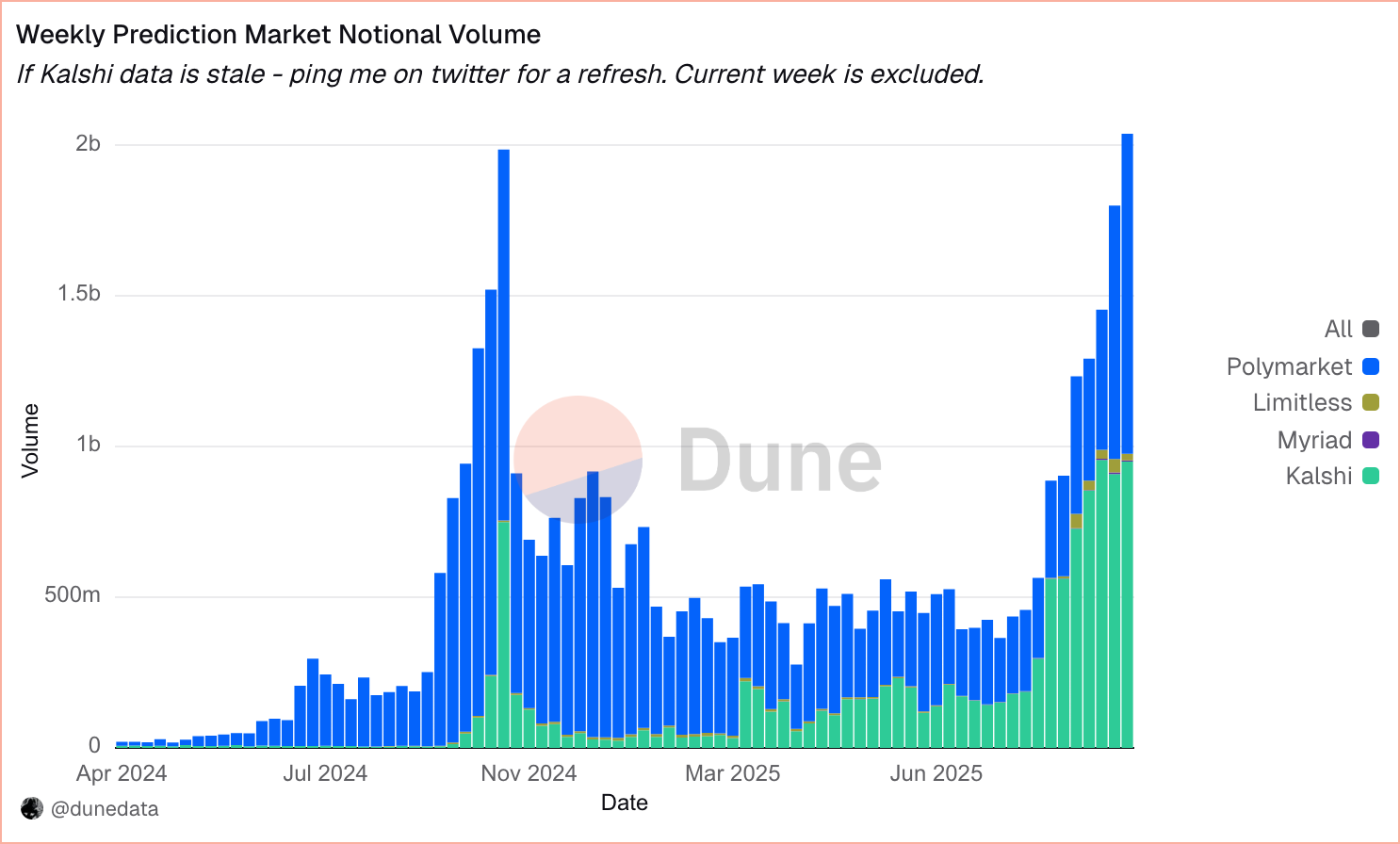
Critics argue these figures include round-trip trades that inflate activity without actual risk transfer. Industry leaders maintain that transparency needs to evolve beyond mere volume metrics.
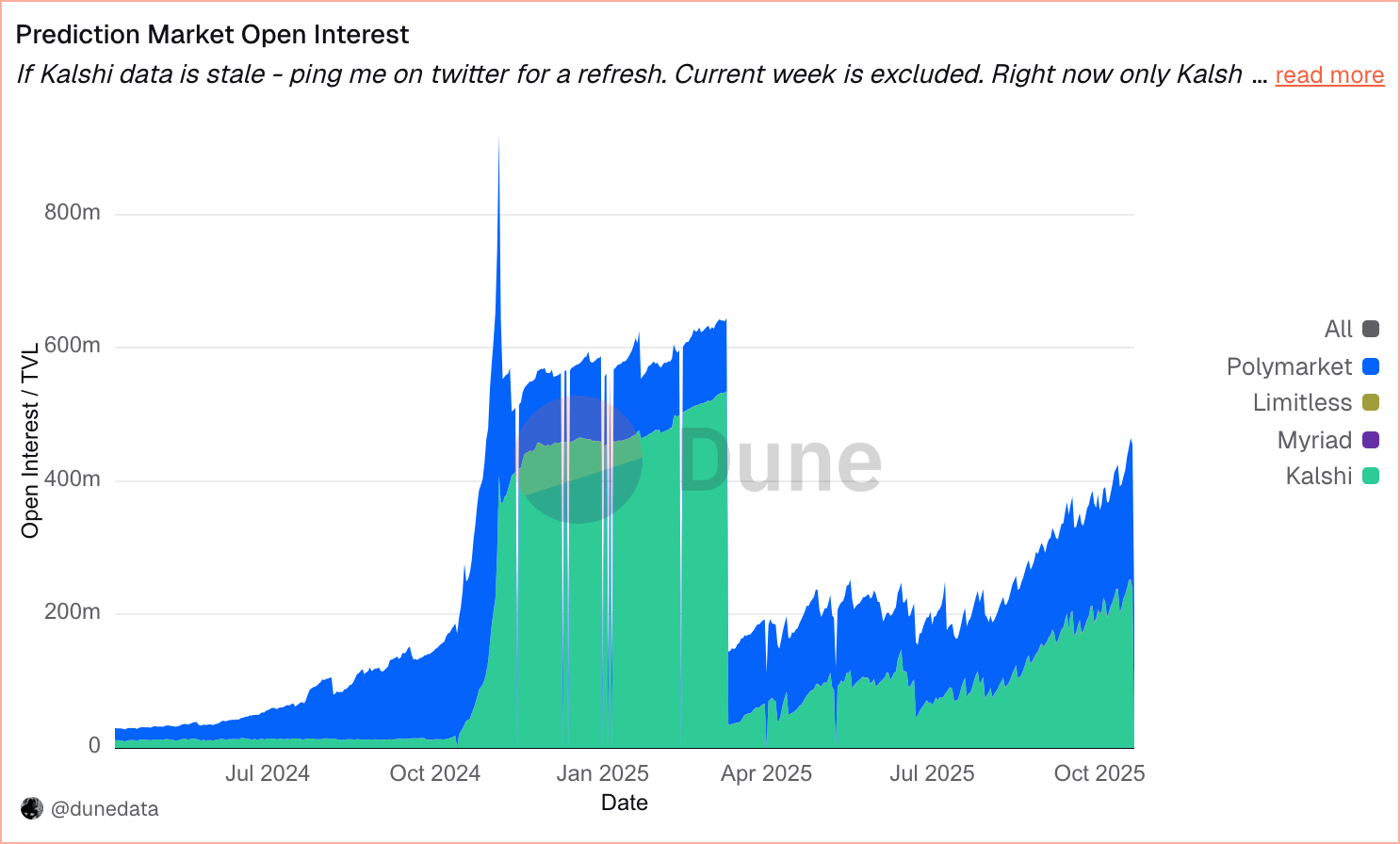
“Volume alone fails to capture economic reality,” remarked Rachel Lin of SynFutures. “We should report time-weighted open interest and net notional settled — that would demonstrate the actual risk transferred when markets resolve.”
Lin emphasized that metrics like liquidity depth, the number of unique funded traders, and retention rates help regulators and institutions differentiate genuine participation from superficial activity. Pellicer added that standardizing disclosures around open interest, trader counts, and holding periods would enhance confidence and demonstrate that these markets transfer actual risk instead of generating mere noise.
Sponsored
Sponsored
Valuations and Investor Logic
Polymarket has introduced a Finance Hub featuring “up/down” equity and index markets, and has collaborated with Stocktwits to integrate outcome forecasts directly into stock pages — transforming investor sentiment into tradable probabilities.
Kalshi’s estimated valuation of around $2 billion and Polymarket’s reported $9–10 billion have ignited discussions on sustainability. Some investors find these multiples justified due to rapid expansion; others regard them as speculative wagers on future network effects.
“These multiples are warranted due to swift scaling,” asserted Pellicer. “Kalshi’s annualized volume surged to $50 billion from $300 million last year. Prediction markets have the potential to disrupt over $1 trillion in conventional derivatives.”
Leo Chan countered that Polymarket’s valuation encapsulates its ability to reorganize information flow throughout global finance — a long-term strategy focused on monetizing collective foresight instead of immediate profits.
Sponsored
Sponsored
From Sportsbooks to Financial Infrastructure
Over 60% of Kalshi’s transactions still revolve around sports, but its future diversification will determine whether institutions regard prediction markets as genuine financial utilities. Lin asserted that legitimacy will stem from pricing outcomes that conventional finance cannot measure.
“Institutions already possess methods to trade earnings or macro events — they don’t need another,” Lin pointed out. “The true worth of prediction markets lies in quantifying what traditional finance cannot: policy decisions, technological advancements, and geopolitical risks.”
Chan observed that user adoption tends to spike during elections, major sports seasons, or breaking news events — each attracting new participants. Pellicer noted that sustainability relies on retention: achieving roughly 30% of new users remaining active enables one to call it meaningful adoption.
Polymarket has partnered with Stocktwits to launch earnings-focused markets, while X (formerly Twitter) has recognized it as an official data provider. Meanwhile, xAI has collaborated with Kalshi, broadening the reach of prediction markets beyond crypto-centric audiences.
Governance and Transparency
The IMF has warned that inadequate transparency and governance may heighten manipulation risks within fast-evolving financial markets — a concern that equally applies to prediction markets as they expand. The industry must implement institutional-grade standards for risk management, margin requirements, and transparency to establish credibility as financial utilities.
“Prediction markets require volatility-adjusted margins, real-time position disclosures, and independent audits,” Pellicer stated. “These reforms would elevate them from speculative instruments to reliable hedging tools.”
Sponsored
Sponsored
Chan concurred that prediction markets function similarly to options and should be governed within comparable regulatory frameworks. Lin underscored the importance of strategic investors — from venture capital to financial institutions — in enhancing regulatory credibility and enabling policy access.
Pellicer noted that prominent investors like Charles Schwab, Henry Kravis, Peter Thiel, and Vitalik Buterin offer both capital and legitimacy, expediting policy engagement and societal acceptance. Noteworthy backers include Founders Fund, Blockchain Capital, Ribbit, Valor, Point72 Ventures, and Coinbase Ventures — bridging the divide between crypto-native and traditional capital in this emerging “probability-data” asset class.
Global Outlook: Beyond the U.S.
Europe’s MiCA framework remains vague regarding prediction markets, while Singapore and Thailand prohibit them under gambling regulations. Nevertheless, new jurisdictions like the UAE and Hong Kong are emerging as experimental grounds for regulated growth. Chan highlighted the UK, whose balanced gambling legislation and “hyper-financialized” culture could fill MiCA’s policy void and drive early adoption.
Lin perceived global experimentation as part of a larger transformation in how economies value information. Pricing outcomes that were previously immeasurable could redefine markets — shifting from trading assets to trading knowledge. Chan proposed that this trend could pave the way for “futarchy” models, where market results rather than votes determine public policy.
Conclusion
The IMF’s July 2025 outlook anticipates a 3.0% global growth — a backdrop that favors risk assets and event markets. With clearer regulations, prediction venues may become standard hedging instruments for both institutions and retail traders.
Prediction markets are transitioning from speculative sidelines toward financial legitimacy. ICE’s investment and CFTC approval signify a maturing infrastructure, though legal fragmentation and governance challenges remain. The distinction between innovation and betting continues to be obscured — driven less by technology and more by regulatory frameworks and trust.
If transparency and oversight evolve concurrently with innovation, event contracts could become a new category of risk-pricing tools for investors and institutions alike. Until then, prediction markets find themselves at a crossroads: part experiment, part infrastructure, and an ongoing test of how finance values foresight.
