


Sure! Here’s the rewritten content while keeping the HTML tags intact:
Despite Bitcoin trading at historic highs, Michael Saylor’s Strategy continues to acquire the asset.
Summary
- Michael Saylor added 390 Bitcoins to his holdings for $43 million, averaging $111,111 each
- This marks the third Bitcoin acquisition made by the company in October
- Strategy retains its position as the leading corporate holder of Bitcoin, with a total of 640,808 BTC
While the market speculates on whether Bitcoin is overheated, Michael Saylor remains active in purchasing, reflecting his unwavering faith in BTC’s future. On Monday, September 27, Strategy disclosed the acquisition of an additional 390 Bitcoin for $43 million, at a price of $111,117 each.
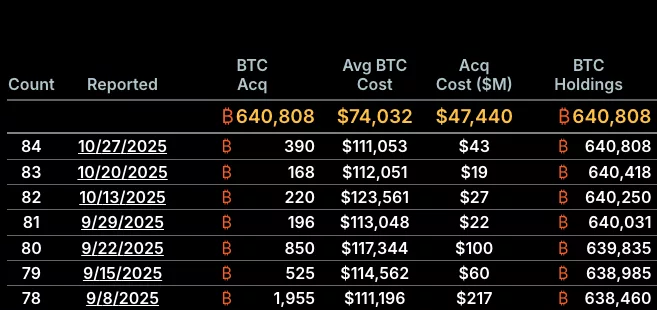
For this latest acquisition, Strategy opted for preferred stock issuance via an at-the-money program rather than utilizing cash flow or taking on debt. This approach allows the firm to bolster its Bitcoin (BTC) holdings without straining short-term liquidity, although it may potentially dilute shareholder value over time.
This was the third purchase by Strategy this month, accumulating a total of 914 BTC at an overall expense of $101 million. The average cost per Bitcoin in this set was $110,500, which stands 49% above its current average cost of $74,032.
Strategy intensifies its Bitcoin purchasing activity
Acquiring BTC near historic peaks underscores Saylor’s belief that the asset is still undervalued. Additionally, the market appears to concur, as traders responded favorably to the news. MSTR stock increased by 2.69% during trading hours on the day of the purchase, reaching $296.67.
Nevertheless, the company’s stock remains more volatile than Bitcoin itself. In the past three months, MSTR has seen a decline of 26%, attributable to continued fluctuations in the crypto markets. However, the stock has appreciated by 16% over the past year.
Strategy maintains its status as the largest corporate Bitcoin holder, with 640,808 BTC. This amount signifies 3% of the total available BTC supply, capped at 21 million, and over 5% of its circulating supply, currently at 19.5 million.
