


Japan has officially entered the regulated stablecoin era with the introduction of JPYC EX, the nation’s first fully licensed digital yen under the updated Payment Services Act. This achievement highlights a significant moment for Japan’s financial landscape, connecting traditional banking infrastructure with the Web3 domain.
Related Reading
Building on previous iterations of JPYC, the new JPYC EX is crafted to function as a compliant, yen-backed stablecoin, linking the country’s banking network to blockchain-based commerce, DeFi solutions, and cross-border transactions. With complete legal backing and asset support, it positions the yen as a future key player in global digital finance.
As per CryptoQuant, the total stablecoin market capitalization has now exceeded $150 billion, serving as the essential backbone of liquidity for crypto markets, DeFi protocols, and worldwide transactions. Analysts from Citi and Bloomberg predict this figure could rise to between $1.6 and $4 trillion by 2030. Amid this swift growth, JPYC is anticipated to capture about 2% of the market, yielding a valuation of approximately $70 billion.

A Fully Regulated Digital Yen Bridging Japan’s Finance and Web3
What sets JPYC EX apart from other stablecoins is its blend of regulatory transparency, asset support, and technological flexibility. Each token is fully collateralized by domestic bank deposits and Japanese government bonds, ensuring complete transparency and stability. This framework positions JPYC EX as one of the globe’s most legally sound stablecoins—a model for compliance-driven innovation in digital finance.
Built on Ethereum, Polygon, and Avalanche, JPYC EX facilitates instant yen transfers with nearly zero fees, making it a valuable tool for both businesses and individuals. It supports commerce, payroll, peer-to-peer payments, and DeFi applications, delivering blockchain efficiency without compromising legal or operational protections.
Related Reading
JPYC EX also closely aligns with Japan’s digital transformation agenda, which seeks to integrate traditional finance with next-gen Web3 systems. By functioning as a settlement layer for e-commerce platforms, NFT marketplaces, and international transactions, the stablecoin enables instant yen transfers across Asia, reducing costs and enhancing accessibility for global trade.
Looking forward, analysts predict JPYC’s market valuation could achieve $70 billion by 2030, representing nearly 2% of the worldwide stablecoin market. This growth potential emphasizes Japan’s aspiration to designate the digital yen as a fundamental element of the decentralized global economy. With its mix of regulatory confidence, technological accuracy, and international reach, JPYC EX may transform the operation of national currencies in the Web3 age.
Stablecoin Dominance Shows a Cooling Phase After Recent Surge
The chart indicates that stablecoin market dominance currently rests around 8.31%, following a sharp increase earlier in October that elevated the ratio above 9%. This level often indicates heightened demand for liquidity and security, as traders shift capital into stable assets during market uncertainty.
In recent months, dominance has climbed steadily from the 7.3%–7.5% range, reflecting a cautious mood as Bitcoin and major altcoins experience selling pressure. However, the recent downturn suggests that some funds are beginning to flow back into riskier assets, potentially signaling an early stage of market stabilization.
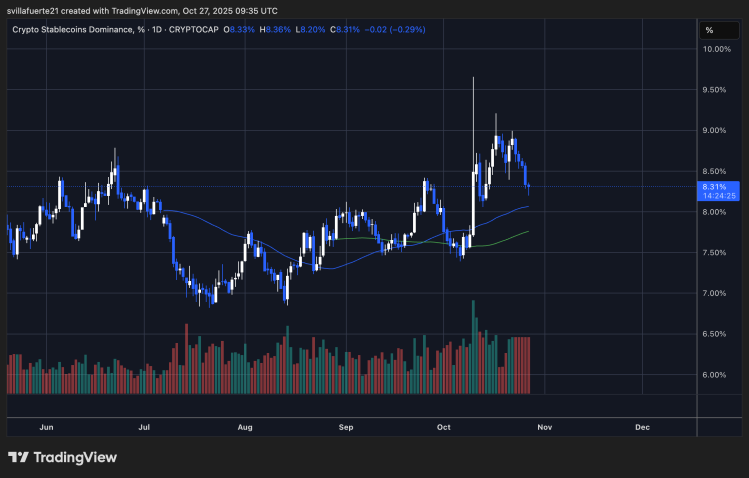
Technically, the dominance remains above both the 50-day and 200-day moving averages, signaling a larger uptrend in liquidity management. If this level holds, it could act as a buffer during ongoing volatility. Conversely, a consistent drop below 8% might imply that traders are reallocating capital into crypto assets, potentially fueling short-term rallies.
Related Reading
Stablecoin dominance continues to remain high—a sign that market participants still favor holding liquid assets. Until dominance begins to show a more definitive decline, this cautious approach is likely to persist, highlighting the market’s delicate balance between risk-averse behavior and the readiness to re-enter into volatile assets.
Featured image from ChatGPT, chart from TradingView.com
