


Bitcoin has recaptured the $88,000 mark, providing a brief sense of stability following weeks of volatile price movements. Nonetheless, the overall landscape remains delicate. Since early December, BTC has struggled to move past the $90,000 barrier, which continues to limit upward attempts and foster market uncertainty.
Related Reading
Compounding the cautious outlook, CryptoZeno, a CryptoQuant analyst, highlights miner behavior as a rising short-term risk factor. His analysis indicates that Bitcoin miner outflows are signaling increasing sell-side pressure, a phenomenon that has historically been significant during times of weak momentum.
The data reveals a clear correlation between miner activity and short-term price fluctuations. Sudden spikes in total miner outflows—particularly when large quantities of BTC are sent to exchanges—often coincide with price pullbacks rather than sustained rallies.
Miners are often viewed as informed market participants, typically operating with relatively low cost bases. An increase in their distribution activities can introduce additional supply during periods when spot demand is already struggling to cope with selling pressure. While miner outflows alone do not indicate a broader market peak, they can exacerbate short-term weakness, especially in the current range-bound conditions Bitcoin is experiencing.
Miner Outflows Reinforce Short-Term Downside Risks
The report outlines that recent surges in Bitcoin miner outflows have often been followed by immediate or near-term price declines, reinforcing the connection between miner behavior and short-term market dynamics. These events suggest that miners—considered informed participants with relatively low production costs—are actively distributing supply during periods of market strength or heightened uncertainty.

While miner selling on its own doesn’t indicate a macro market top, it often adds additional supply at critical moments, increasing short-term pressure when liquidity is low or spot demand struggles to absorb new inflows.
CryptoZeno also notes that increased miner outflows typically reflect a mix of factors. These include profit-taking after rallies, the need to cover operational expenses, or a defensive strategy against weakening price structures. From an on-chain perspective, this behavior is not uncommon during corrective or range-bound phases.
However, when miner transfers to exchanges cluster closely in time, their effect becomes more pronounced. Concentrated outflows can significantly elevate sell-side pressure on exchanges, increasing the likelihood of corrective price shifts rather than sustained upward movement.
At the macro level, miner distribution becomes particularly impactful when paired with broader challenges. Neutral or declining risk appetite, tighter liquidity conditions, or softening derivatives sentiment all diminish the market’s ability to absorb additional supply. In such contexts, selling driven by miners is less likely to be smoothly managed and can instead exacerbate downside volatility, keeping Bitcoin vulnerable in the near term.
Related Reading
Bitcoin Struggles Below Key Resistance
Bitcoin is trading within a narrow consolidation range after failing to reclaim the $90,000 level, as depicted in the daily chart. Following the sharp decline in November, price found support in the $85,000–$87,000 zone, where selling pressure began to lessen and volatility reduced. Since then, BTC has been moving sideways, indicating indecision rather than a clear trend reversal.
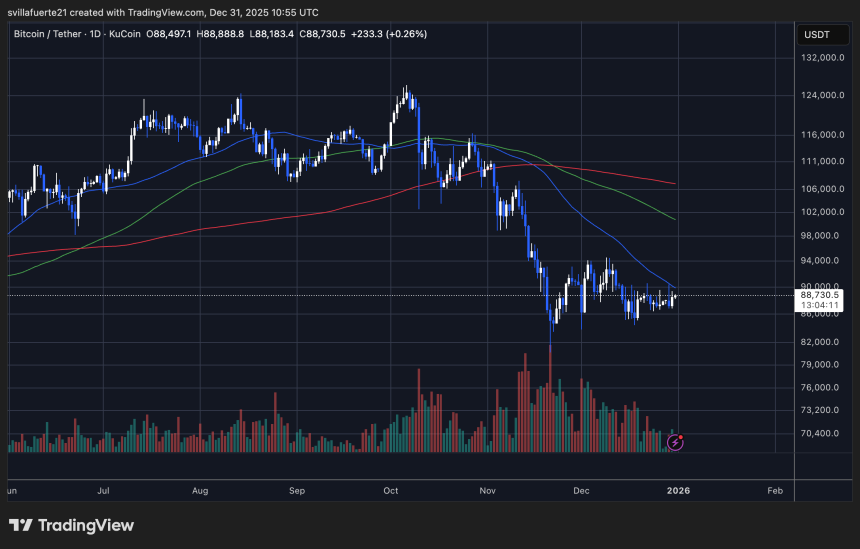
From a technical standpoint, Bitcoin remains constrained below its declining short-term moving averages. The 50-day moving average continues to trend downward, serving as dynamic resistance. Both the 100-day and 200-day moving averages are positioned well above the current price, reinforcing an overall bearish structure. As long as BTC remains below these levels, attempts for upward movement are likely to be met with selling pressure rather than sustained success.
Related Reading
Following the heavy sell-off in November, trading volume has gradually decreased. This implies that aggressive sellers have stepped back, yet new demand has not yet emerged with conviction. This is typically indicative of a stabilization phase rather than the onset of a new impulsive move.
Structurally, Bitcoin appears to be forming a base, but confirmation is still lacking. A daily close above $90,000 could signal a significant shift in momentum and open the door for a recovery toward higher resistance levels. Conversely, if the $85,000 support area is breached, BTC may face another downward leg. At present, the chart reflects balance, hesitation, and a market on the lookout for a catalyst.
Featured image from ChatGPT, chart from TradingView.com
