


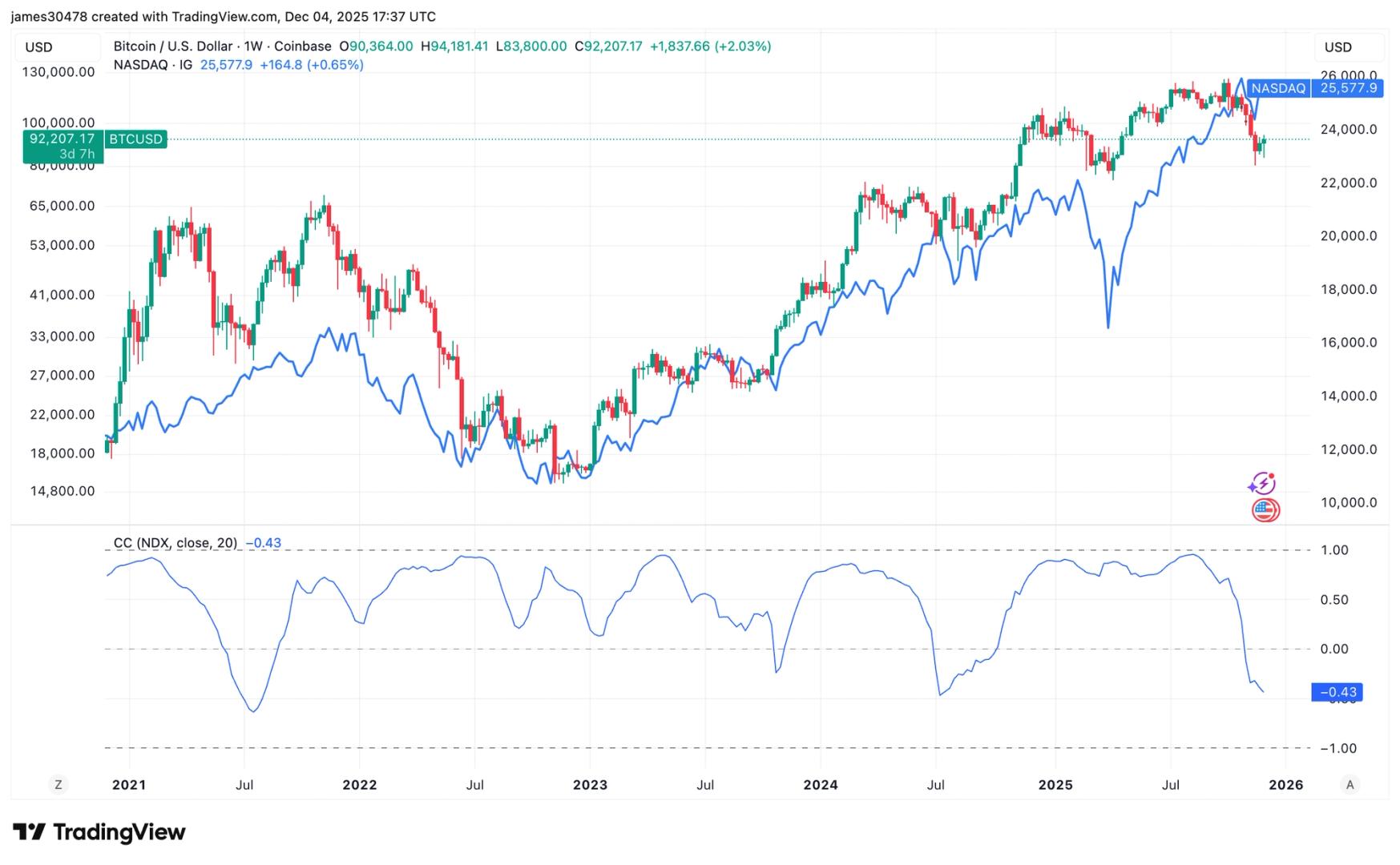
Bitcoin has started to display distinct behavior compared to traditional risk assets, potentially hinting at a significant development.
The negative correlation observed between bitcoin and the Nasdaq 100 often aligns with market bottoms for bitcoin, and the current situation mirrors several prior pivotal moments.
This marks the fourth occurrence in the last five years where the two assets have entered negative territory in a 20-day correlation coefficient, now resting at -0.43. This pattern resembles the negative correlation periods witnessed during the summer of 2021 and August 2024, both associated with notable bitcoin lows. Even though bitcoin is often characterized as a leveraged tech asset that tends to excel in risk-on phases and lag in risk-off phases, the present divergence stands out.
Bitcoin has experienced a decline of up to 36% from its all-time high in October. In contrast, the Nasdaq 100 saw a maximum drop of a mere 8% and currently trades only 2% off its record peak. Bitcoin has not yet rebounded like the broader tech sector, presently sitting 27% below its historic high.
The last instance of negative correlation occurred during the unwinding of the yen carry trade, which drove bitcoin down to approximately $49,000, ultimately marking a local bottom. Prior to that, negative correlation was seen in September 2023 when bitcoin traded just under $30,000, followed by a rally to $40,000 by the year’s end. The initial occurrence happened in May 2021 amid the China mining ban, during which bitcoin fell from $60,000 to $30,000 before reaching new heights in November 2021.
Collectively, these instances indicate that the negative correlation between bitcoin and the Nasdaq 100 frequently arises near crucial turning points for bitcoin. While the current setup hints at another possible bottom, the timing of any recovery remains uncertain.
