


The price of Bitcoin remained under pressure on Thursday, as U.S. spot Bitcoin exchange-traded funds faced net outflows for the fifth consecutive day.
Summary
- Bitcoin ETFs experienced over $825 million in outflows during the last five trading days.
- Investors are cautious ahead of a significant BTC options expiry on Deribit set for Friday.
- A bearish flag pattern has been noted on the daily chart.
According to SoSoValue data, the 12 spot Bitcoin ETFs saw $175.29 million in net outflows on Christmas Eve, Dec. 24, led by BlackRock’s IBIT, which saw $91.37 million exit.
Grayscale’s GBTC and Fidelity’s FBTC followed with smaller outflows of $24.6 million and $17.1 million, respectively. The other ETFs accounted for a cumulative outflow of $42.1 million. Remarkably, none of the BTC ETFs attracted inflows on that day.
Wednesday’s outflows marked five straight days of declines, with over $825 million flowing out of the funds. This month alone has seen nearly $804.33 million in withdrawals, potentially rising to over a billion if institutional interest continues to falter.
However, as of the latest update, December’s figures still fall short compared to the $3.5 billion in outflows noted in November.
Market analysts suggest that the poor performance of the ETFs is likely linked to the Christmas holiday season, with expectations for improvement afterward.
Additionally, investors appear to be exercising caution as they prepare for the expiry of approximately $23.6 billion worth of Bitcoin contracts on Deribit tomorrow, Dec. 26, marking one of the largest expiries in the exchange’s history.
Meanwhile, well-known analyst Ted Pillows pointed out that the U.S. has now become the largest seller of Bitcoin, contrasting with the Asian market, which continues to buy the primary crypto asset.
“Much of the selling is attributed to tax-loss harvesting, which is expected to conclude within a week,” remarked fellow market analyst Alek Carter in a separate post on X.
Recently, Bitcoin (BTC) declined from a recent high of $90,168 to $87,152 on Tuesday, subsequently trading within a range of $86,000 to $88,000. As of this writing, it was priced at $87,750, remaining nearly 30.4% below its all-time high reached in October.
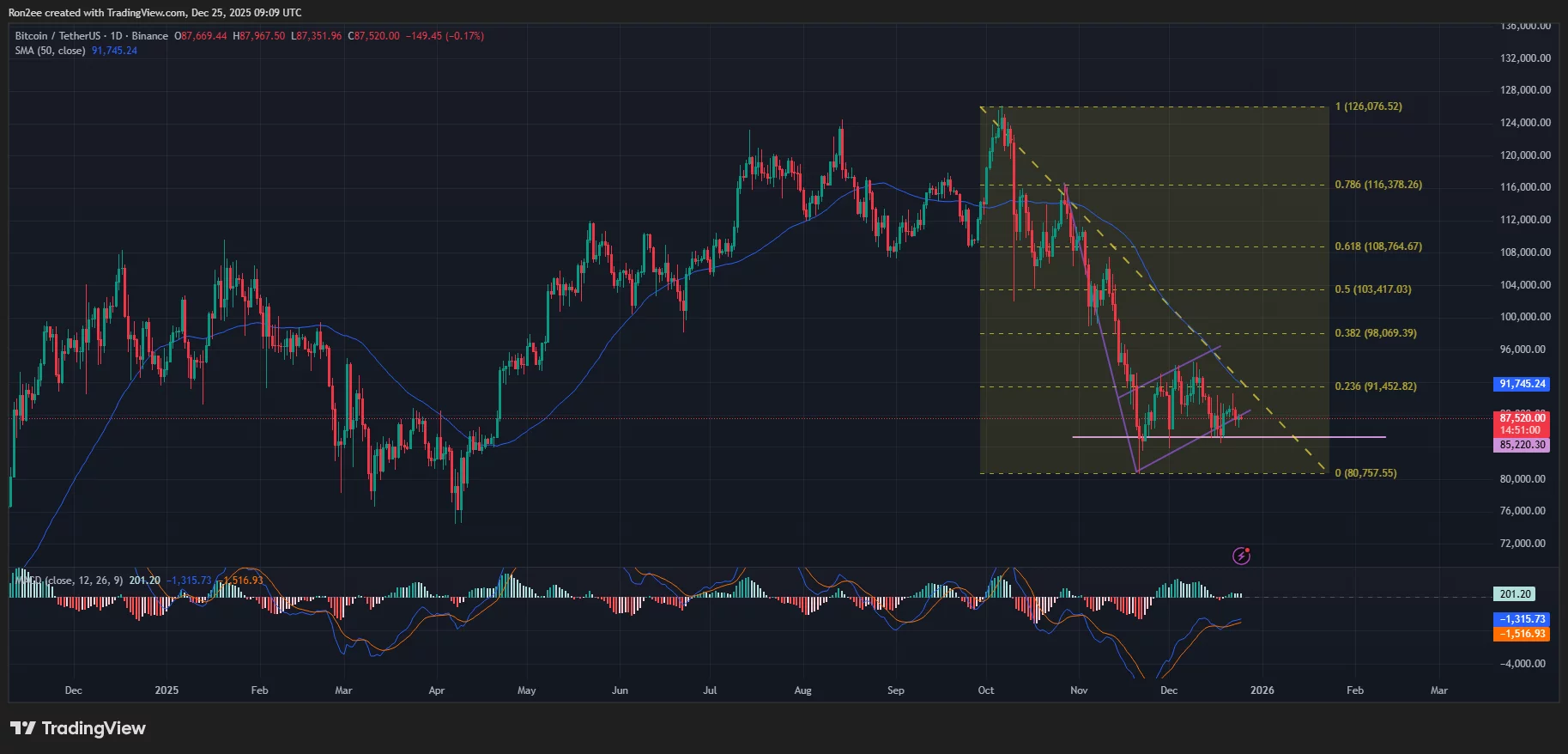
Technically, Bitcoin is trading below its 50-day SMA, indicating bearish short-term momentum. This is further supported by the MACD, which signals diminishing buying pressure as the MACD line remains below the signal line.
Additionally, Bitcoin is approaching a potential breakdown from a bearish flag pattern observed on the daily chart, typically signaling a period of sustained downside in the near term.
Currently, traders are monitoring the $85,200 level, which has served as a strong demand zone this month. A decline below this level could lead to a drop towards the Nov. 21 low of $80,757.
Disclosure: This article is not intended as investment advice. The content and materials presented here are for educational purposes only.
