


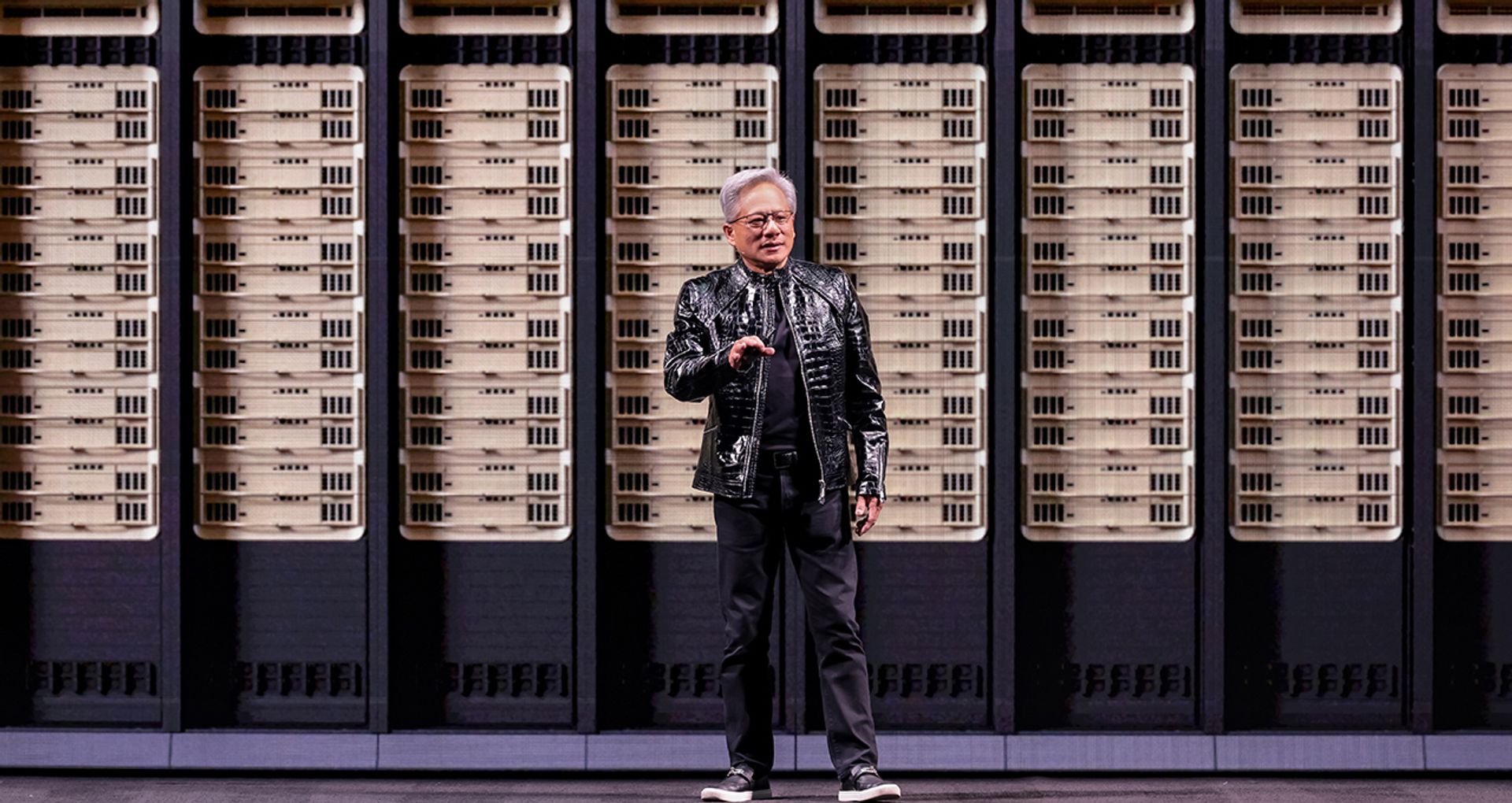
Nvidia CEO Jensen Huang announced that the company’s next-generation Vera Rubin platform is already in “full production,” revealing new details at the CES technology event in Las Vegas regarding hardware that can deliver five times the artificial-intelligence computing power of Nvidia’s previous systems.
Rubin is anticipated to launch later this year and is specifically designed for the rapidly growing sector of the AI industry, facilitating outputs from trained models.
Huang stated that Rubin’s premier server will feature 72 of Nvidia’s graphics processing units and 36 central processors, which can be connected into larger “pods” containing over 1,000 Rubin chips.
A significant focus was on efficiency. Huang mentioned that Rubin systems could enhance the efficiency of generating AI “tokens”—the fundamental units produced by language models—by about 10 times, aided by a proprietary data type that the company hopes the broader industry will adopt. He noted that this performance increase comes with only a 1.6-times rise in transistor count.
Huang characterized AI development as a competitive race where faster processing leads to achieving the next milestone more rapidly, compelling competitors to invest heavily in chips, networking, and storage.
How bitcoin miners are affected
This infrastructure race is also transforming segments of the crypto market.
Bitcoin miners have increasingly positioned themselves as power-and-rackspace operators rather than solely crypto businesses, marketing their energy contracts, cooling capabilities, and data-center resources to AI clients.
Hosting AI workloads can yield more consistent cash flows than bitcoin mining during downturns, particularly for firms with low-cost power, established facilities, and cooling systems.
However, the AI surge also heightens the stakes. Data-center space is becoming a valuable asset, and top locations are being driven up by hyperscalers, cloud companies, and AI startups.
This can increase rents, equipment expenses, and financial barriers for smaller miners. In essence, miners that function as infrastructure firms may thrive, whereas those depending on basic mining margins could face a difficult 2026.
Additionally, Nvidia spotlighted new networking switches utilizing a connection technology known as co-packaged optics, which is vital for linking thousands of machines into a single system.
The company mentioned that CoreWeave will be among the first to implement Rubin systems and anticipates that Microsoft, Oracle, Amazon, and Alphabet will also adopt them.
