


Bitcoin (BTC) traders are expecting a local bottom to form in mid-November, as the 50-day simple moving average (SMA) approaches crossing below the 200-day SMA near $100,000—a scenario that has historically indicated local bottoms.
Additionally, some analysts are examining lunar phases alongside price charts, observing that First Quarter moons often precede rallies that extend into Full or Third Quarter moons. These diverse approaches, combining classic technical analysis with lunar phase timing, are gaining interest as Bitcoin tests crucial support levels.
Death Cross and Key Support Levels Indicate November Bottom
The anticipated convergence of Bitcoin’s 50-day and 200-day SMAs, referred to as a death cross, is projected to occur in mid-November near $100,000. Historically, this pattern signals local bottoms without necessarily indicating long-term downturns.
Sponsored
Sponsored
According to Binance’s analysis, the average price change one month after a death cross is only -3.2%, which challenges the notion that it reliably initiates persistent bear markets.
Analyst Colin asserts that the lowest plausible level for Bitcoin in this bull market cycle is around $98,000, coinciding with substantial support zones. This also aligns with the 50-week SMA, which has provided support since Q1 2023.
Binance data from October 2025 shows that the 50-week SMA is approximately $101,700, a significant level during the ongoing bull market.
Since Q1 2023, Bitcoin has consistently closed weekly candles above the 50-week SMA, as pointed out by analyst Ted Pillows in his October post. This level, currently around $102,800, is crucial for maintaining the bull run.
A weekly close below this critical support could signify a potential downturn in market structure.
Sponsored
Sponsored
Rising Wedge Formation Could Lead to 15-35% Dip
Despite optimistic long-term indicators, Bitcoin’s weekly chart currently shows a rising wedge, a bearish pattern characterized by converging trendlines that signal diminishing momentum.
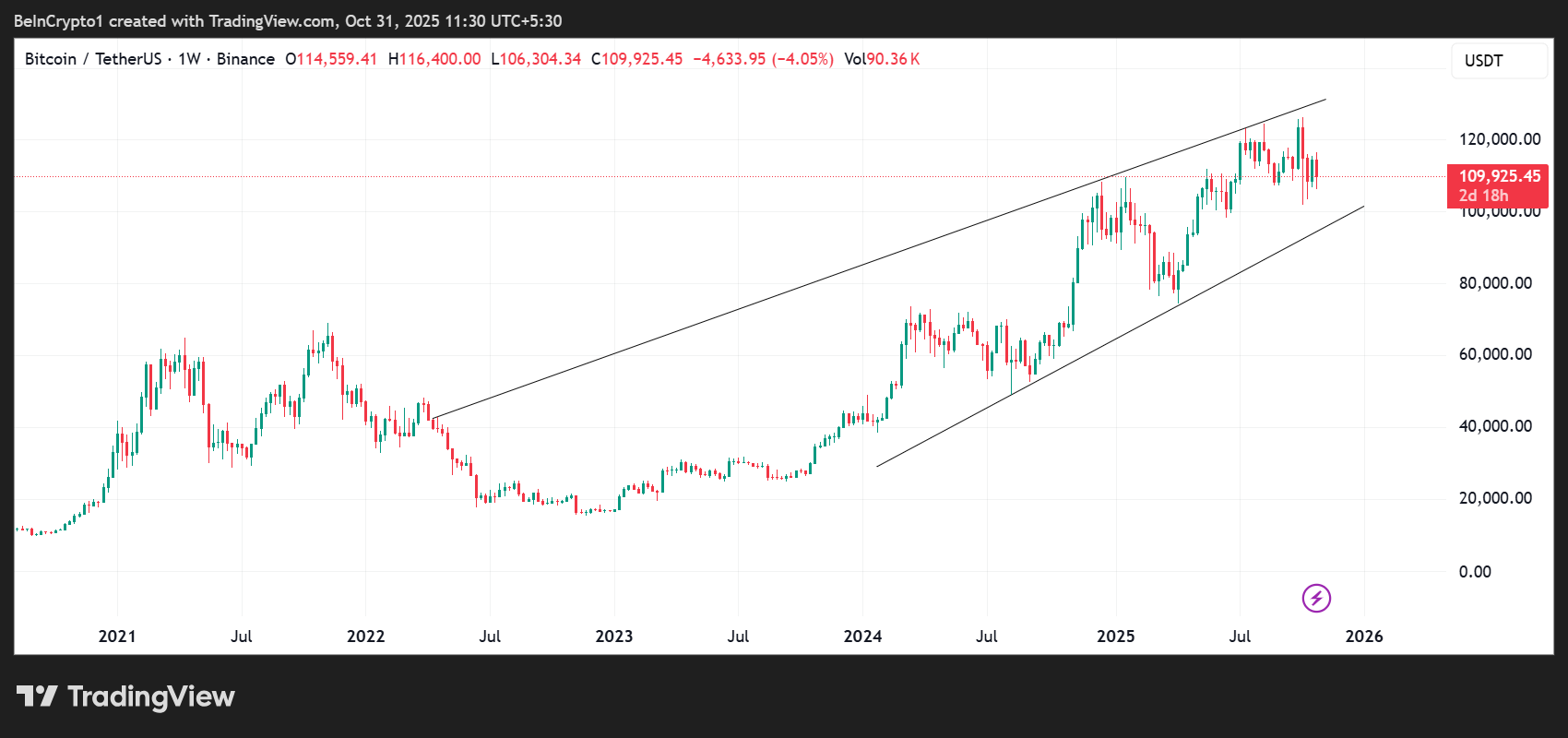
Historically, this setup has led to declines between 15% and 35%, as observed in both 2018 and 2021. This pattern indicates weaker buying pressure at progressively higher prices within a tightening range.
Nonetheless, the overall bull market pattern persists. Bitcoin continues to register higher lows and higher highs within a rising channel since 2022.
Historically, rebounds from the lower boundary of the channel have increased by 60% to 170%. Some analysts maintain a price target of $170,000 or higher, citing this robust uptrend and the absence of traditional overbought cycle signals observed at macro tops.
The current sideways trading range of $105,000 to $110,000 is viewed as a period of consolidation rather than a breakdown in the market.
Colin’s analysis suggests that the market is testing holders’ resolve, particularly for altcoin investors, as the cycle extends beyond a typical Q4 peak. He notes that in the recent bear market, Bitcoin’s low of $15,000 fell below the previous cycle’s high of $20,000, marking a first for the digital asset.
Sponsored
Sponsored
Lunar Cycle Observations Add to Bullish Case
Some traders are correlating Bitcoin’s price actions with lunar phases. Analyst LP_NXT shared an analysis demonstrating that when Bitcoin’s movements are aligned with moon cycles, a distinct pattern emerges for 2025.
First Quarter moons, including the recent event on October 29, have often coincided with the initiation of upward trends that extend into the Full or Third Quarter moon phases.
The First Quarter moon on October 29, 2025, could potentially align with a bullish trajectory according to this theory. This timing aligns with technical perspectives suggesting that mid-November may signify a local bottom.
Proponents attribute these cycles to recurring market psychology rather than superstitious beliefs. Although lunar phase analysis lacks the rigor of established technical tools, its prevalence among traders illustrates the variety of strategies employed in the crypto markets.
Sponsored
Sponsored
The confluence of lunar timing, established support levels, and moving average crossovers makes November 2025 a significant point of interest for traders.
Bullish Structure Holds as Market Consolidates
The current market scenario juxtaposes short-term bearish technical indicators with long-term bullish momentum. Colin’s analysis emphasizes the necessity for patience, suggesting that market shakeouts may occur for those anticipating a conventional Q4 peak.
He advocates holding Bitcoin until a new all-time high is achieved, possibly rotating into altcoins using gains realized in Bitcoin a few weeks later.
The so-called death cross, while typically perceived as negative, functions more as a lagging confirmation within Bitcoin’s historical context.
Meanwhile, Ledger’s educational resources indicate that it often signals capitulation (exhausted selling and reversal) rather than predicting significant movements in advance.
As October 2025 concludes, Bitcoin’s capacity to stay above the 50-week SMA will dictate the trajectory of the bull market.
The mid-November timeframe, suggested by both moving average analysis and lunar timing, presents traders with an opportunity for potential accumulation. Regardless of whether traditional or unconventional methods prove accurate, November 2025 is poised to be a pivotal period for Bitcoin price movements.
