Disclosure: The opinions expressed here are solely those of the author and do not reflect the views of crypto.news’ editorial team.
The field of artificial intelligence has experienced remarkable growth over recent years. A report from the Guardian noted that in 2025 alone, Big Tech invested over $155 billion in AI, as companies compete for dominance in the sector.
Summary
- AI’s missing element — While it can diagnose illnesses and compose poetry, it lacks genuine awareness, which necessitates reflection, context, and personal experience.
- Decentralized AI, built on blockchain, allows agents to share knowledge, learn in real-time, and evolve collectively rather than being confined to corporate structures.
- From warehouse robotics to delivery drones, blockchain could enable machines worldwide to exchange real-world experiences instantaneously.
- By 2025, 85% of companies will be utilizing AI agents, but only collaborative, open data layers can avert repeated errors and enhance learning.
- Trust through transparency — Blockchain’s unchanging records make AI decision-making visible, facilitating public verification and building trust in autonomous systems.
Despite significant investments, which notably exceed federal spending on employment, education, and social services during the same timeframe, some critics argue that AI development is too slow. There’s still a crucial element missing.
While it might identify various cancers, it doesn’t understand pain. It can craft sonnets but lacks real inspiration. This gap between AI and true understanding delineates the boundaries of current technology.
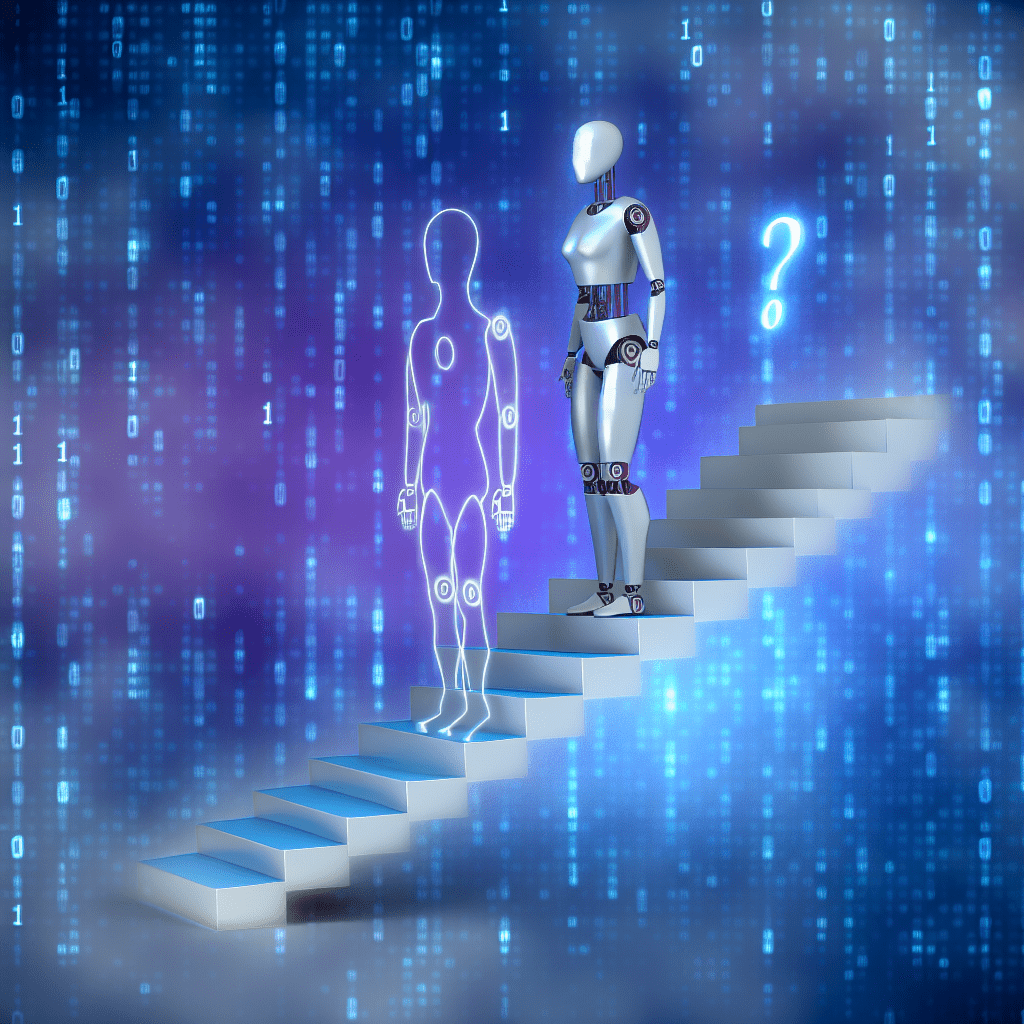
Yet, genuine awareness demands more than computational prowess; it requires self-awareness, contextual comprehension, and personal experience. How can we embed these qualities into AI agents? This is where blockchain becomes relevant, and decentralized AI is a probable solution.
This model of artificial intelligence is developed and managed on distributed infrastructure rather than dominated by a single entity. It facilitates collaboration among developers, users, and even autonomous AI agents to learn from one another within a shared network.
The spiral dynamics connection
In the 1970s, theorists Don Beck and Christopher Cowan crafted a human development and societal evolution model called Spiral Dynamics, inspired by previous work from psychology educator Clare Graves.
They posited that human consciousness evolves through various fluid stages of psychological and cultural complexity that arise as societies adjust to changing circumstances.
At its core, societies consist of people collaborating to solve problems. Beck and Cowan categorized these stages into color-coded levels from beige, which represents instinctual survival groups, to yellow, which denotes integrated communities valuing holistic and systematic solutions.
In relation to AI, most centralized large language models (LLMs) remain anchored in early development stages. They operate as isolated systems trained on static datasets, limiting their capacity for real-time growth.
However, blockchain technology, particularly within a DeAI framework, holds the potential to change this paradigm. Instead of merely exchanging datasets, agents would contribute to a collective knowledge pool, allowing both companies and individuals to train AI models independently of any central authority.
This continuously refreshed and verified database could steer AI towards a model resembling shared intelligence.
Why centralized AI falls short
It’s evident that centralized AI has limitations as it operates within restrictive boundaries. Each dataset could be owned by a single corporation, and any modifications would hinge on engineers retraining the model in a closed environment before making changes public.
This doesn’t mirror human learning, as previously mentioned. Every interaction is significant, and every error presents an opportunity for growth.
Can blockchain-based AI achieve similar outcomes? Quite possibly. It would enable agents to share verified information and contribute actively without waiting for a central authority to authorize changes.
In a DeAI system, this collaborative process is automatic, with every node contributing to training machine learning models. This can be achieved through federated learning, where nodes utilize their own data to train models, sharing model updates rather than raw data, while every exchange enhances a shared intelligence ledger visible to the entire network.
However, speed is meaningless without trust. Blockchain maintains a public record of all activities, and since these records are immutable, they could provide AI with learning pathways that endure. With no ties to any singular company’s narrative, AI could discern the origin of information, filter out noise, and adapt more swiftly.
Another area that requires exploration is embodiment. Human awareness is shaped by interactions with the physical world via our senses, and AI should not face major hurdles in this regard.
Reports indicate that robots developed by companies like Boston Dynamics navigate unpredictable environments, while neural implants such as Neuralink are bridging biological and digital intelligence. Blockchain could facilitate further advancements. For instance, instead of merely training a warehouse robot to dodge obstacles, imagine it possessing sensors that could “feel” and learn from each slip, bump, or near-miss.
Now envision if that experiential data could be instantly shared within a decentralized AI structure, empowering machines like urban delivery drones globally. This would culminate in a worldwide network of embodied knowledge. The information wouldn’t remain localized; rather, it would integrate into a broader network of agents, enabling machines to teach one another in real time and evolve as a cohesive distributed entity.
This evolution would exceed the capabilities of traditional machine learning. It would transform AI from a passive rule-following system into one that continuously adapts.
As this transformation gains traction, it could naturally lead to the emergence of novel autonomous AI agents, able to make informed decisions and act based on real-time shared intelligence.
The incoming surge in AI agents
Current statistics suggest that an increasing number of businesses are implementing such tools. A recent report from Warmly predicts that by the end of 2025, approximately 85% of global companies will rely on AI agents for daily operations. Unlike today, where these tools are primarily used for generating text or images, they will be tasked with negotiating contracts, managing workflows, and making autonomous decisions.
However, a potential obstacle may emerge: progress will stagnate if each enterprise confines its agents behind firewalls. They will replicate the same errors concurrently, squandering time and resources.
Fortunately, blockchain can disrupt this cycle. An integrated, decentralized data layer would allow AI agents to benefit from millions of interactions simultaneously. This would enable them to adopt superior strategies almost instantaneously, mirroring how humans learn more effectively in collaborative environments compared to isolation.
Can blockchain trigger AI consciousness?
This raises a significant question: Can blockchain-integrated AI agents achieve a state of consciousness? While it’s uncertain, since human consciousness remains inadequately understood, if defined as the ability to collectively process information, adapt, and exhibit emergent behaviors, then yes, blockchain can propel AI in that direction.
Imagine a network of thousands of agents, each enhancing its capabilities and sharing updates on-chain. A single insight would not disappear; it would proliferate. Over time, these patterns could begin to represent what some might term “meta-intelligence,” a level of awareness unattainable by any single model, company, or server.
Moreover, blockchain will enhance transparency. Within such networks, every decision, data point, and interaction is permanently recorded and accessible to all.
This visibility could fundamentally alter how humans engage with AI. Instead of wondering about how a model reached a conclusion, they could trace the reasoning chain and verify sources. Additionally, they could evaluate results against public data.
For AI agents, transparency would equate to an extensive library of validated strategies. For instance, when one agent resolves an issue, others can quickly learn from that experience without duplicative efforts. This compounding effect could exponentially hasten development in ways that centralized systems cannot replicate.
Why it matters now
AI is infiltrating every sector—finance, healthcare, logistics, creative industries—just as public trust begins to wane. Concerns about bias, manipulation, copyright infringement, and the risk of surrendering control to opaque systems grow increasingly prevalent.
While blockchain may not address all these issues, it provides a groundwork for AI development that evolves transparently, rather than in secrecy. That openness could be pivotal in differentiating between trustworthy AI and that which incites fear.
If DeAI begins to exhibit signs of collective intelligence, a new question will arise for users: not whether AI can become conscious, but how they will choose to engage with it once that occurs.
Blockchain encompasses more than a financial ledger; it represents a framework for shared knowledge. If society wishes for AI to evolve similarly to humans—not confined but interconnected—they will necessitate that kind of open infrastructure.
The alternative is a future dominated by silos, closed models, sluggish updates, and recurring errors.
A decentralized approach, while not flawless, grants AI something it has historically lacked: the capability to learn collaboratively, transparently, and at scale. This could represent the initial real stride towards what some may audaciously label consciousness.