

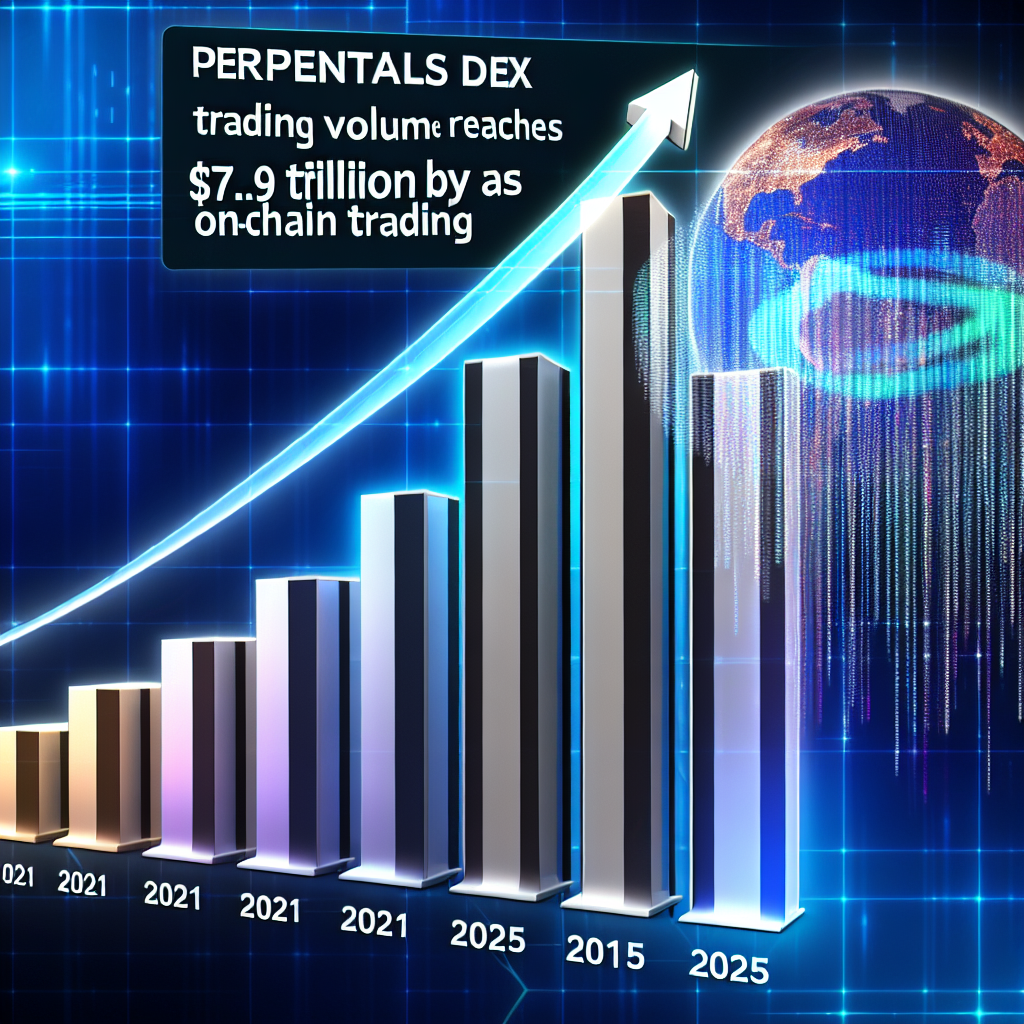
Perpetual decentralized exchanges are concluding 2025 with a total trading volume of $12.09 trillion, a significant rise from $4.1 trillion at the beginning of the year.
Data from DefiLlama indicates that approximately $7.9 trillion of this cumulative volume was achieved in 2025. This signifies that 65% of all perpetual DEX trading volume took place within a single year, highlighting the rapid scaling of onchain derivatives throughout 2025.
In December alone, the trading volume for perpetuals hit $1 trillion, maintaining the momentum initiated in October when monthly volumes first reached $1 trillion.
This increase reflects a significant uptick in the usage of onchain derivatives over the past year, as perpetuals DEXs captured an increasing portion of leveraged crypto trading activities.

Perpetuals DEXs began to emerge around 2021, with dYdX and Perpetual Protocol credited as early pioneers offering decentralized perpetual futures onchain.
The sector’s growth experienced a sharp acceleration in 2023, signified by the advent of Hyperliquid.
Perp DEX activity accelerated in the second half of 2025
The nearly $8 trillion in volume generated in 2025 was predominantly concentrated in the latter half of the year.
According to DefiLlama, the first half of 2025 accounted for roughly $2.1 trillion, while the second half generated about $5.74 trillion, constituting 73% of the total volume for the year.
Trading activity appeared relatively stable during the first half of 2025, indicating a consistent baseline for onchain derivatives usage instead of a breakout phase.
This trend shifted mid-year, with volumes accelerating in the third quarter, culminating in Q4, when monthly volumes consistently surpassed $1 trillion. The trading volume in the fourth quarter exceeded the total volume from the first half of 2025.
As liquidity improved and execution became more efficient, perpetuals DEXs increasingly served as primary platforms for leveraged trading rather than just alternatives to centralized exchanges.
Related: Aster maintains tokenomics while community expresses confusion post-CMC update
Hyperliquid dominance challenged as rival perp DEXs gain traction
Hyperliquid maintained a leading position in the perps DEX market for most of the year, particularly in the first half, when its monthly volumes consistently ranged from $175 billion to $248 billion.
Competing platforms such as Aster and Lighter remained relatively minor players, with Aster yielding single-digit billions and Lighter only starting to gain traction after the first quarter.

The competitive environment began to evolve mid-year as rival platforms gained momentum more rapidly than Hyperliquid. Both Aster and Lighter experienced significant increases in activity beginning in June.
Lighter transitioned from sub-$50 billion monthly volumes to consistently exceeding $100 billion by the third quarter, indicating rising trader engagement and depth of liquidity.
The most notable challenge to Hyperliquid’s lead appeared in the fourth quarter, as Aster saw remarkable growth in October and November, with monthly volumes climbing to $259 billion during both months.
By year-end, the data reflected a shift from a single dominant player to a more competitive, multi-venue market landscape.
Magazine: Koreans ‘pump’ alts post-Upbit hack, China BTC mining surge: Asia Express
