


The cryptocurrency bull run seems to have come to an end, with Bitcoin, altcoins, and the Fear & Greed Index reaching their lowest points in several months.
Summary
- Indicators suggest that the crypto bull run has concluded as Bitcoin experiences a significant drop.
- The Crypto Fear and Greed Index has decreased to 26.
- Potential key factors could facilitate a crypto recovery in the near future.
Bitcoin (BTC) has fallen below the critical support level of $104,000 for the first time since June, marking a brief entry into a bear market after a 20% decline from its all-time high.
Reasons the crypto bull run appears over
The total market value of cryptocurrencies, excluding Bitcoin, Ethereum (ETH), and stablecoins, has dropped to $670 billion from a year-to-date peak of $911 billion. Additionally, the Altcoin Season Index has fallen to 25.
The Crypto Fear & Greed Index now sits in the fear zone at 26, indicating investor anxiety. This month has also seen liquidations surge, surpassing the $20 billion mark last Friday.
All these indicators imply that the crypto bull run has concluded—at least temporarily. This downturn has been propelled by increasing risks in the global economy, including concerns in the regional banking sector and the rising risk of decoupling between the world’s two largest economies.
The crypto market crash last Friday was initiated by a statement from U.S. President Donald Trump regarding a 130% tariff on goods imported from China, following China’s warning about export controls on rare earth materials crucial for the industrial sector.
A prolonged trade conflict between the U.S. and China poses significant risks for the crypto market, as it could lead to higher inflation and complicate the Federal Reserve’s ability to lower interest rates further.
Moreover, the crypto bull run has faltered as gold has solidified its status as a more attractive safe-haven asset. The price of gold has continued to rise, drawing investments from both individual and institutional investors in recent weeks.
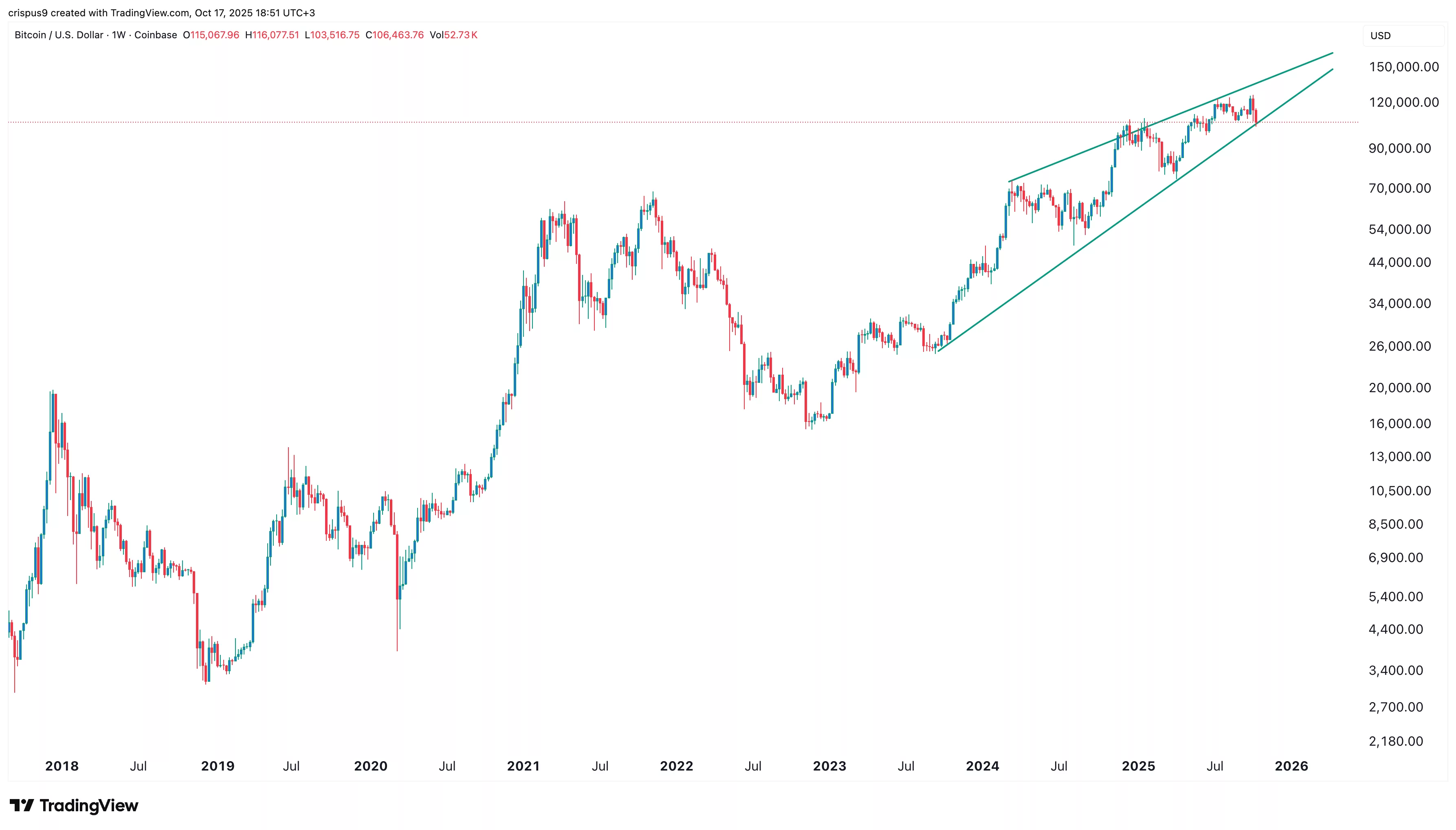
In addition, Bitcoin’s price has developed a concerning pattern known as a rising wedge, characterized by two ascending and converging trendlines.
Is a rebound possible for the crypto market?
The pressing question for investors is whether the cryptocurrency market will recover as the current downturn progresses.
Several factors indicate that Bitcoin and other cryptocurrencies may experience a resurgence in the weeks or months ahead. Historical trends suggest that Bitcoin’s price typically rebounds following a bear market or correction.
For instance, Bitcoin’s price fell over 32% from its highest point in January to its lowest point in April, only to recover to a new record high.
There are three main catalysts that could revitalize the crypto market soon. First, the Federal Reserve may continue to lower interest rates to bolster the labor market.
Second, the anticipated meeting between Trump and Xi Jinping at the APEC Summit in South Korea may positively impact both crypto and stock markets, especially if they reach an agreement.
Lastly, a recovery in the crypto market could materialize if the government shutdown concludes and the Securities and Exchange Commission begins approving altcoin ETFs.
