


Bitcoin is maintaining a position above $90,000 as the market approaches a much-anticipated FOMC meeting, a pivotal event that could shape the forthcoming trajectory of risk assets. While price movements keep traders anxious, on-chain indicators reveal a surprisingly contrasting narrative beneath the surface. A new report from XWIN Research Japan via CryptoQuant indicates that Bitcoin’s exchange reserves have been sharply declining throughout 2025, even as prices adjusted toward the $90K mark.
Related Reading
The data reveals that the total BTC held on centralized exchanges has fallen to 2.76 million BTC, marking one of the lowest levels recorded. The significance of this trend is underscored by its timing: during the considerable November–December sell-off, exchange balances didn’t increase; they diminished more rapidly. The report points out this trend in the red-highlighted area of the chart, showcasing increasing outflows as prices fell.
This trend suggests something atypical: investors are not sending coins to exchanges in an attempt to sell at a loss. Instead, they continue to withdraw BTC for long-term holding, reflecting confidence rather than capitulation. With rising volatility leading up to the FOMC decision, the stark difference between short-term price anxiety and long-term accumulation is becoming a key dynamic in the current Bitcoin landscape.
Shrinking Exchange Reserves Indicate Structural Strength
The report highlights the significant structural implications of Bitcoin’s rapidly declining exchange reserves. When fewer coins are held on centralized exchanges, it indicates a reduced supply of Bitcoin available for immediate sale, effectively tightening liquid availability. According to the data, this decline is not being driven by short-term traders but rather by long-term holders and institutional investors gradually moving BTC into self-custody or cold storage.

What is particularly noteworthy about this trend is its timing. Historically, sharp price drops trigger a surge of inflows to exchanges as investors prepare to sell or panic-exit their holdings. However, this instance tells a decidedly different story. Even as Bitcoin dipped into the $90K range, exchange balances continued to decline, indicating that long-term outlook buyers are actively accumulating rather than withdrawing.
This divergence between price trends and on-chain activity signifies underlying strength. While short-term fluctuations may persist—particularly around macro events like the FOMC meeting—the broader market structure indicates a gradual tightening of available supply. As reserves approach historic lows, the prospect of a future “supply shock” becomes increasingly realistic.
Despite weak performance in the spot market, on-chain metrics are slowly shifting toward bullish territory, suggesting that the groundwork for the next major trend may already be setting itself beneath the surface.
Related Reading
BTC Tests Critical Support as Market Awaits Direction
Bitcoin’s price action on the 3-day chart indicates a market struggling to stabilize following a sharp corrective phase. BTC is currently trading around $90,437, just above the 200-day moving average — historically a significant dynamic support during mid-cycle retracements. The recent bounce from the $87K–$88K area suggests that buyers are defending this level, but the market remains fragile as long as prices stay below the 50-day and 100-day moving averages, both of which are currently trending downward.
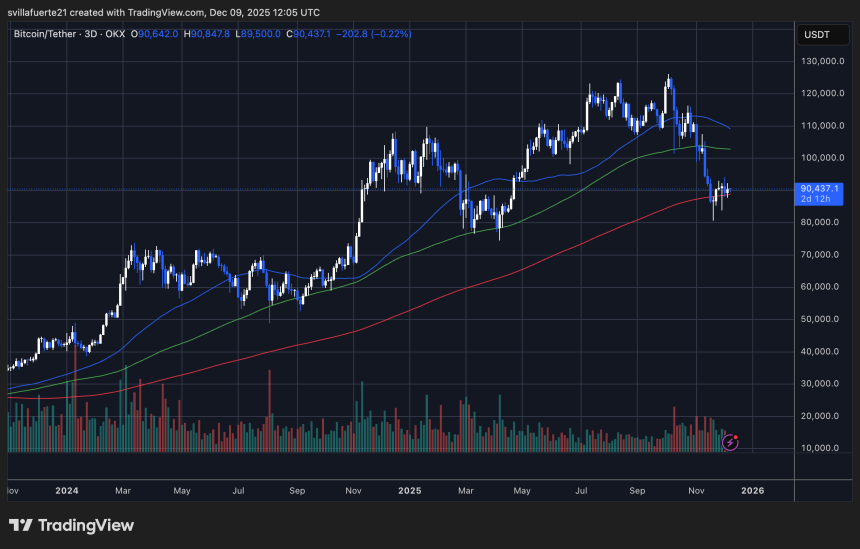
The chart indicates a clear change in momentum. After months of consistent higher lows, Bitcoin broke its ascending pattern in late November, resulting in a swift drop toward the high-$80K range. Volume increased during the decline, showing more aggressive participation on the sell side. However, subsequent candles demonstrate decreasing sell volume, suggesting a waning of short-term selling pressure.
Related Reading
For a substantial recovery, BTC needs to reclaim the $95K–$97K zone, where prior support has converted into resistance. A failure to break through this area could keep the market in a consolidation phase with the risk of another retest of the 200-day moving average.
Featured image from ChatGPT, chart from TradingView.com
