


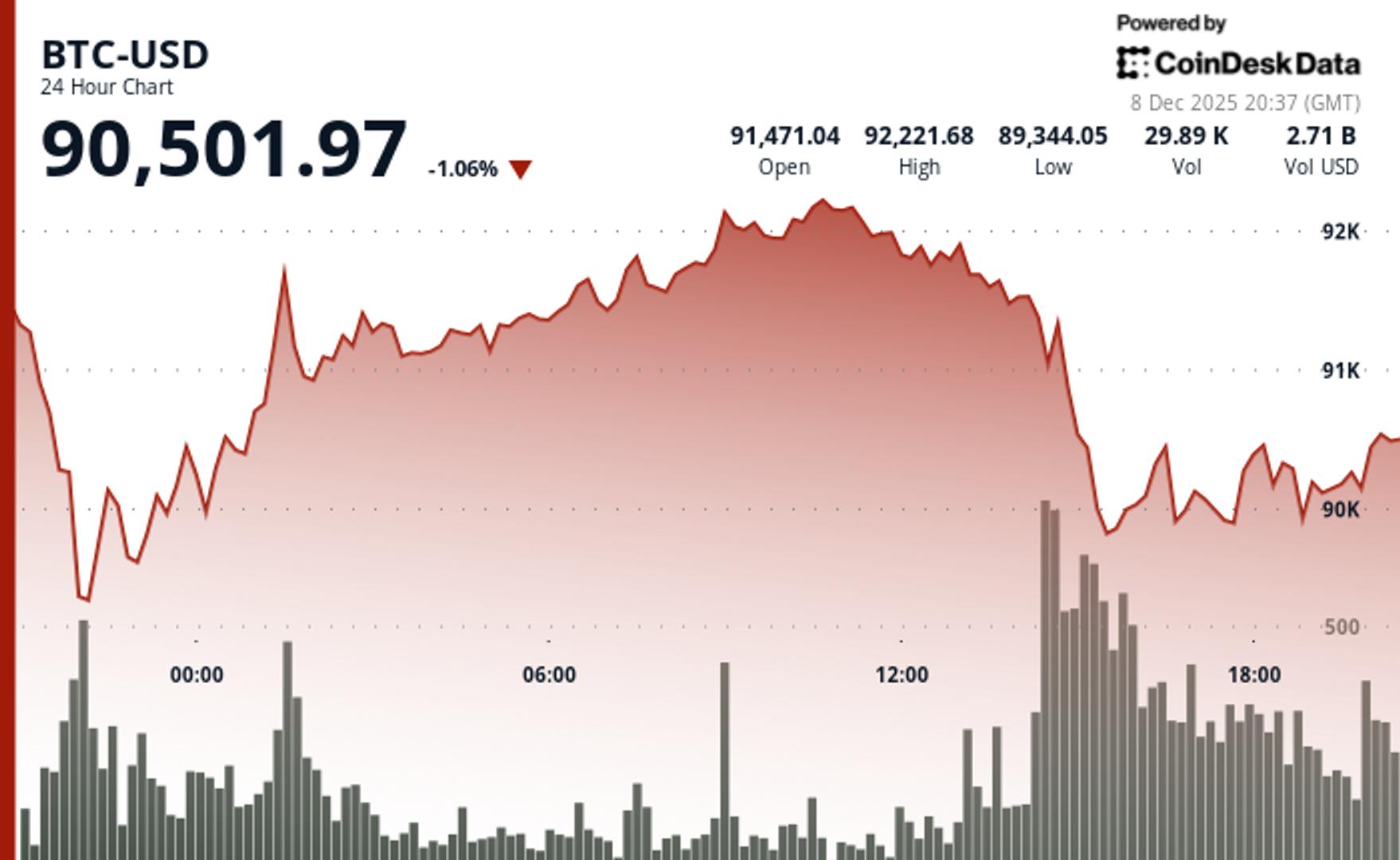
Bitcoin attempted a late weekend rally, but even those minor gains were largely reversed in early U.S. trading on Monday, with the price quietly settling near the $90,000 mark for the rest of the day.
Trading around $90,500 as U.S. stocks closed, bitcoin was down about 1% over the past 24 hours.
Major altcoins also struggled to maintain their gains. Ethereum’s ether dipped slightly but managed to climb to its highest relative price against BTC in over a month. Other notable gainers included privacy-centric Zcash and institutional-focused blockchain Canton Network (CC), both achieving double-digit gains. The wider cryptocurrency market, represented by the CoinDesk 20 Index, fell by 0.8%.
While crypto activity was subdued, long-term government bond yields surged amid concerns about issues in Japanese bonds impacting other markets. The U.S. 10-year Treasury yield jumped to 4.19%, its highest in about three months, while government debt in the U.K. and other European nations also sold off. Concurrently, the Japanese 10-year bond yield continued to rise towards 2%, a level not seen in nearly two decades.
U.S. equities also fell during the day, with the S&P 500 down by 0.5% and the Nasdaq by 0.3%, affecting broader risk sentiment.
This week’s major event will be the final Federal Reserve meeting of the year. Although a 25 basis-point cut is fully anticipated, any guidance about future policy or liquidity measures could provoke volatility on Wednesday.
“Any relaxation in financial conditions or further depreciation of the US dollar could provide supportive conditions, while any hawkish surprise regarding the pace or extent of policy easing from the Federal Reserve could heighten downside pressures on crypto markets,” noted LMAX market strategist Joel Kruger in a report.
BTC encounters structural challenges
Despite bitcoin’s recent rebound from November’s lows, Bitfinex analysts cautioned that the largest cryptocurrency is facing structural weaknesses and decreasing spot demand.
While the S&P 500 is hovering near record highs, BTC remains rangebound, illustrating a widening disconnect between crypto and traditional risk assets, indicating relative weakness, they highlighted in a Monday report.
Bitfinex pointed out several pivotal indicators supporting this perspective:
- Ongoing outflows from U.S.-listed spot bitcoin ETFs, with traders opting to sell into strength rather than accumulate, as demonstrated by a significantly negative Cumulative Volume Delta (CVD) across key exchanges.
- More than seven million BTC are currently at an unrealized loss, reflecting bearish sentiment akin to the consolidation phase of 2022.
- Though capital inflows remain slightly positive at $8.69 billion monthly (as measured by Net Realized Cap Change), they are considerably below peak levels, providing only a small buffer against downside risks.
All these factors culminate in a precarious landscape as the year-end approaches, according to Bitfinex analysts.
“With waning spot demand, the market is now facing a significantly weaker buy-side environment,” the report stated. “This diminishes immediate price support and elevates sensitivity to external disruptions, macro-driven volatility, and any further tightening of financial conditions.”
