

Since the inception of Bitcoin, the count of addresses holding over 0.1 BTC has consistently increased throughout various market cycles, up until now. Recent data indicates that the number of addresses in this category has stagnated over the past two years, breaking a trend that persisted for more than a decade.
This stagnation highlights a shift in how smaller and mid-sized investors interact with Bitcoin, despite an ongoing increase in broader institutional activity within the market.
Small Holder Participation Hits A Plateau
The 0.1 BTC benchmark has traditionally marked a significant milestone for retail holders, providing enough volume to indicate commitment while still being accessible. Over the years, the number of wallets surpassing this threshold grew consistently, even during downturns when long-term investors accumulated quietly.
Related Insights
This trend is no longer present. Since 2023, the number of addresses with more than 0.1 BTC has leveled off and shows no signs of resuming its former growth path. Notably, data from on-chain analytics platform Santiment reveals that the count of these addresses has remained stable at approximately 4.44 million for the past year, implying that fewer new participants are opting to establish self-custodied Bitcoin positions at this threshold.
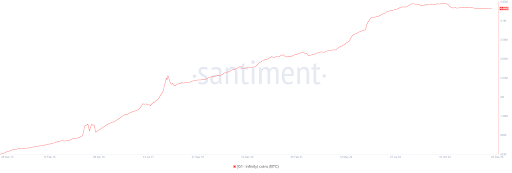
This stagnation is particularly striking given Bitcoin’s increasing mainstream visibility and ongoing attempts to reach new all-time highs this year. In previous market cycles, such circumstances typically triggered a surge in retail accumulation. However, this time the address count remains static, suggesting that retail addresses holding Bitcoin may actually be on the decline.
The Evolution of Bitcoin’s Holder Base
While on-chain data reveals a slowdown in the growth of Bitcoin addresses exceeding 0.1 BTC, it does not explicitly indicate a decrease in overall adoption. Many market participants are now obtaining Bitcoin exposure entirely through off-chain methods.
Related Insights
Large investor groups, including high-net-worth individuals, funds, and corporations, are purchasing substantial amounts of Bitcoin. For example, data from Santiment illustrates that major Bitcoin holders with more than 100 BTC have been consistently increasing their balances throughout 2024 and 2025, even as smaller address groups have stagnated.
Simultaneously, more investors are turning to custodial solutions for accessing Bitcoin rather than managing their own wallets. Spot Bitcoin ETFs have emerged as critical avenues for new BTC exposure. In the US alone, Spot Bitcoin ETFs now control nearly $120 billion in Bitcoin, with BlackRock’s IBIT consistently demonstrating the highest demand.
Collectively, these trends indicate a new phase in Bitcoin’s evolution. Where individual self-custodied users once dominated, the landscape is increasingly influenced by institutions, ETFs, funds, and professionally managed capital. Consequently, the figures from on-chain wallet metrics represent just a fraction of the actual user base.

Featured image from Pixabay, chart from Tradingview.com
