

The Shiba Inu (SHIB) token is facing difficulties in price recovery, which analysts attribute to fundamental structural issues rather than mere market fluctuations.
This viewpoint emerges from recent analyses that state SHIB’s aspiration to reach the $0.0001 price mark is a “dead-end road,” due to the token’s inherent weaknesses.
Sponsored
The Structural Challenge: Supply Overhang vs. Delayed Deflation
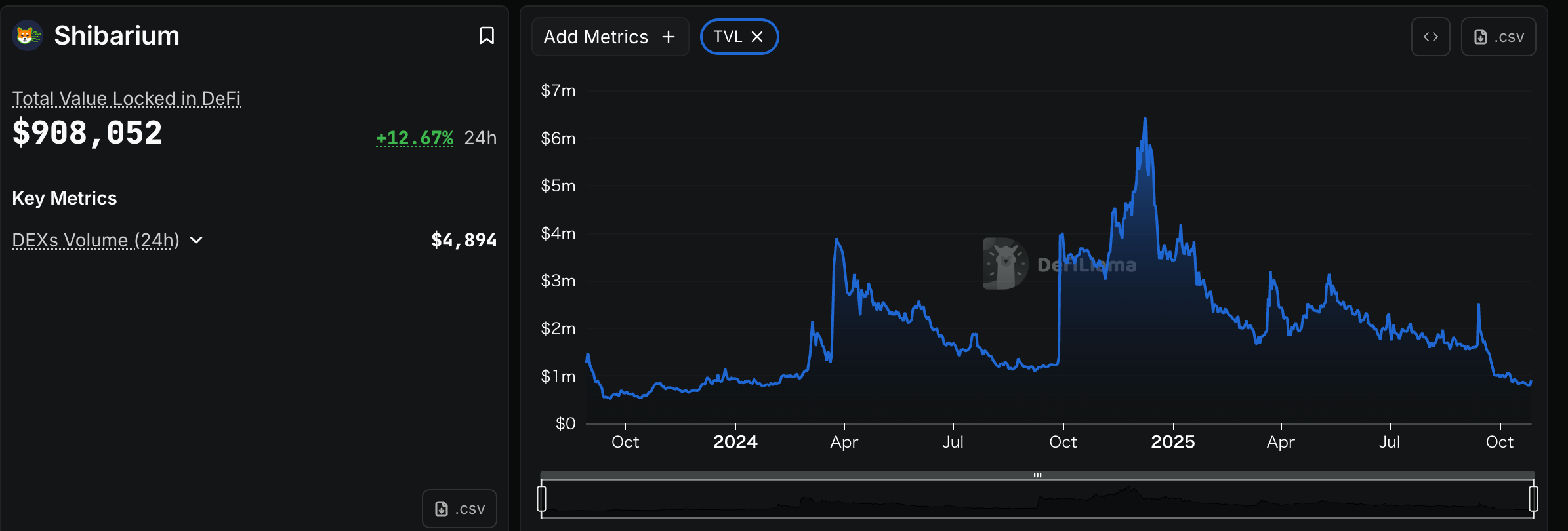
This grim perspective is reinforced by stark on-chain data: the Total Value Locked (TVL) in its layer-2 solution, Shibarium, has persistently stayed below $1 million since early October, revealing a critical lack of utility and adoption within the ecosystem.
SHIB is caught in a fundamental conflict: the vast circulating supply juxtaposed with the sluggish pace of its deflationary mechanism. The ecosystem was designed to leverage its layer-2 network, Shibarium, to burn tokens, reducing the total supply of around 589 trillion tokens.
However, the ongoing low TVL on Shibarium remains, indicating a fraction of the network’s potential. Consequently, the token burn rate is significantly lagging behind market expectations. This stagnation suggests that development efforts have yet to yield substantial network activity or user adoption.
With SHIB’s market capitalization still in the billions, a TVL below $1 million starkly indicates that decentralized applications (dApps) and users are not adopting the chain at the necessary scale.
Sponsored
Analysts view this technical shortfall as the primary structural cause. They increasingly consider ambitious price targets like $0.0001 as unfeasible. The immense token supply necessitates substantial, consistent deflationary pressure that the present ecosystem does not deliver.
The Utility Deficit and Capital Flight to AI/DePIN
A secondary yet crucial factor contributing to SHIB’s troubles is the ongoing rotation of capital within the crypto market. This capital is shifting towards sectors that offer tangible utility. As the broader Web3 trend transitions decisively from “meme” to “utility,” SHIB is losing traction to projects that deliver real-world value.
In the latter half of 2025, capital has gravitated towards sectors like AI compute (e.g., Bitfarms’ transition) and DePIN, with projects generating revenue from data, computation, and enterprise efficiency. These utility-focused tokens provide clear fundamentals beyond speculation.
Sponsored
In contrast, SHIB struggles to overcome its “meme coin” reputation. The absence of TVL confirms that Shibarium has not established a unique, compelling use case. It requires this to draw developers and users from established Layer-2 networks.
The persistent utility deficit implies that whales and shrewd investors are opting to divest from SHIB and redirect capital to more promising, utility-oriented sectors.
Community Resilience and the Competitive Landscape
Sponsored
The capital flight is not confined to utility tokens; it also targets alternative meme projects promising aggressive tokenomics. A notable figure highlighted on X that “the smart ones are rotating to Shib on Base,” noting a 32.6% supply burn and “AI-driven utility” as pivotal factors.
This active competition indicates that investors are actively seeking quicker burn mechanisms and verifiable utility. This compels the original SHIB project to vie with AI tokens and newer, more aggressive meme coin models.
For SHIB to remain pertinent and aim for price recovery, its team must urgently showcase measurable and innovative utility. This requires more than mere community enthusiasm; it necessitates attracting significant liquidity and developer engagement to Shibarium. Such efforts will ultimately prove that the token serves as a crucial component of Web3 infrastructure.
Reviving Shibarium’s TVL is the essential initial sign that SHIB can liberate itself from its structural limitations.
