

The most renowned indicators for predicting Bitcoin price tops did not activate during the recent bull market, prompting analysts to question the reliability of the underlying data. This discussion delves into various popular tools, investigating their lack of effectiveness this cycle, and suggests ways to adjust them to fit Bitcoin’s changing market dynamics.
According to the Bitcoin Magazine Pro Price Forecast Tools indicator, the recent bull market did not hit several historically dependable top models including Delta Top, Terminal Price, and Top Cap, with Top Cap not even being approached in the previous cycle. The Bitcoin Investor Tool, which applies a 2-year moving average multiplied by 5, also went untested, while the Pi Cycle Top Indicator failed to deliver accurate timing or price signals, despite being closely monitored by numerous traders. This has raised understandable concerns regarding whether these models have become ineffective or if Bitcoin’s trading behavior has evolved beyond them.
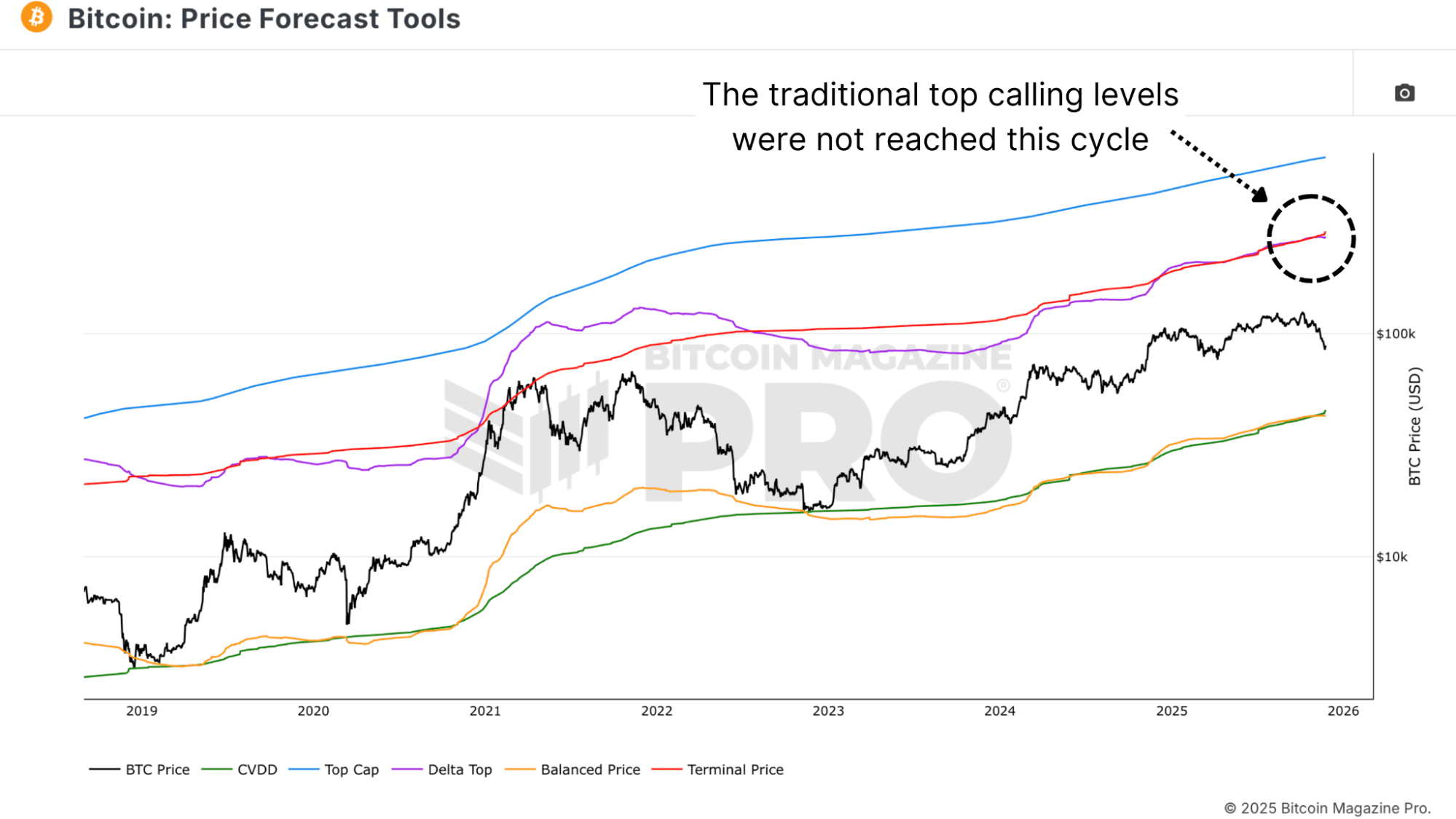
Bitcoin remains an evolving asset with a shifting market structure, liquidity, and participant demographics. Instead of assuming that the data is flawed, a better approach may be to refine the metrics to align with different perspectives and time frames. The aim is not to abandon these tools, but to enhance their robustness and adaptability to a market that no longer provides the same explosive increases and violent cycle peaks as it did in previous years.
Bitcoin Price: From Fixed Thresholds to Dynamic Signals
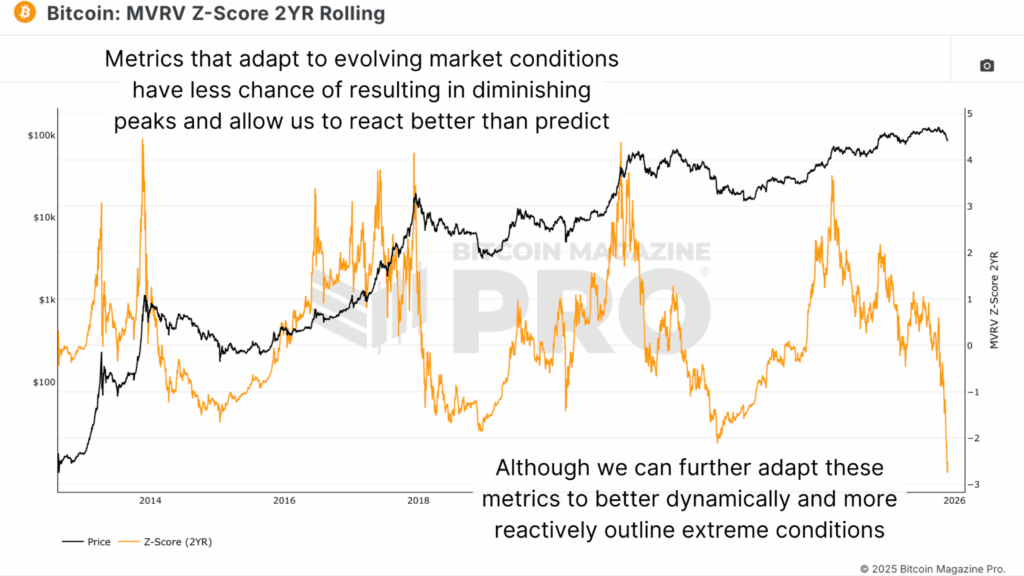
The MVRV Z-Score 2-Year Rolling metric has long been essential for spotting overheated conditions, but in this cycle, it did poorly in identifying the bull market peak. It indicated a significant spike as Bitcoin first moved past the $73,000–$74,000 range, yet did not provide a clear exit signal for the later stages of the surge. Currently, the metric is presenting the highest oversold readings recorded.
View Live Chart
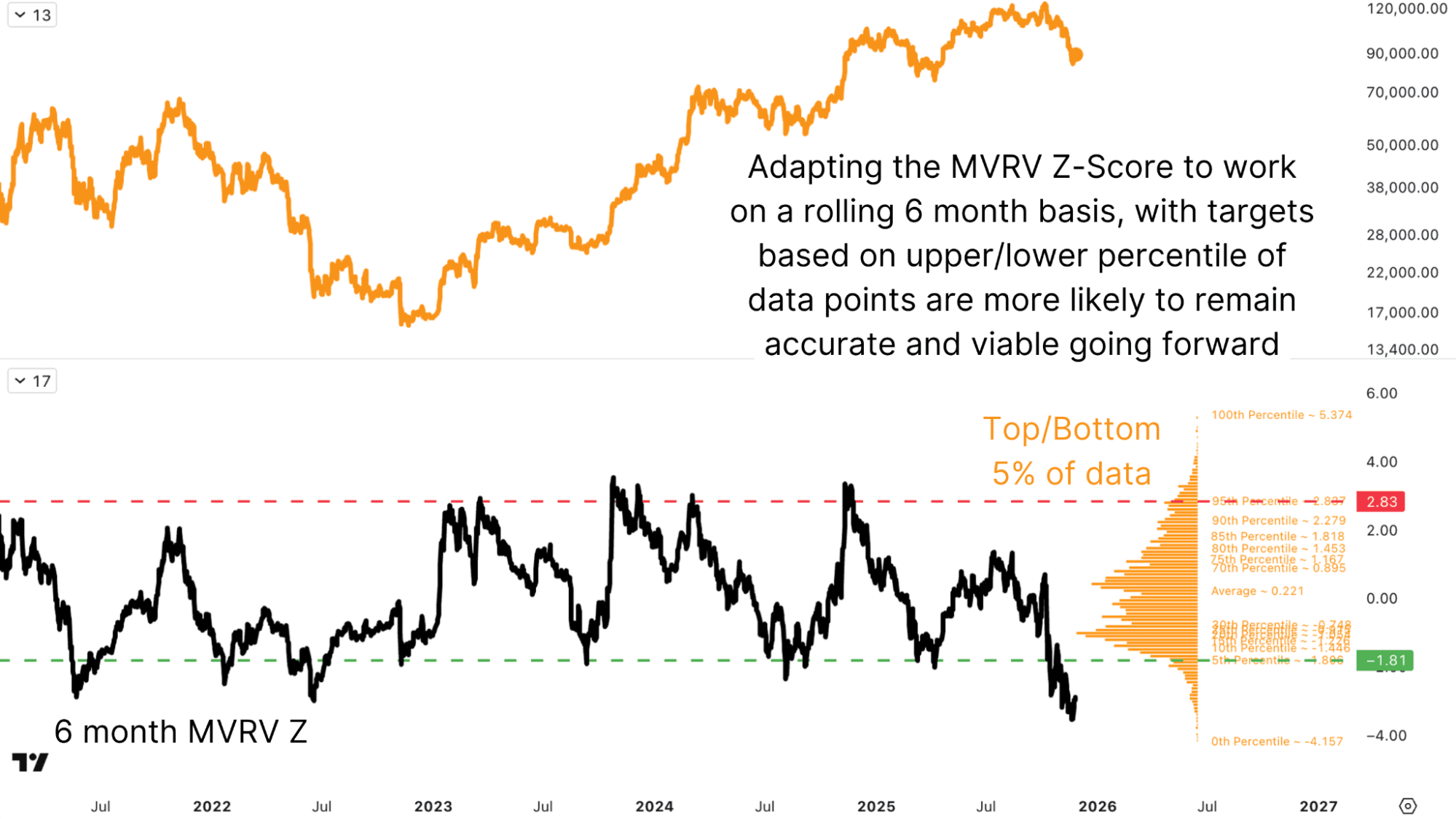
To improve this limitation, the MVRV Z-Score can be reconfigured to a 6-month rolling basis instead of two years, making it more attuned to recent market conditions while still grounded in realized value dynamics. Moreover, transitioning away from fixed thresholds to dynamic distribution-based bands enhances its utility. By tracking the percentage of days spent above or below varying Z-Score levels, one can delineate zones like the top 5% and the bottom 5% on the downside. Throughout this cycle, Bitcoin did signal in the upper bands when it first surpassed $100,000, and historically, movements into the top 5% region have correlated reasonably well with cycle peaks, even if they didn’t capture the precise high.
Cyber Monday Sale: 40% Off Annual Plans!
The BEST savings of the year are here. Enjoy 40% off all our annual plans.
- Access over 150 Bitcoin charts.
- Receive Indicator alerts to ensure you don’t miss out.
- Private TradingView indicators for your preferred Bitcoin charts.
- Exclusive Members-only Reports and Insights.
- API access and more—all for a FRACTION of the standard industry rates.
All available for just $17/month with the Black Friday deal. This is our biggest sale of the year!

Bitcoin Price: Faster-Reaction Metrics for Today’s Cycle
Beyond traditional valuation tools, activity-based indicators like Coin Days Destroyed can be enhanced by shortening their lookback periods. A 90-day moving average of Coin Days Destroyed has historically tracked significant distributions from long-term holders, but given the more subdued and erratic nature of the current cycle, a 30-day moving average often proves to be more insightful. With Bitcoin’s price movements no longer demonstrating the same parabolic trends, metrics must respond more swiftly to reflect the shallower yet significant waves of profit-taking and investor rotations.
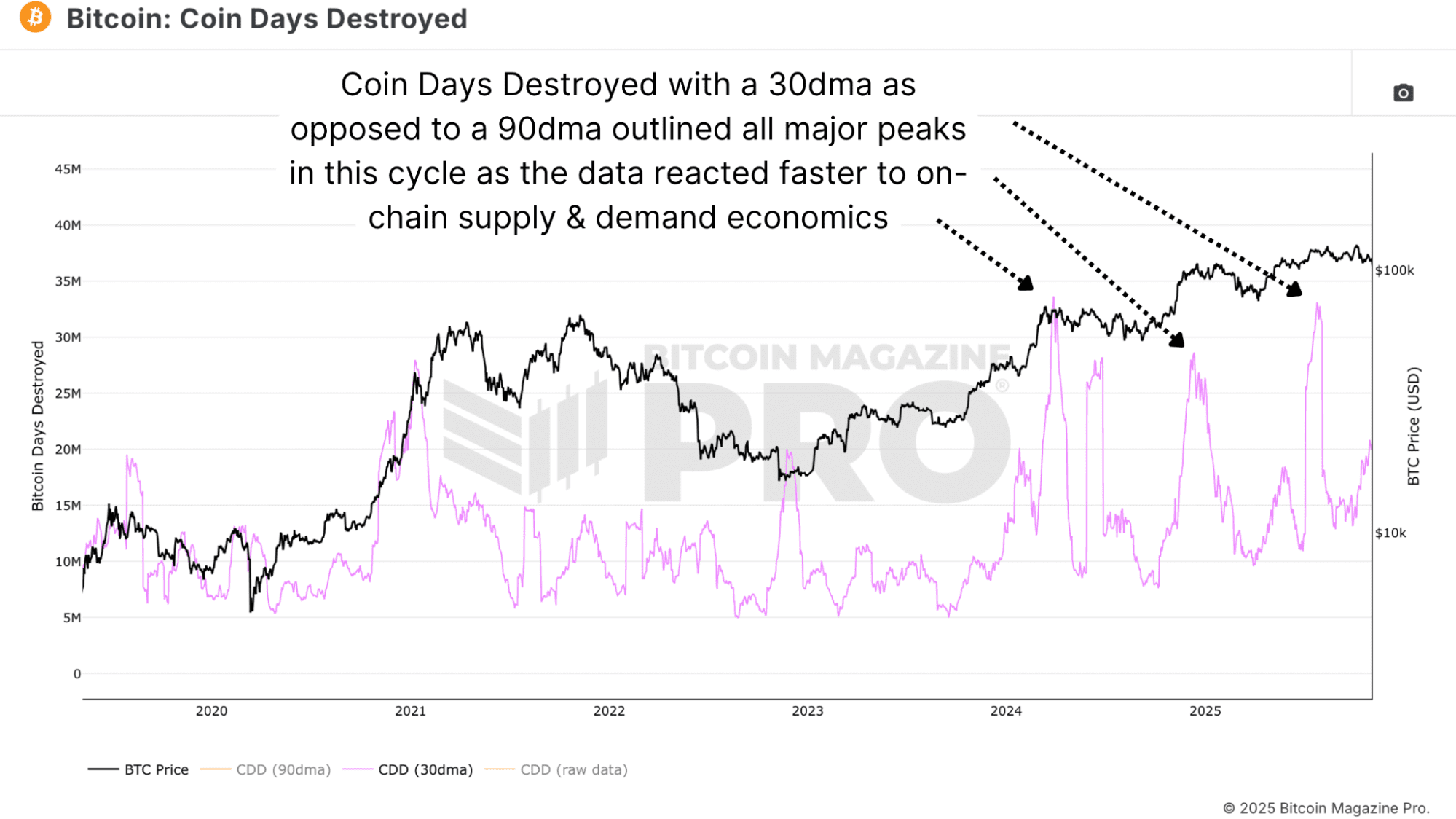
When excluding the latest data and focusing on the price surge leading up to the all-time high of this cycle, the 30-day Coin Days Destroyed metric indicated almost precisely at the cycle peak. It also triggered earlier when Bitcoin first broke through approximately $73,000–$74,000, and similarly when it surpassed $100,000, successfully flagging all significant distribution phases. While this is easily assessed in retrospect, it emphasizes that on-chain supply and demand signals remain critically relevant; the challenge is to align them with the current volatility trends and market depths.
Bitcoin Price Spent Output Profit Ratio (SOPR)
The Spent Output Profit Ratio (SOPR) offers another perspective on realized profit-taking, yet the raw data can be erratic, featuring sharp spikes, frequent reversals to the mean, and large swings during both rallies and intra-bull capitulations. To derive more actionable insights, using a 28-day (monthly) change in SOPR is recommended. This smoothed variation highlights periods where the rate of profit realization is intensifying to extreme levels over a brief duration, thus cutting through the noise caused by intra-cycle volatility.
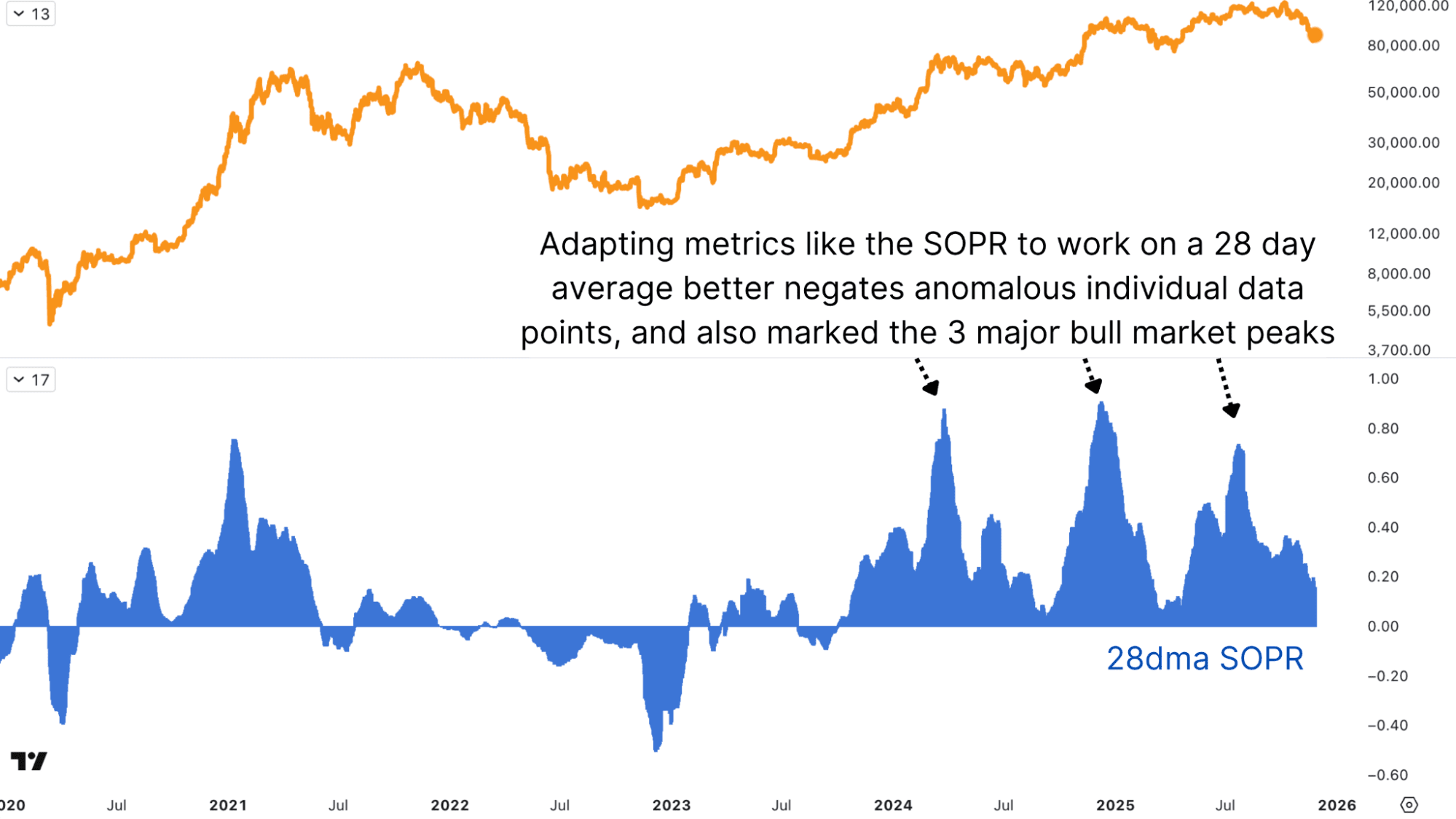
For the recent cycle, the monthly SOPR change identified distinct peaks as Bitcoin initially crossed the $73,000–$74,000 mark, again above $100,000, and once more around the $120,000 level. Though none of these captured the ultimate price peak perfectly, they all indicated phases of heightened profit-taking pressure reflective of cycle exhaustion. Employing monthly changes rather than the raw metric clarifies the signal, particularly when viewing Bitcoin’s purchasing power against equities and gold.
Bitcoin Price Cycle Conclusion: Adapt or Fall Behind
Looking back, numerous popular indicators for predicting market tops proved effective throughout this bull cycle when assessed through the proper perspective and timeframe. The guiding principle remains: respond to the data rather than attempting to forecast. Instead of waiting for a single metric to accurately indicate a peak, using a suite of modified indicators, filtered through the views of purchasing power and shifting market dynamics, can elevate the likelihood of recognizing when Bitcoin is overheated and transitioning into a more favorable accumulation phase. The coming months will be devoted to fine-tuning these models to ensure they remain not just historically relevant but also rigorously accurate moving forward.
For a more detailed examination of this subject, check out our latest YouTube video here: Why Didn’t The Bitcoin Top Calling Metrics Work?
For in-depth data, charts, and professional insights into Bitcoin price trends, visit BitcoinMagazinePro.com. Don’t forget to subscribe to Bitcoin Magazine Pro on YouTube for more expert market insights and analyses!

Disclaimer: This article is for informational purposes only and should not be construed as financial advice. Always conduct your research before making any investment choices.
