

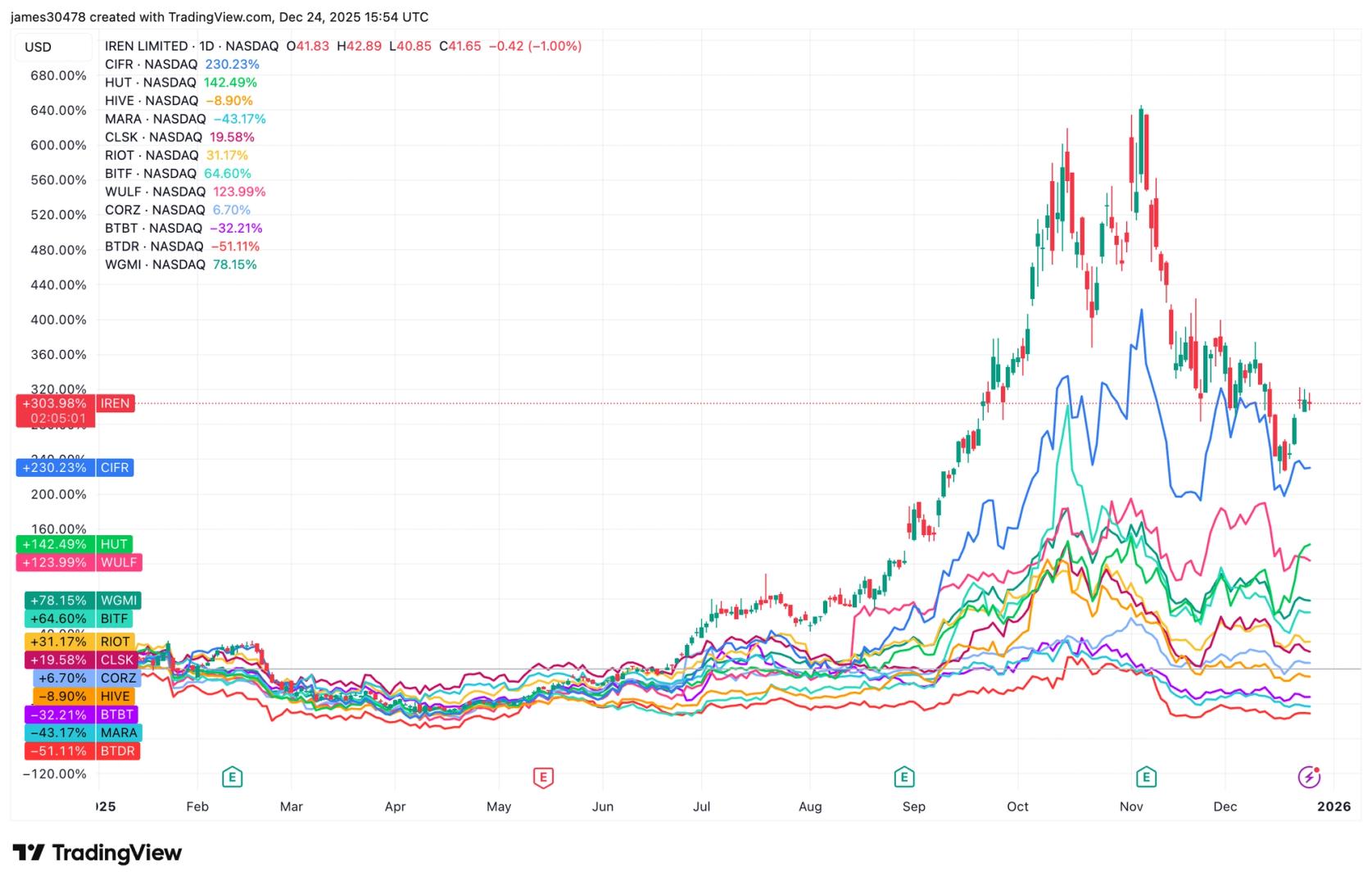
As 2025 comes to an end, bitcoin experienced a challenging year, down approximately 7% year-to-date, as gold, the S&P 500, and tech stocks continue to achieve record levels.
Consequently, publicly traded bitcoin mining stocks have exhibited significant disparities, heavily influenced by investments in artificial intelligence (AI) and high-performance computing (HPC) infrastructure. Companies actively shifting towards AI have emerged as the top performers.
IREN (IREN) has led the way with an impressive +300% year-to-date (YTD) increase, driven by substantial GPU cloud contracts and support from Microsoft.
Cipher Mining (CIFR) trails closely at +230%, expanding AI hosting collaborations, particularly with Fluidstack.
Hut 8 (HUT) also surged, registering around +139%, bolstered by a recent AI announcement: a $7 billion, 15-year lease for an AI data center providing 245 MW at its River Bend site in Louisiana.
In contrast, three of the four largest bitcoin holders among public miners lagged behind AI/HPC miners.
Marathon Digital (MARA), the largest BTC holder among miners, with 53,250 BTC, fell -44% YTD. CleanSpark (CLSK) (13,011 BTC) and Riot Platforms (RIOT) (19,324 BTC) posted modest gains of 16% and 32% respectively, without a focused AI diversification until later in the year.
Core Scientific (CORZ) remained independent after shareholders turned down a $9 billion all-stock acquisition offer from CoreWeave in October, betting on greater intrinsic value amid rising AI demand. Its shares have seen a mere 9% increase year-to-date.
Bitdeer Technologies (BTDR), the largest underperforming mining firm in the sector, has dropped roughly 50%. Most of the losses occurred post-Q3 earnings announcement, where the company revealed a net loss greater than anticipated and a delay in its ASIC chip project, creating uncertainty about its AI expansion strategy.
This year’s events have highlighted a clear trend: miners repurposing facilities for AI data centers are outperforming operators focused solely on bitcoin.
