

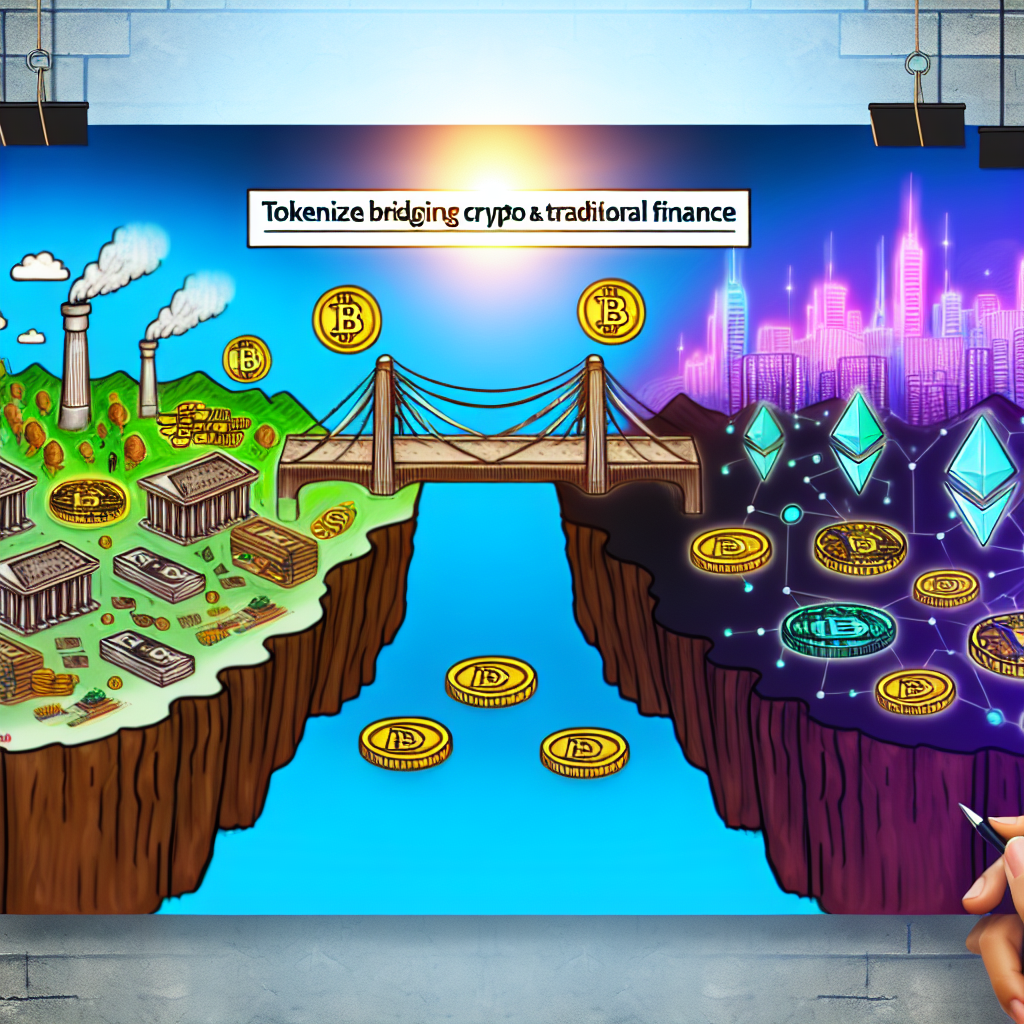
Former crypto critic and BlackRock CEO Larry Fink, alongside chief operating officer Rob Goldstein, asserts that tokenization will serve as a vital link between the crypto world and traditional finance, reinforcing their commitment to the sector.
In an opinion piece authored by Fink and Goldstein and published Monday in The Economist, they indicated that while tokenization is not set to replace the current financial framework soon, it is expected to facilitate the merging of the two domains.
“Imagine it as a bridge constructed from both riverbanks, meeting in the center. One side features traditional institutions, while the other consists of digital-first innovators, including stablecoin issuers, fintech firms, and public blockchains,” they wrote.
“These two sectors aren’t in competition but are learning to work together. In the future, assets such as stocks and bonds won’t be segregated in different portfolios; instead, all types of assets could potentially be transacted and stored within a unified digital wallet.”

As the largest asset manager globally, overseeing over $13.4 trillion in assets, BlackRock’s co-founder and CEO, Fink, transitioned from skepticism about crypto to a supportive stance.
Financial sector can finally recognize the benefits of tokenization
Initially, Fink and Goldstein found it challenging to grasp the “big idea” behind tokenization because it was overshadowed by the crypto boom, which often appeared speculative.
“However, in recent times, traditional finance has uncovered what lies behind the buzz: tokenization has the potential to significantly broaden the range of investable assets beyond the traditional stocks and bonds that dominate current markets,” they noted.
BlackRock is already leading the market with its tokenized cash fund, valued at $2.8 billion. The BlackRock USD Institutional Digital Liquidity Fund (BUIDL), was launched in March 2024.
Regulators need to support collaboration between TradFi and tokenized markets
Nevertheless, Fink and Goldstein emphasized that tokenization must progress cautiously, under suitable regulations, necessitating that policymakers and regulators adapt the framework to allow traditional and tokenized markets to collaborate.
Related: Plume CEO predicts RWA will expand 3-5x in 2026, moving beyond crypto natives
Bond exchange-traded funds (ETFs) have followed a similar trajectory in fixed income, linking dealer markets with public exchanges to enable more efficient trading for investors, as noted by Fink and Goldstein.
“With the introduction of spot Bitcoin ETFs, even digital currencies are making their way onto traditional exchanges. Each of these advancements forges connections, and the same principle holds for tokenization,” they stated.
“Regulators should strive for uniformity: risk assessment should focus on the inherent nature of an asset rather than its format. A bond remains a bond, even if it exists on a blockchain.”
Magazine: Animoca’s investment in altcoin growth, analyst projects $100K Bitcoin: Hodler’s Digest, Nov. 23 – 29
