


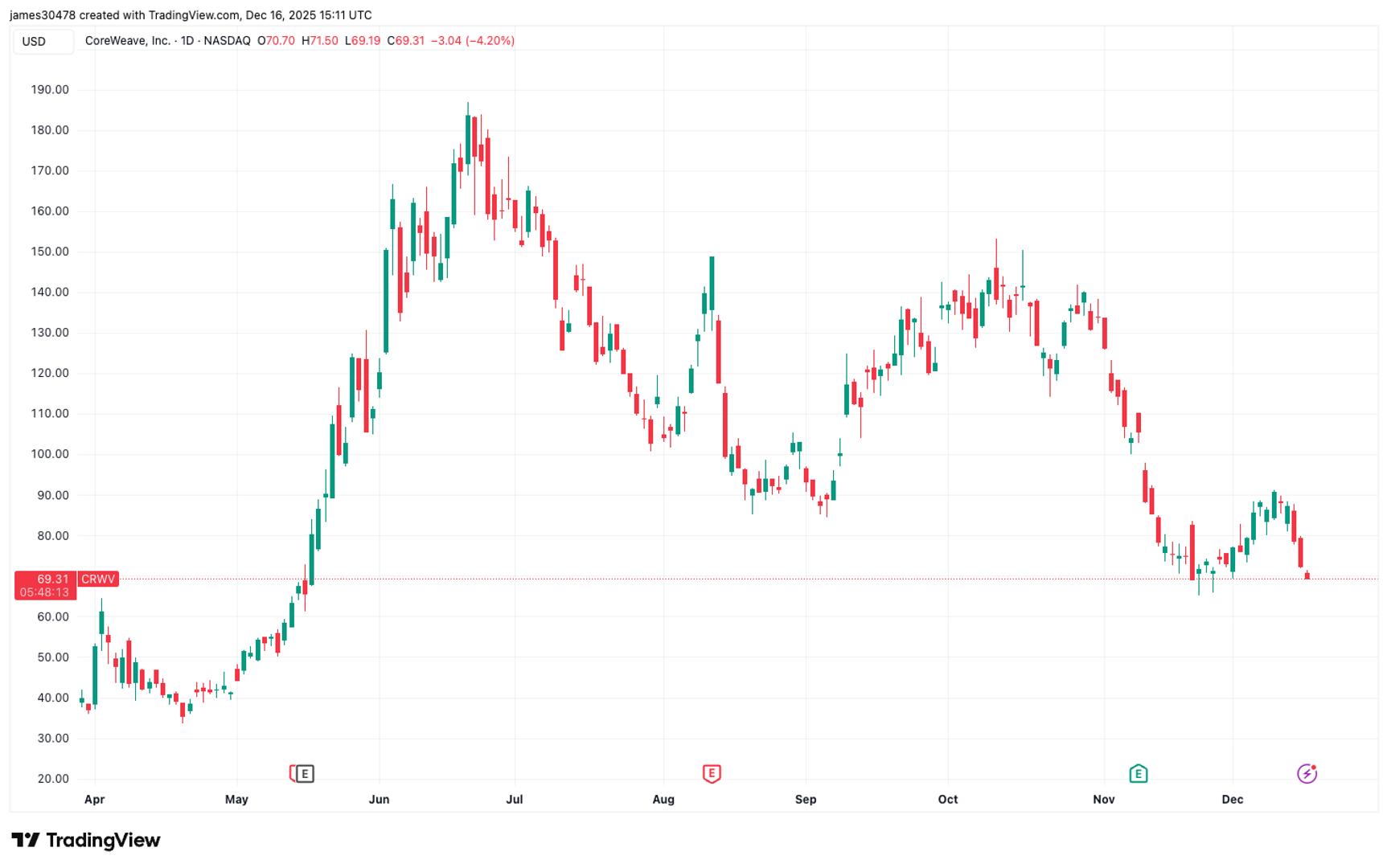
CoreWeave (CRWV) has experienced a decline of over 60% in its share price since its peak in June, raising concerns that the AI infrastructure surge might have reached its limit.
Recent information from the Wall Street Journal indicates that the expansion is precarious, marked by operational delays, significant leverage, and tightening credit conditions.
According to the report, investors are increasingly worried about two main risks associated with CRWV. First, the company is heavily dependent on high-interest debt to acquire advanced AI chips from NVIDIA (NVDA). Second, its revenue heavily relies on a few major clients, including OpenAI, Microsoft (MSFT), and Meta (META).
Some challenges CoreWeave faces stem from basic construction issues. Heavy rainstorms in North Texas delayed concrete pouring at a crucial data center site, pushing back schedules for computing capacity. This highlights how even minor infrastructure issues can disrupt multi-billion dollar AI investment strategies.
Investor confidence waned further in late October when CoreWeave’s planned $9 billion acquisition of Core Scientific fell apart. Core Scientific (CORZ), a company that transitioned from bitcoin mining to data center management, rejected the deal after shareholders expressed fears it would expose them to CoreWeave’s volatile stock and leveraged balance sheet.
Shares of Oracle (ORCL) and Broadcom (AVGO) have declined by double digits recently, following their third-quarter earnings reports, both companies noting a slowdown in AI spending.
Bitcoin miners feel the pain
The spillover between crypto and AI mining has occurred as bitcoin miners seek diversified revenue streams. IREN (IREN) and Cipher Mining (CIFR) have shifted their focus towards AI-driven high-performance computing, securing clients like Microsoft. Both companies had previously surged over 500% this year, but have since dropped about 50% in recent weeks. Another troubling trend is that the bitcoin mining sector increasingly relies on debt for expansion.
CoreWeave shares fell an additional 4% on Tuesday, trading below $70 for the first time since May.
