Disclosure: The opinions presented here are solely those of the author and do not reflect the views of crypto.news’ editorial team.
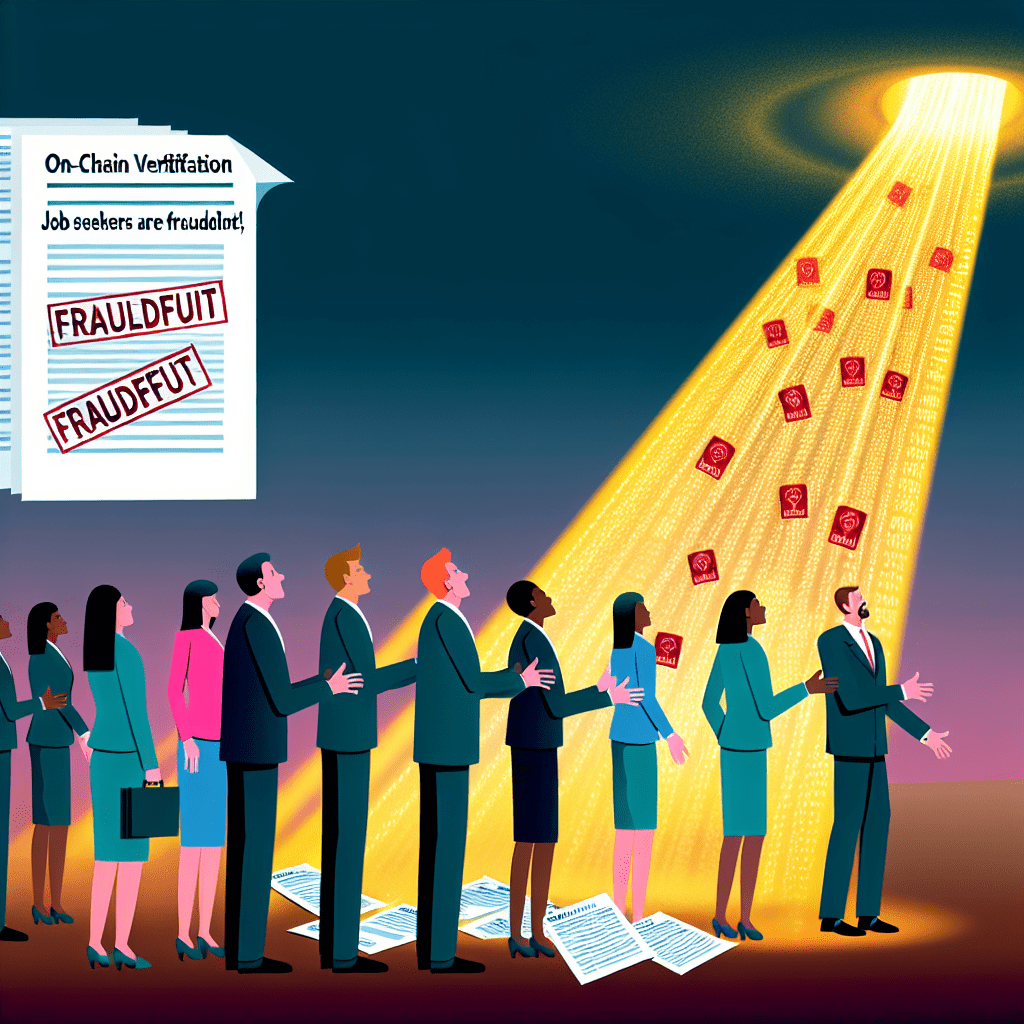
By 2028, as many as one in four candidate profiles might be fabricated, as highlighted in a recent Gartner report. If this forecast holds even partially true, the hiring dilemma many believe revolves around AI-assisted cover letters will seem trivial in retrospect. The real issue isn’t that job seekers are leveraging tools to enhance their applications; it’s that authenticity is becoming optional.
Summary
- AI is inundating hiring workflows with polished yet unverifiable applications and artificial identities, undermining the resume-centric filtering process reliant on self-reported information.
- Conventional solutions—improved HR tools, tighter KYC, or enhanced fraud detection—won’t address a system that is anchored in trust, which can now be artificially generated at scale.
- The only enduring solution is a transition to proof-based professional reputation (verifiable credentials, on-chain contribution proofs, zk-verified work history), reinstating trust by validating actual accomplishments.
The existing hiring framework is ill-equipped to withstand the impending wave of AI-enhanced identity fraud, and if proof-based reputation does not become the norm, the job market may splinter in irreversible ways. Some may argue this is hyperbolic or that the market will adapt as it has before, but we’re discussing fundamental shifts rather than mere superficial changes. This is about the potential collapse of the core assumption that the individual on the other side of the interaction is who they claim to be.
Discussion often revolves around ChatGPT-generated resumes, auto-apply browser extensions, and candidates sending out thousands of applications in a matter of minutes. While frustrating for hiring managers, this mostly distracts us from the more profound issue: artificial credibility is proliferating far more rapidly than our verification mechanisms can keep up. A polished application once indicated effort. Now, it signals little more than the ability to use a prompt effectively.
AI-generated applications are becoming standard
From a recruiter’s perspective, applications seem impressively crafted these days — eloquent, customized, convincing, yet increasingly disconnected from any proof of genuine skills. The hiring funnel wasn’t designed for a reality where thousands of nearly indistinguishable applicants can emerge overnight. When everyone appears qualified on paper, resumes cease to serve as filters and become mere background noise.
What has shifted is not just the volume of applications, but the intent behind them. We are entering a new phase where AI isn’t merely aiding candidates in presenting themselves better; it is enabling non-candidates to seem legitimate. While fake profiles aren’t new, they were once easy to identify. Now, they come equipped with synthetic work histories, AI-generated photos, and invented references that often appear more polished than anything a real person would write. And if Gartner’s predictions hold, this trend could define the market moving forward.
For rapidly evolving sectors like crypto, the risks are even greater. These environments operate quickly, hire on a global scale, and frequently depend on informal trust due to limited time for extensive background checks. When a contributor can seemingly appear out of nowhere, receive payments, and vanish using a burner wallet, misplaced trust can lead to significant repercussions, not just an undesirable hire. We have already observed treasury drains and grant misappropriations initiated through fake identities, and those incidents occurred prior to AI magnifying the issue.
Some may contend that enhanced fraud detection, better HR tools, or more stringent KYC processes will rectify the problem. However, our attempts to fix the traditional system have proven ineffectual. Resumes can be embellished, degrees can be purchased, references can be rehearsed, and now AI can refine all of this into seemingly legitimate submissions. The crux of the issue lies not in the screening tools, but in the entire hiring framework being reliant on self-reported data, which is becoming increasingly untrustworthy.
Transitioning from claims-based PDFs to a verified professional reputation
What then is the alternative? The only feasible path forward involves transitioning from self-reported claims to a proof-based professional reputation. This doesn’t imply a surveillance-state approach, but rather a method through which individuals can verify what they have genuinely accomplished without revealing their entire history. Decentralized identifiers represented a valuable step toward confirming someone’s real identity, but they fall short of answering the primary question in hiring: Can this individual deliver?
This is where verifiable credentials and on-chain proof of contributions become crucial—serving not merely as buzzwords but as necessities. Picture the ability to privately validate that a candidate worked where they claimed, completed a course without needing to contact a university, or confirm a developer’s contributions without relying on screenshots from a private GitHub repository that might belong to someone else. Zero-knowledge proofs make this feasible, providing proof without oversharing. Unlike resumes, these verifiable signals cannot be easily faked through eloquent writing.
Detractors argue that tying work histories to cryptographic proofs is intrusive or over-engineered. However, consider how web3 contributors function: pseudonymous identities built upon genuine output rather than job titles. Trust does not necessitate a legal name; it requires evidence that past actions belong to the individual. This is the transformation the hiring market invariably needs, whether it welcomes it or not.
Ensuring reputation is verifiable
Should this transition occur, the market implications would be substantial. Hiring platforms that rely on volume-based matching will struggle as companies seek systems that evaluate verified capabilities. Agencies and marketplaces founded on manual vetting will find it challenging to compete with proof-driven processes. Compensation structures could shift as reputation turns portable and verifiable; highly-trusted contributors could command elevated rates without intermediaries. Conversely, the expense of pretending to succeed within an industry would rise exponentially, which is precisely the aim.
The AI-generated application crisis is merely a symptom. The true problem is that we’ve allowed unverifiable claims to form the bedrock of hiring practices, and now technology is exacerbating that issue into a major crack. If one in four candidate profiles proves to be fake, as projected by Gartner predicts, companies won’t merely be inundated; they will lose faith in the entire system. When trust vanishes, opportunities evaporate alongside it.
We can either bolster credibility in hiring processes now or wait for the market to collapse under the weight of counterfeits. The future demands more than just polished language; it requires validated proof.