


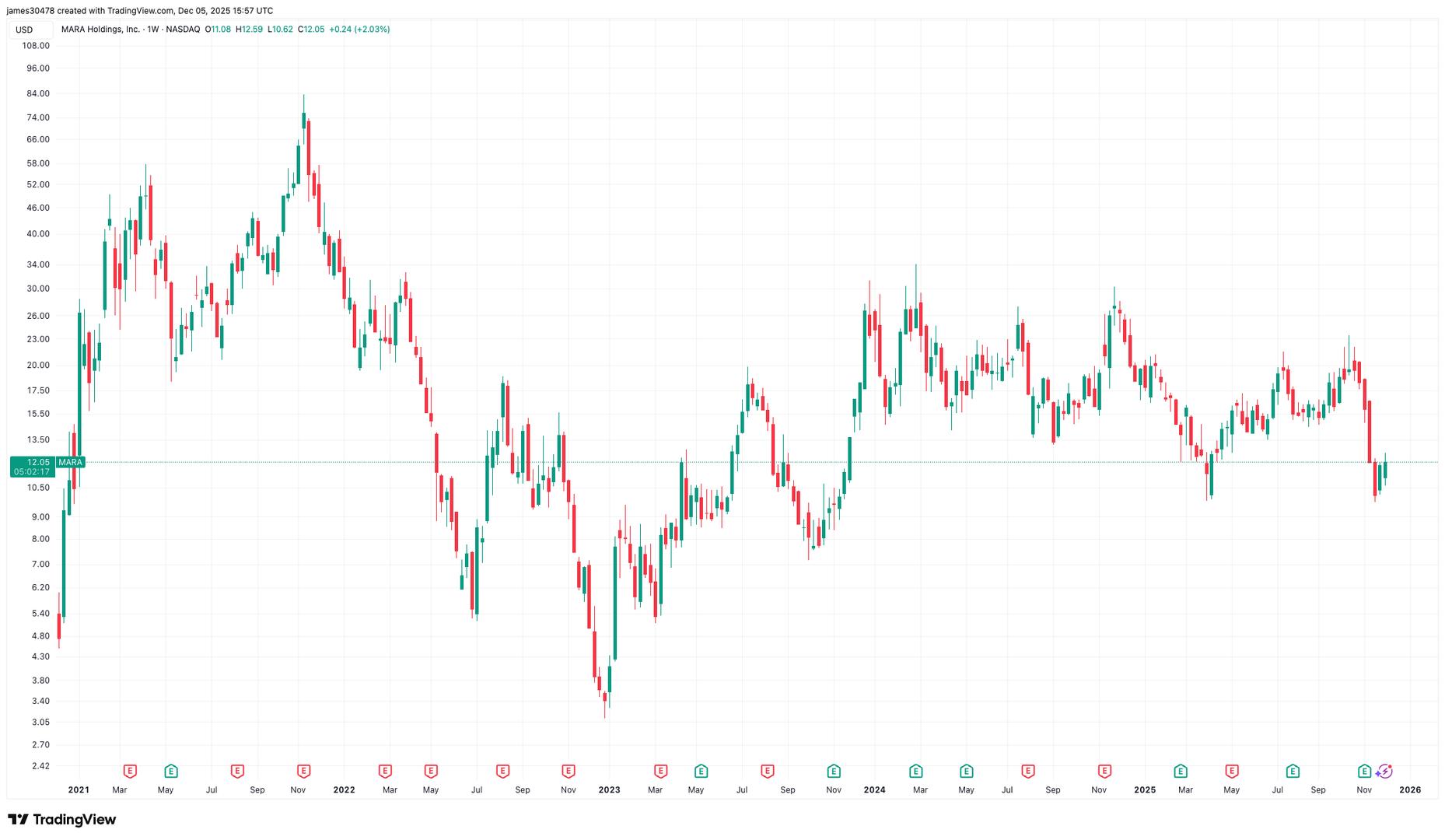
The two largest publicly traded companies that own bitcoin, MicroStrategy (MSTR) and Marathon Digital Holdings (MARA), have each experienced a decline of about 40% over the last six weeks.
CoinDesk Research has provided comprehensive analysis on the MSTR downturn, but MARA, which has seen a 55% drop year over year, is also gaining interest as some investors perceive it to be undervalued at current prices.
Matthew Sigel, the head of digital assets research at VanEck, contends that the notion of MARA being cheap is not backed by the underlying data. Sigel claims that the company is trading at a premium to its bitcoin assets, not a discount.
He points out that MARA has $3.3 billion in outstanding convertible debt against $4.9 billion in bitcoin holdings. After accounting for the convertible debt, this leaves a net bitcoin value of only $1.6 billion before other business liabilities are factored in.
This is in contrast to a $4.7 billion equity market cap, leading Sigel to imply that MARA is trading at a premium when debts are considered, rather than at a discount to its bitcoin assets.
Sigel further discusses MARA’s high short interest, currently at 27%. Adjusting for delta hedging related to the company’s convertible notes, he estimates that the actual short interest drops to around 15%, reflecting a 44% decrease.
In contrast, MSTR has over $8 billion in convertible debt against a $53 billion market cap.
Once hedge-related shorts are excluded, MSTR’s short interest decreases by only 31%, or about 9 million shares. Sigel describes MARA’s short interest as more structural, while MSTR’s appears to be driven more by fundamentals.
Sigel asserts that over half of MARA’s equity volatility is attributed to its capital structure and financing conditions rather than pure bitcoin beta. He concludes that MSTR provides a clearer exposure to bitcoin duration, while MARA’s mining equity performance is influenced heavily by its problematic capital structure.
