

A significant change in regulations is under review by MSCI, recognized as a key player among index providers globally. If this proposal goes through, it will have a substantial impact on how publicly traded companies with digital assets—especially Bitcoin—are categorized and incorporated into major equity indexes.
This proposal brings vital questions for corporations, investors, asset managers, and others who rely on index benchmarks regarding the definition of operating businesses and the influence of balance sheets on eligibility for indexes.
Join the push for MSCI to retract its rule excluding digital assets.
Here’s what is at stake—and its significance.
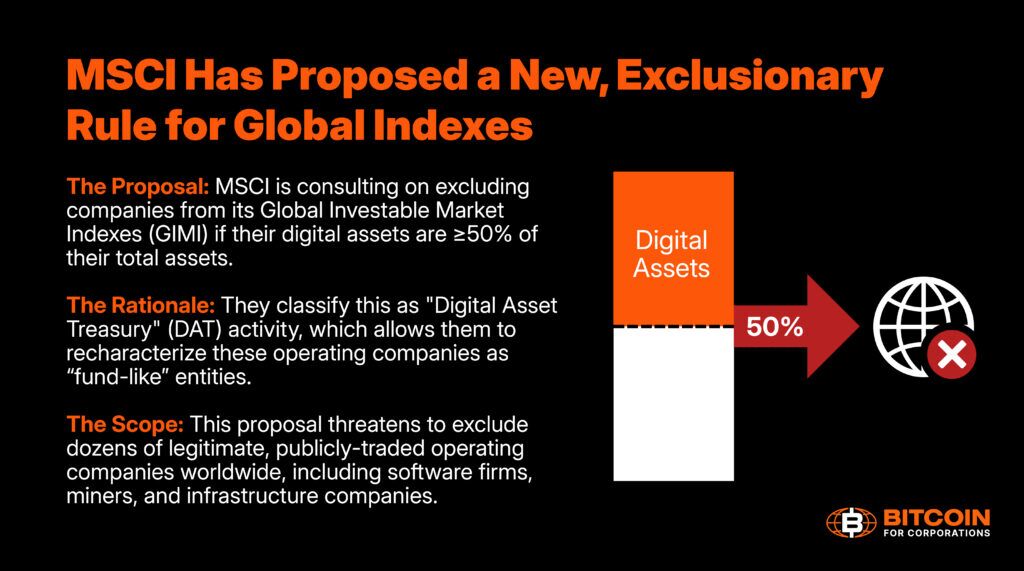
1. MSCI Is Suggesting a New 50% Balance-Sheet Threshold
Central to the proposal is a straightforward rule:
If digital assets comprise 50% or more of a company’s total assets, that company would be excluded from MSCI’s Global Investable Market Indexes.
MSCI believes that exceeding this threshold alters the “primary business” of the company, making it lean towards a fund-like structure rather than an operational one.
This single metric would supersede all other measures of the company’s actual functions.
2. The Proposal Misclassifies Operating Companies as Investment Funds
The primary concern is clear:
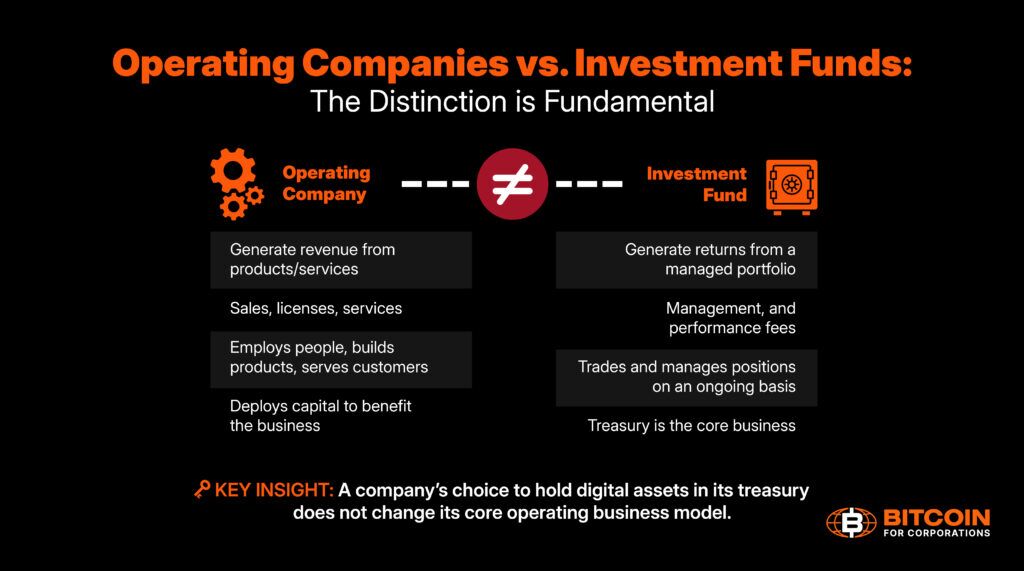
owning Bitcoin on a balance sheet does not convert an operating business into an investment fund.
- Operating companies generate income from their products and services
- They have employees, invest in R&D, and cater to customers
- Treasury assets are intended to support a long-term capital strategy
In contrast, investment funds solely focus on managing portfolios for returns.
Equating these two structures—based solely on a balance-sheet ratio—erases a distinction that has historically been crucial to corporate and securities law.
If your organization depends on clear, principles-based definitions for operating companies, this misclassification is significant. Bitcoin For Corporations is urging MSCI to retract the proposal and collaborate on a more principled framework. You can lend your voice to the open letter here.
3. Treasury Strategy Does Not Redefine Core Business Activity
A company may alter how it manages excess capital without changing its operational functions.
- A manufacturer that holds cash is still a manufacturer
- A software company holding foreign currency remains a software company
- A company that uses Bitcoin as a treasury reserve remains an operating company
Treasury management is a capital allocation decision, not a shift in business model.
4. This Would Be a Radical Departure From Decades of Index Practice
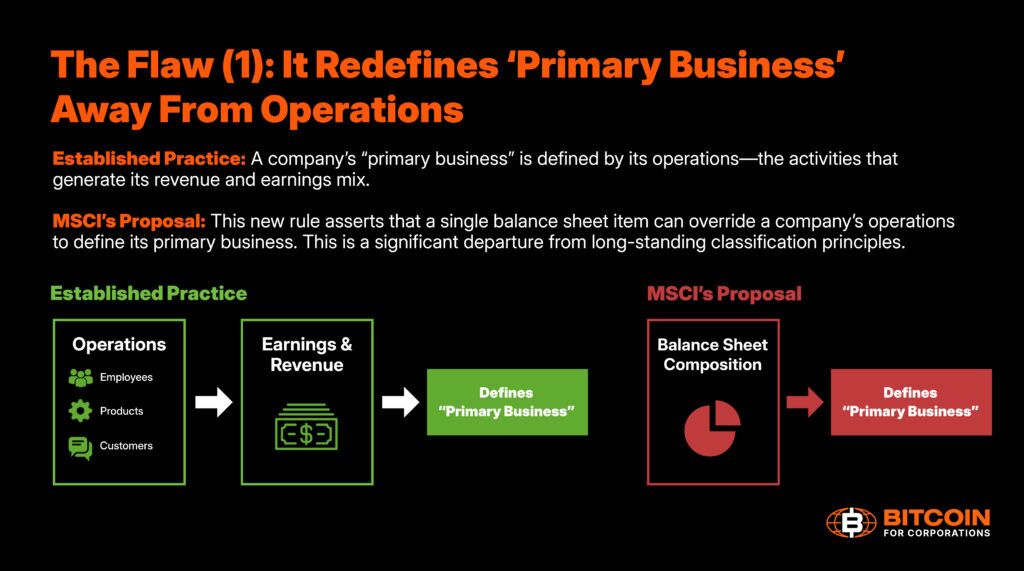
Historically, index classification has been determined by operational realities, rather than asset composition alone.
Defining primary business has been based on:
- Sources of revenue
- Earnings contributions
- Continued commercial activities
This new proposal replaces that comprehensive method with a singular, market-driven metric referring to the assets on the balance sheet—something that has never been uniformly applied across various asset classes.
5. Digital Assets Are Being Singled Out—Uniquely
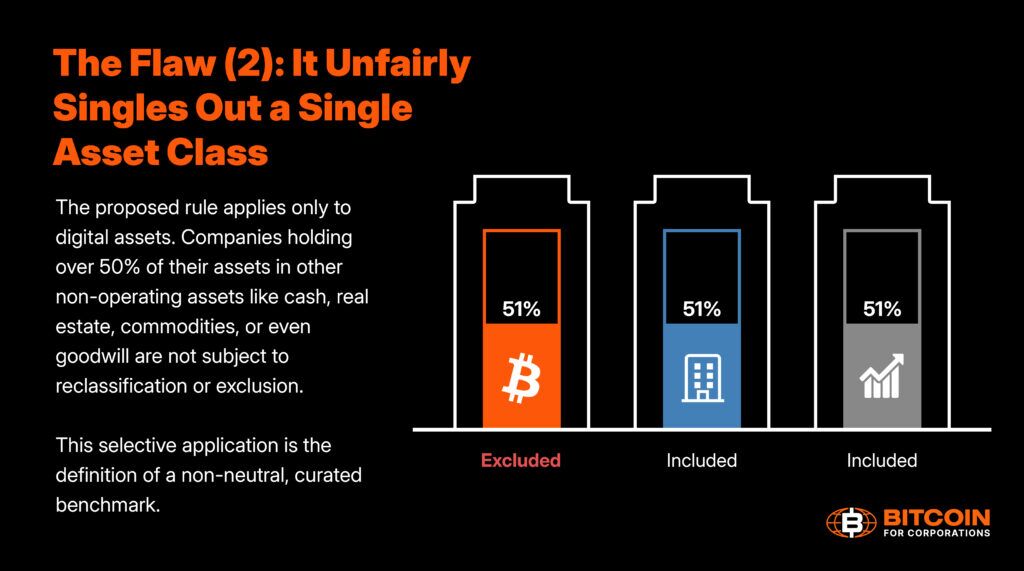
According to the proposal:
- A company with 51% of assets in Bitcoin → excluded
- A company with 51% in real estate → included
- A company with 51% in equities or commodities → included
No comparable rule applies to other treasury assets.
This lack of neutrality runs counter to the principles that global indexes are designed to uphold.
6. The Proposal Conflicts With Core Index Principles
MSCI’s benchmarks are founded on three essential principles:
- Neutrality – no favoritism towards any asset class
- Representativeness – mirroring genuine economic activities
- Stability – minimizing unnecessary turnover
A rule that reclassifies companies based on fluctuating market prices undermines all three principles.
7. The Rule Would Introduce Structural Instability Into Indexes
Consider a company possessing:
- 45% of assets in digital form → eligible
- No changes in operations
- Normal market appreciation elevates it to 51%
Under this proposal, that company would suddenly be excluded—despite:
- Unchanged revenue
- Unchanged operations
- Unchanged business strategy
This creates a situation where companies could fluctuate in and out of indexes solely due to price changes, leading to unnecessary rebalancing, costs, and tracking errors for index-linked funds.
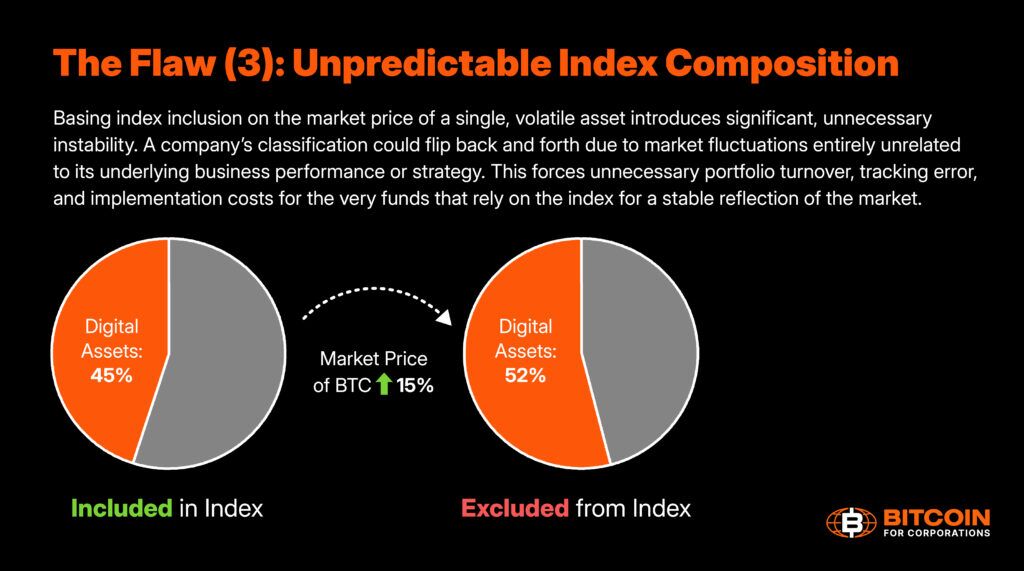
This sort of mechanical instability would create real expenses for index-tracking funds, issuers, and long-term investors—without enhancing market clarity. That’s why corporations and market participants are pressing MSCI to retract the proposal and reevaluate it with industry input. Join the movement urging MSCI to withdraw this rule proposal, and put your name on the open letter here.
8. A More Robust Alternative Already Exists
The challenge is not classification—it’s the methodology behind the classification.
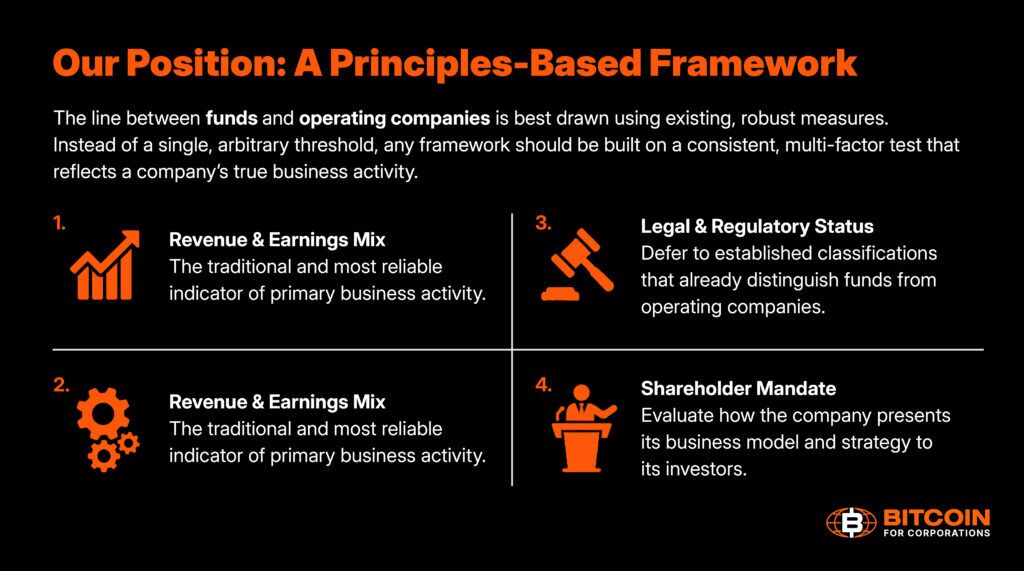
A principles-based, multi-faceted approach would assess:
- Revenue and earnings composition
- Legal and regulatory positions
- Core corporate functions (employees, R&D, capital expenditures)
- Public disclosures and strategic objectives
This method reflects the entire business, rather than a singular, variable ratio.
9. The Coalition’s Ask Is Clear and Constructive
- Withdraw the existing proposal due to its inherent flaws
- Engage with the market to draft a neutral, principles-based framework that maintains index integrity
The aim is not to seek special treatment—but to ensure uniform treatment consistent with established market practices.
Why This Matters
Indexes serve not merely an academic purpose. They:
- Guide trillions in capital allocation
- Influence passive investment trends
- Impact cost of capital for publicly listed companies
If index rules become arbitrary, erratic, or asset-driven, they cease to mirror the real economy—and begin to distort it.
Final Thought
If your organization is dependent on fundamentals-driven equity benchmarks, this proposal impacts you—regardless of your current digital asset holdings.
Indexes are effective only when they maintain neutrality, stability, and a foundation in operational reality. Market participants are pressing MSCI to withdraw the suggested digital asset rule and aim for a principles-based alternative. If you or your organization rely on fair and consistent equity benchmarks, adding your name to the open letter supports the preservation of those standards.
Index integrity consists of clear principles, not price-driven criteria.
Engagement at this stage ensures that global benchmarks remain neutral, stable, and representative for all who depend on them.
Disclaimer: This material was compiled on behalf of Bitcoin For Corporations for information only. It represents the author’s analysis and views, and should not be considered investment advice. Nothing contained in this article constitutes an offer, invitation, or solicitation to buy, sell, or subscribe for any securities or financial products.
